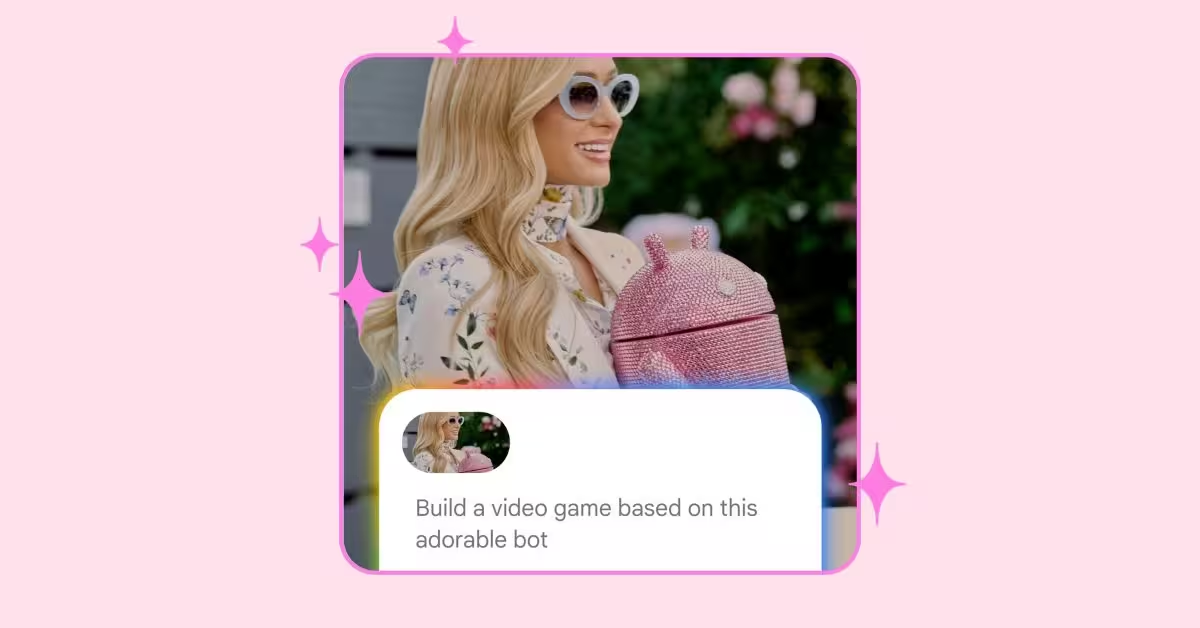
"It was just one of the most painful and traumatizing, humiliating, degrading experiences of my life," Paris Hilton says in a new interview with Laurie Segall, and she backed those words by signing on to Segall’s project. Hilton appears in Searching for Mr. Deepfakes, a 13-part TikTok investigation Segall launched to hunt for the owner of a site that makes explicit sexual images of women without their consent.
The series arrives on TikTok as a rapid-fire, creator-driven attempt to reach younger women directly: many episodes run just two to four minutes. Mostly Human, Segall’s production company, is producing the project in partnership with BFD and Hilton’s 11:11 Media; Segall says the format is deliberate. She told viewers she "loves this idea of creating a new playbook for unscripted content" and called the rollout "kind of a beta test for it." Hilton will promote the series through her own digital and social channels and appears in Segall’s interviews about the emotional fallout of deepfake abuse.

Segall, who spent a decade at before starting Mostly Human, has shifted from long-form reporting to a hybrid model that places short videos on social feeds alongside a podcast adaptation. The podcast will include a four-part version of Searching for Mr. Deepfakes that debuts June 4 and will publish episodes on Thursdays for four weeks. The two platforms are meant to complement each other: quick, attention-getting TikTok entries that point to deeper conversations in a podcast format.
The connection to Hilton is central and personal. She says the violation she endured occurred before she was even 20, tying her participation to lived experience rather than celebrity advocacy. Segall framed the collaboration as a way to get help and information into the hands of people who need it most: "We really want people who need this the most to see it," she said, signaling that distribution — not just exposé — is part of the project’s aim.

The format creates a tension the series acknowledges but does not resolve on screen: Segall is trying to make an investigation about explicit sexual imagery and digital abuse widely accessible on TikTok, a platform built for fast, public sharing. That raises questions about how to present sensitive material in short bursts without amplifying harm. Segall has argued that "content doesn’t have to sit in one place," and her move from traditional outlets to social-first work is meant to put resources where younger audiences spend time. Still, the subject itself — nonconsensual explicit images created digitally — resists simplification into 120-second clips.
Segall’s production choices reflect that push-and-pull. The TikTok episodes are compact by design; the podcast offers longer stretches for context and testimony. Producers describe Searching for Mr. Deepfakes as a quest to find the site’s owner, and Segall has said she "saw around the corner" in planning a distribution strategy that could reach victims quickly. But the investigation’s distribution choices also shape what can be shown, how names and images are handled, and how much audience guidance each short episode can carry.
For Hilton, appearing in the series is a public decision to tie her own trauma to an active effort to expose a source of harm and to push a different model of reporting. For Segall, the project is an experiment in marrying reach and rigor: a 13-part TikTok run that doubles as a four-part podcast mini-series. The upcoming podcast, arriving June 4 and running on Thursdays for four weeks, will be the first sustained place to hear longer interviews and follow the investigation’s next steps.
What remains unresolved — and what viewers will be watching for — is whether the series actually finds and identifies the owner of the site it targets. The series sets out to locate that person; the short-form and podcast episodes will show how far Segall and her partners go. The immediate next moment is the podcast debut on June 4, and between the TikTok installments and the four podcast episodes, audiences will soon learn whether the project was merely a distribution experiment or a full investigative reckoning that names the actor behind the abuse.