




Rob Mariano said Friday that Jonathan Young “butchered his press” after his elimination from Survivor 50, arguing the finalist’s post‑game interviews undercut his own case and helped cement Aubry Bracco’s victory.
Mariano made the comment on May 29 at the 2026 ATX TV Festival in Austin, less than two weeks after he and Amber Mariano attended the Survivor 50 live finale in Los Angeles on May 20; Amber was in the audience while Mariano was backstage and later said, “I was actually separated from her when that actually happened.”

The criticism matters now because Mariano — who helped Young prepare for the season — is not an outside observer: Young finished in the final three and received three votes to win, and his exit interviews the day after the live finale included public statements that he thought he had played a better game than winner Aubry Bracco and blamed a “bitter” jury and outside influence for his loss.
Mariano told the festival crowd that he warned Young about jury math and messaging. “I think when it got to the stage where there was a jury and there wasn’t a jury, I remember telling him you’ve got to count your votes and [being] careful about how you put people on the jury is more important than just getting to the end,” Mariano said. “But I told him that that was a wrong move. I don’t think belittling Aubry’s game to make your game better is a good look, and he agrees. But in the moment, he felt it.”

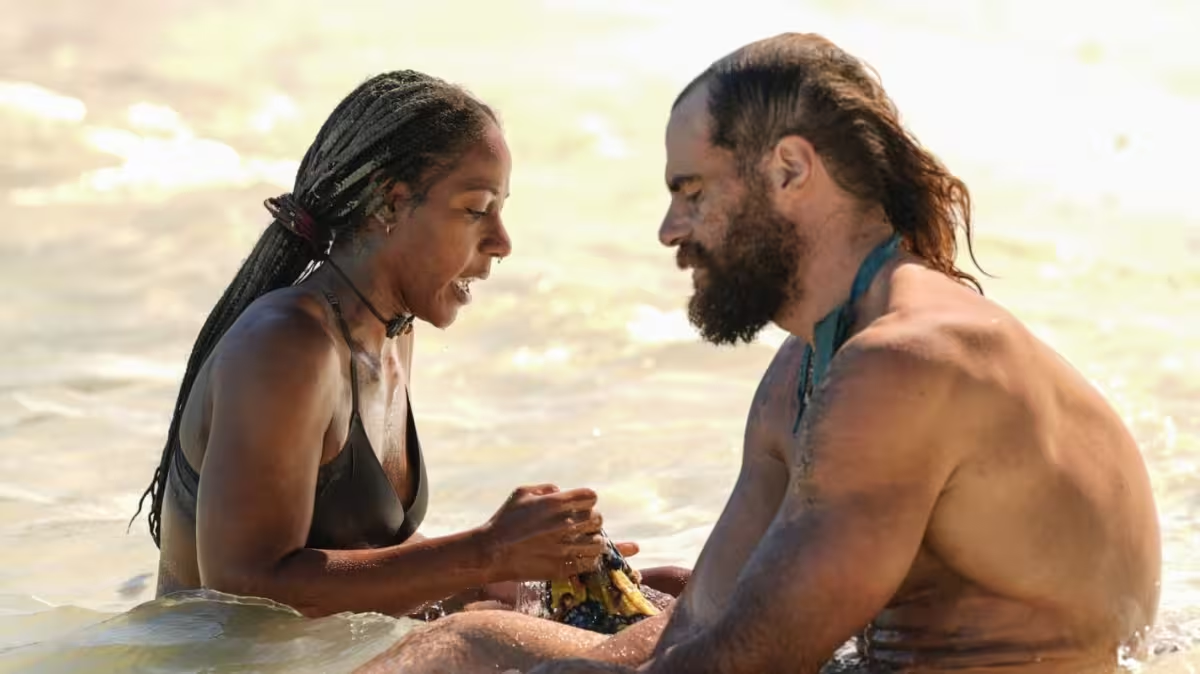
Those remarks underscore the specific clash between Young’s public defense and Mariano’s read of the fallout: Young told TV Insider and other press he believed he played a superior game and that a bitter jury — and Cirie Fields’ influence corralling votes at Ponderosa — swung the outcome toward Aubry. Mariano pushed back not by disputing Young’s effort but by arguing that his post‑elimination rhetoric damaged his standing. “He butchered his press,” Mariano said. “He’s not me, he can’t play my game. He has to play his game. He did the best he could.”
The exchange is more than personalities. Mariano repeatedly framed jury management as the core responsibility of a finalist — a point he tied to concrete advice he gave Young during preparations. “It gets hard, because he’s a pretty emotional guy and I think he took it really hard,” Mariano said, adding that if a player belittles a rival’s game in public it can make managing a jury impossible. At the same time Mariano acknowledged the binary of the endgame: be careful with jurors or risk never making the final.
Context sharpens the stakes: Mariano is a five‑time Survivor contestant and a former winner, so his critique carries weight within the franchise conversation about strategy and rhetoric. The season’s live finale, the first in five years, put the postgame moment and exit interviews in a brighter, faster spotlight than usual, and Mariano also joked about the rare live‑TV slipups — saying host Jeff Probst owned a fire‑making reveal that night and that live television sometimes trips up even seasoned pros.
The real friction here — and the conversation likely to continue online and in interviews — is whether Young’s claims about a bitter jury and outside influence are substantive explanations for the vote split, or whether his own public comments after the loss reshaped how viewers and jurors interpreted his play. Mariano says the latter: belittling Aubry’s win, he argued, “was a wrong move” that harmed Young’s case even before public opinion could form.
What happens next is the central open question: the precise lines Young used in his exit press remain the hinge of this dispute. Mariano’s verdict now sits on an explicit record — his May 29 remarks and Young’s exit interviews — and until Young clarifies or revisits those comments, Mariano’s assessment will shape how the season is discussed: as a close strategic loss complicated by a finalist’s own postgame handling rather than solely by jury bitterness.



