
Guzman y Gomez is closing its US business, CEO Steven Marks told shareholders on Friday, saying the performance of its US stores had not been acceptable. Marks, who said he had spent the last three months in the US, concluded the business could no longer justify the investment required.
The move affects the eight stores Guzman y Gomez currently lists in the Chicago area on its US website and is expected to generate up to US$40m in one‑off costs. Analysts had warned the US venture would be a long haul; some had not expected the US business to break even for at least another decade.

“I have always been confident in the differentiation of our food and guest experience, however this was not translating to an improvement in sales momentum,” Marks told shareholders. He added bluntly: “Having spent the last three months in the US, I realised this was going to take significantly more time and capital than we had expected.”
The scale of the write‑down makes the decision immediate and consequential. GyG’s US experiment — offering larger burritos and opening stores in Chicago to attract American customers — has been judged by management to be consuming capital without delivering the sales lift necessary to justify further investment.
Guzman y Gomez framed the closures as a reset. The company told shareholders on Friday that Australia remains the core focus of the business even as it expands in Singapore and Japan. At the end of 2025, there were 237 GyG stores in Australia, and the chain, alongside rival Zambrero, is considered among the fastest growing in the country.
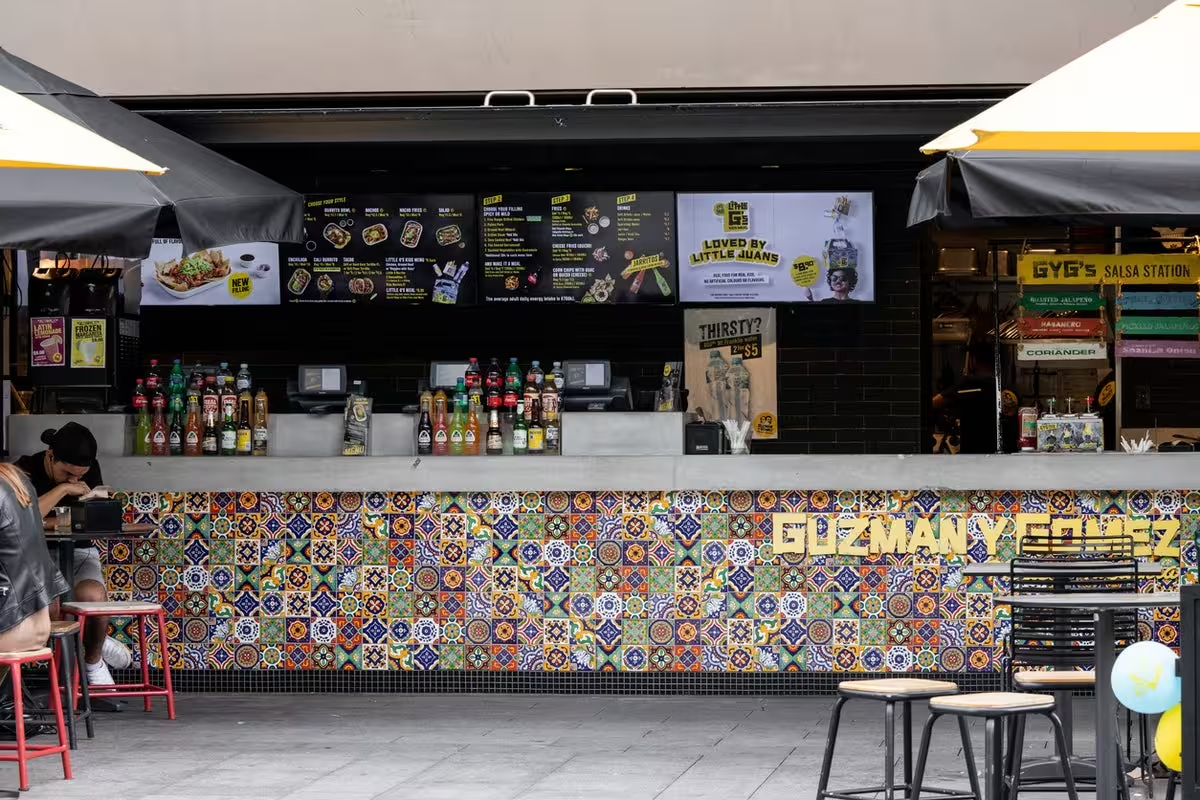

That domestic strength partly explains the decision to cut losses overseas. Michael Toner, commenting on the exit, said: "On current unit economics, we believe the US business had very low prospects of being successful, and the losses of the business were weighing down the earnings of the group so the sooner exit than anticipated is positive." The company has signalled it will absorb the one‑off costs and reallocate management attention and capital back to its core and its Asian expansion.
Context helps explain why the U‑turn matters now. Guzman y Gomez had publicly aimed to become the best and biggest restaurant company in the world. The US market, however, is crowded with Mexican food and difficult for Australian fast‑food chains. Analysts had flagged a tough road competing with established Mexican‑themed chains and many Latin American restaurants, and the US has repeatedly been described as a graveyard for Australian retailers and fast‑food concepts.
The friction in the story is not only commercial but strategic. Management pushed into the US expecting scale would follow; reality showed slower sales momentum and higher capital needs. That gap between expectation and execution — and the speed with which the company has chosen to bite the cost of exit — is the key tension. The write‑off is large enough to matter to short‑term earnings and sharp enough to force a reassessment of growth ambitions.
What happens next is plain: Guzman y Gomez will wind down its US operations, take the up to US$40m hit, and direct resources back to markets where it sees clearer returns. The company has announced expansion in Singapore and Japan and insists Australia remains the heart of the business. The immediate effect will be fewer American storefronts and a consolidation of GyG’s strategy around markets where its unit economics are stronger.
The broader lesson for Australian chains is unforgiving: the US can be a proving ground that quickly becomes a drain. For Guzman y Gomez, the decision is a retreat and a recalibration — an admission that global ambition will now be measured by where returns can justify the costs, not by the scale of the plan. Management’s choice to accept a heavy one‑off charge now suggests it prefers to fix the balance sheet and refocus, rather than fund an extended American experiment that analysts had judged unlikely to break even for at least another decade.