























“Strong Northern Lights to Illuminate 20 States Tuesday Night”

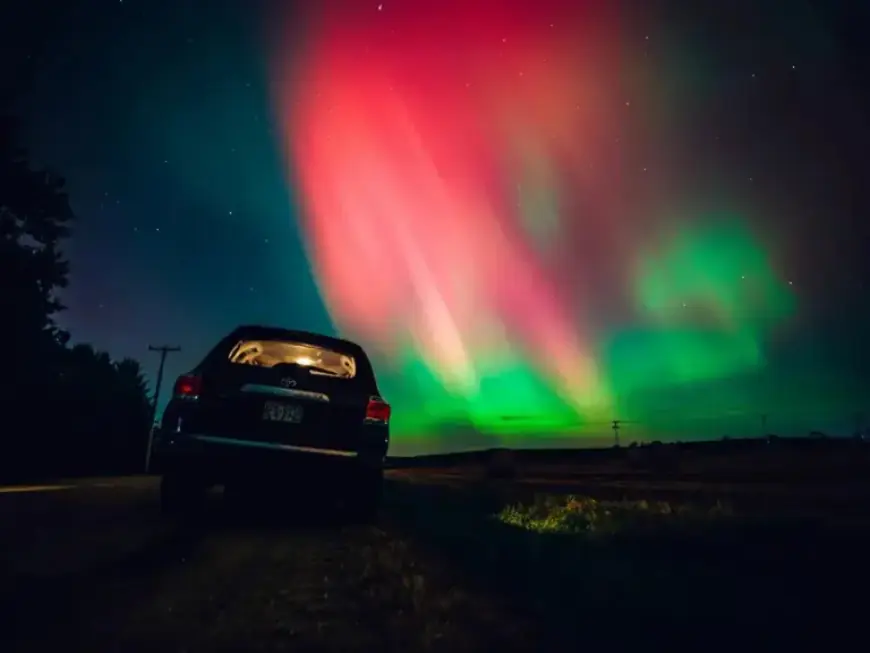
NOAA has issued a geomagnetic storm watch for the night of March 31 into April 1. Strong northern lights could illuminate parts of up to 20 states Tuesday night. The agency cautioned that a G2 or even G3-class storm is possible.
The disturbance began with an X1.5-class solar flare on March 30. That eruption came from sunspot AR 4405 and sent an Earth-directed coronal mass ejection. Forecasters also noted a fast CME tied to an X1.4 flare late on March 29.
Where the aurora may appear
NOAA’s aurora view line places visibility mostly along the U.S.-Canada border. Alaska and northern areas of Washington, Idaho, Montana, North Dakota, South Dakota, Minnesota, Wisconsin, Michigan and Maine are in prime position. A moderate G2 event could push displays into Oregon, Wyoming, Nebraska, Iowa, Illinois, Indiana, Ohio, New York, Vermont and New Hampshire.
A full pink moon will be in the sky after dark. The moonlight could wash out faint aurora. Wait until the moon sets and seek a dark site for the best view.
Timing and forecasts
Exact arrival times depend on solar wind speed. Models are still refining the CME’s trajectory and timing. A G2 watch covers the March 31 UTC-day, but the forecast could change.
Monitor NOAA’s 30-minute aurora forecast and SpaceWeatherLive for live updates. Filmogaz.com also recommends using aurora apps such as Aurora Now or My Aurora Forecast. Watch the interplanetary magnetic field Bz; a sustained southward Bz near -5 nT often precedes strong displays.
Viewing tips
- Go to a site with little light pollution and a clear northern horizon.
- Use a light pollution map or a Dark Sky finder to choose your spot.
- Be patient; aurora can appear low on the horizon and then intensify.
Photographing the lights
Use Night or Pro mode on your smartphone. Stabilize the device with a tripod or steady surface. Shoot in RAW when possible and try exposures of five to ten seconds.
Why the aurora occurs
The northern lights result from charged particles from the sun hitting Earth’s magnetic field. Those particles excite oxygen and nitrogen high in the atmosphere. The excited gases then glow in colors such as green, red and purple.
Stay tuned to official space weather sources for updates. Clear skies and wide eyes will give you the best chance to see the show.