























Antoinette Rijpma-de Jong wins surprise Olympic gold in 1,500m in Milan

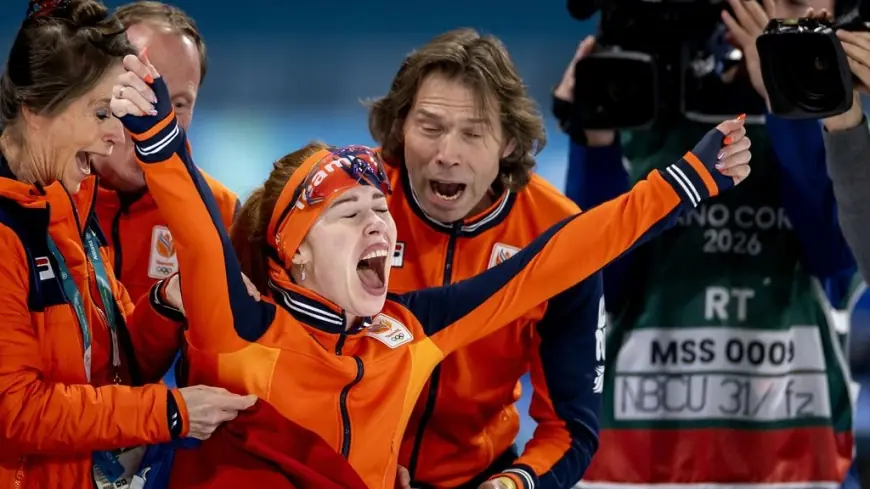
antoinette rijpma-de jong seized a shock Olympic victory in the 1, 500 metres in Milan, posting a 1: 54. 09 that beat Norway’s Ragne Wiklund by 0. 06 seconds. The result — her first Olympic title and a sixth Olympic medal overall — reshapes the late stages of the speed‑skating tournament with the mass start remaining on Saturday.
Antoinette Rijpma-de Jong’s winning race
Rijpma-de Jong, 30, set her gold time of 1: 54. 09 in the penultimate pair and then watched the final pair fail to surpass it; Japan’s Miho Takagi, the pre‑race favorite, did not eclipse the mark. The margin over Ragne Wiklund was 0. 06 seconds, with Canadian Valérie Maltais taking bronze.
Ragne Wiklund and Valérie Maltais on the podium
Wiklund had laid down a strong benchmark in the pair before Rijpma-de Jong, stopping the clock at 1: 54. 15 — a few tenths faster than Maltais — forcing the Dutch skater to target that time. Maltais ultimately finished third, behind the Norwegian and the Dutch winner.
Race dynamics: opening laps and the decisive final lap
Rijpma-de Jong gained most of her advantage with a blistering opening lap of 25. 26, almost half a second quicker than Wiklund’s opener. Subsequent laps of 28. 0 and 29. 8 narrowed that lead to just 0. 01 seconds entering the final circuit. Crucially, Rijpma-de Jong’s closing lap proved faster than Wiklund’s, and that quicker finish extended her lead to 0. 06 seconds at the line, delivering the gold.
Dutch team context and other Dutch skaters
This victory is Rijpma-de-Jong’s first Olympic title and her sixth Olympic medal across four Winter Games. Earlier in these Winter Games she won silver in the team pursuit. Individually she had already earned bronze in the 3, 000 metres in 2018 and bronze in the 1, 500 metres in 2022; she also held silver and bronze from the team pursuit prior to this gold.
Femke Kok finished fifth in her international debut over 1, 500 metres, clocking 1: 54. 79 in the first pair, where she skated without an opponent. Kok had to race so early because she had not competed in a world‑level event this season; she had been viewed as an outsider after suddenly improving the track record in Heerenveen last October and narrowly finishing second at the Olympic qualifying tournament behind Rijpma‑de Jong.
Marijke Groenewoud placed tenth with a time of 1: 55. 16, adding to earlier disappointments in the 3, 000 and 5, 000 metres at these Games. Groenewoud did, however, win silver with the pursuit team and is scheduled to skate the mass start on Saturday.
Favorites, qualification and what the result means
Reigning world champion Joy Beune did not start in Milan after failing to secure a spot at the Olympic qualifying tournament. With Beune absent, Miho Takagi had been the favorite — she had finished behind Ireen Wüst in the 1, 500 metres at the past two Winter Games and won this season the only World Cup event that Beune did not win. Rijpma-de-Jong had been a medal candidate — she finished second twice in World Cup races this season and took silver at the World Championships last year — but she had not been the top pick for gold.
What makes this notable is that Rijpma-de Jong’s first Olympic title arrived on top of a long and consistent career: four Olympic appearances and six medals now place her among the most decorated active Dutch women in the event. The timing matters because the Olympic skatetournament is nearly complete, with the mass start for men and women scheduled for Saturday, leaving little time for rivals to respond on the ice.
Friday 20 February: the day for Rijpma-de Jong
Friday 20 February became the day of Rijpma-de Jong when her penultimate‑pair clock held up through the final pair. Her combination of a rapid opening lap and a stronger closing circuit than her nearest challenger produced a narrow but decisive victory, continuing a streak that makes her the fifth consecutive Dutch woman to win Olympic gold in the 1, 500 metres, following Ireen Wüst, Jorien ter Mors and others who took the title in prior Games.