

















Iowa State Vs Byu: Late-Night Tip, Matchup Edges and Key Numbers to Watch

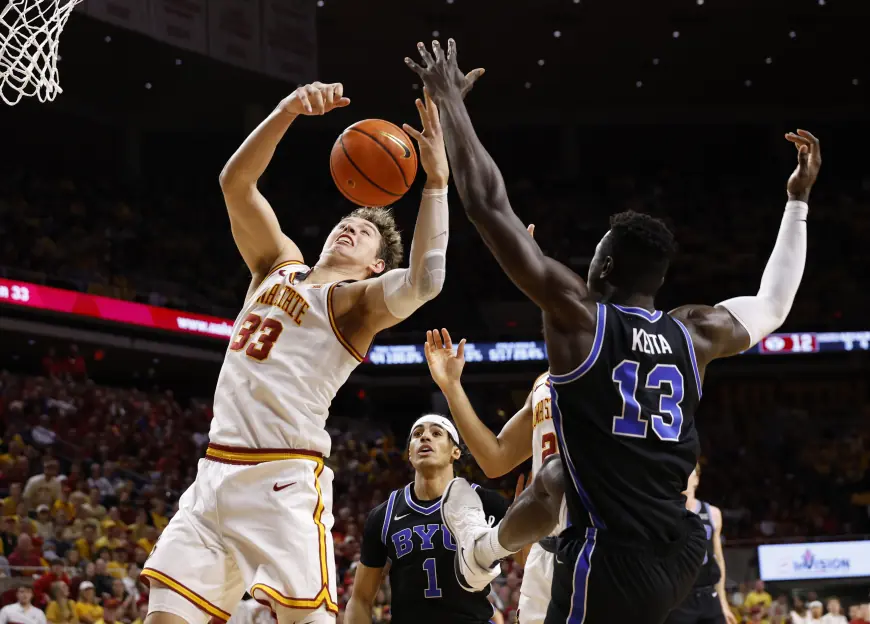
Iowa State Vs Byu brings No. 6 Iowa State to Provo for a Saturday night meeting with BYU that is scheduled to tip at 8: 30 p. m. MT on. The game carries weight for both teams: BYU seeks a signature Quad 1A win, while Iowa State is competing to preserve its standing as a national seed.
Development details: Iowa State Vs Byu
The matchup is set for an 8: 30 p. m. MT tipoff Saturday on and has drawn clear statistical projections: a KenPom projection favors Iowa State 79-78 and assigns BYU a 45% win probability. Iowa State enters the game ranked No. 6, while BYU is reeling from a seven-point loss to the No. 4 team, returning to Provo after that defeat. BYU played that Arizona game without Richie Saunders, and AJ Dybantsa carried much of the offensive load in that loss.
Iowa State’s internal dynamics have shifted this season. With an injury to Toppin, the Cyclones now count Joshua Jefferson and AJ Dybantsa among the defensive standouts likely to be in contention for seasonal honors. Jefferson has been a central playmaker, listed as averaging 16. 5 points, 7. 5 rebounds and 5. 2 assists while shooting 38% from three. Milan Momcilovic leads the Cyclones in scoring at 18 points per game and is noted for an elite three-point percentage and volume.
Context and escalation
Iowa State’s profile this season is a blend of offensive firepower and identifiable flaws. The Cyclones rank fourth in Big 12 offensive efficiency and third in defensive efficiency. They are a potent shooting team, converting 39% from three as a unit and hauling in offensive rebounds at a 36% clip. That combination has helped secure marquee wins over teams such as Purdue and St. John’s.
However, the Cyclones show vulnerabilities that have influenced results away from Ames. In conference road games they are 3-3, with losses at Kansas, Cincinnati and TCU. Turnovers present an issue—walking into the weekend they rank 12th in turnover percentage in Big 12 play—and free-throw shooting lags at 64%, the lowest mark in the league. A recent home setback to TCU, a 62-55 defeat, illustrated those problems: the Cyclones committed 17 turnovers and connected on just 5 of 22 three-point attempts while going 2-for-8 from the foul line.
Immediate impact
The immediate stakes are concrete. For BYU, a win would serve as a needed signature, enhancing their resume with a Quad 1A opportunity that has so far been elusive. For Iowa State, maintaining its position for a potential No. 2 seed in the NCAA Tournament is at play; the Cyclones are in consideration for a 2 seed for the second consecutive season. The matchup therefore affects postseason positioning as well as individual recognition: Jefferson’s All-American candidacy and Momcilovic’s scoring form are both on display.
What makes this notable is how complementary strengths and weaknesses map directly onto likely game outcomes: Iowa State’s three-point accuracy and offensive rebounding create extra possessions and scoring efficiency, while turnovers and poor free-throw shooting reduce margin for error on hostile courts.
Forward outlook
The next confirmed milestone is the game itself at 8: 30 p. m. MT on. The KenPom forecast of 79-78 underscores an expectation for a one-possession contest; the model’s 45% projection for BYU quantifies the matchup as closely contested. Beyond the broadcast, the immediate season implications are set—BYU aims for a résumé-boosting victory at home, and Iowa State looks to protect its seeding trajectory and shore up road inconsistencies.
Coaches will lean on established rotation pieces: Jefferson’s playmaking and Momcilovic’s perimeter shooting for the Cyclones, and BYU’s reliance on contributors such as AJ Dybantsa following the absence of Richie Saunders in the prior outing. The game’s outcome will be decided on measurable factors highlighted in recent games—three-point accuracy, offensive rebounds, turnover rate and free-throw efficiency—each of which has demonstrable influence on both teams’ seasonal arcs.