
























Lunar New Year 2026 live: Year of the Fire Horse ushers in varied celebrations across Asia

The Year of the Fire Horse is being welcomed across Asia with familiar rituals and fresh variations — from floral shopping in Hong Kong to muted street festivities in Bangkok and exuberant lion dances in Sydney. The 15-day Lunar New Year festival, which follows the first new moon of the lunar calendar, is observed during the period that falls between Jan. 21 and Feb. 20 each year.
Street mood and public rituals: from subdued processions to colourful dances
In Bangkok's Chinatown this year, public celebrations have been noticeably restrained as the country observes a one-year mourning period following the passing of the queen mother last October. Local authorities have foregone official festivities, though private businesses and residents still gathered at temples and shrines, lit incense and made wishes for the year ahead. Street decorations are less ostentatious than in recent years, but the atmosphere remains reverent and familial.
Farther afield, Sydney offered a contrasting spectacle. On the steps of Town Hall, lion dances took place at midday in hues that broke with tradition — green, yellow, blue and pink — drawing crowds of families. Martina Taylor, 48, watched with her four-year-old daughter Olivia. "She loves it, " Martina said, dressed for the occasion in red pants and shiny red shoes. Olivia, who had already seen multiple lion dances that day, declared her favourite was the "pink" lion and that she loved the drumming.
Public behaviour and private observance are also shifting in other parts of the region. In South Korea, a recent trend toward simplified rituals continues: more than 60% of people surveyed said they will not set up the traditional, elaborate charye tables used to honour ancestors, opting instead for smaller, more intimate commemorations.
Food, symbols and markets: tradition adapts to modern tastes
Food remains central to the festivities and varies widely by country. In Malaysia and Singapore, yusheng — a raw fish salad — is a highlight of reunion dinners and must be tossed by everyone present with chopsticks to complete the ritual. In South Korea, giving tins of luncheon meat as New Year gifts has become a commonplace practice, reflecting contemporary tastes and convenience.
Markets around Hong Kong were busy on the eve of the New Year, with shoppers purchasing flowers and festive plants amid unseasonably warm weather. Mandarin oranges remain a ubiquitous symbol: exchanged in pairs to invite good fortune, the fruit's pronunciation is linked to words for luck and wealth in local dialects, and its round shape represents unity and completeness.
Public displays and online controls: fireworks, themed shows and content crackdowns
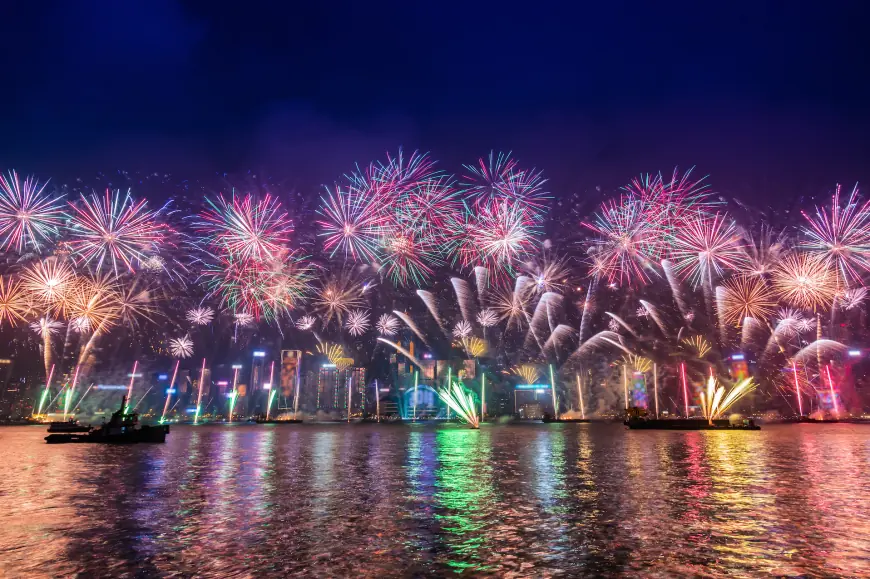
One of the marquee events this year will light up Victoria Harbour on Feb. 18 at 8 p. m. ET, when a horse-themed fireworks display is scheduled to run for roughly 23 minutes. The show is built around equine imagery and auspicious symbols — including scenes themed ‘Galloping into the New Year’ and ‘Celebrating the New Spring Together’ — and will feature a high density of bursts designed to emphasise prosperity and good fortune for the Year of the Fire Horse. Organisers plan synchronised musical accompaniment to enhance the spectacle, and many vantage points across both harbour sides will offer good views for spectators.
Meanwhile, authorities in parts of the region are also shaping how the festival appears online. In one major country, an annual campaign to remove what is considered antisocial content has been renewed for the holiday period; this year's focus includes posts that promote the virtue of not having children. The effort is part of wider attempts to influence public discourse during a season when family, fertility and tradition are prominent topics.
Across cities and communities, the Year of the Fire Horse has produced a patchwork of expression: joyful and colourful in some neighbourhoods, restrained and reflective in others, and increasingly shaped by modern tastes and state guidance. For millions who mark the calendar, the festival remains a time for reunion, ritual and hopes for good fortune in the year ahead.