
























Another small earthquake rattles Great Falls

Residents of Great Falls and nearby communities felt another tremor Thursday evening as a magnitude 3. 7 earthquake struck just north of the city. It was the fourth quake to rattle the area within a roughly two-week span; authorities say there were no injuries or serious damage.
What happened
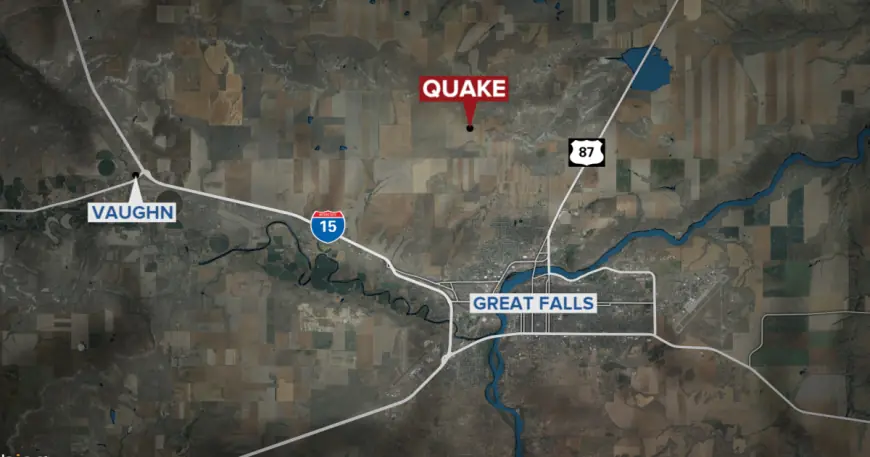
The U. S. Geological Survey logged the event at 8: 36 p. m. Eastern Time on Thursday, Feb. 12, 2026. The quake was centered about 5. 7 miles north of Great Falls at a depth of roughly 6. 2 miles. Seismic analysts characterize the magnitude as 3. 7, classifying it as a small but widely felt event in a populated pocket of the Treasure State.
Where it was felt
People reported feeling the shaking across Great Falls and nearby towns including Sun Prairie and Ulm. Some residents said they felt movement as far away as Dutton and Choteau. Descriptions ranged from a brief jolt to light rolling, typical of shallow, moderate-magnitude events that transmit energy across local communities.
A string of recent activity
This tremor follows a sequence that began late last month. On Jan. 29, 2026 at 2: 41 p. m. Eastern Time, a stronger 4. 2 magnitude quake rattled the region several miles northeast of Great Falls. That larger event was followed that same evening by a smaller 2. 7 magnitude shock, and then a 3. 2 magnitude quake on Saturday, Jan. 31. Seismologists characterize the recent episodes, including Thursday’s 3. 7, as likely aftershocks linked to the Jan. 29 event.
Seismic setting of the region
The area sits within one of the most seismically active corridors in the western United States, part of the broader intermountain seismic belt that runs through the western third of the state. Most earthquakes in the region are small, rarely felt by people and seldom damaging. A regional seismic monitoring effort maintains dozens of permanent stations across western Montana to track activity and refine locations and magnitudes.
Historical context highlights that while large, destructive quakes are rare locally, the state has experienced significant events in the past. Notable examples include a major 7. 3 magnitude quake in 1959 that triggered landslides and reshaped parts of a national park landscape, and a sharp 5. 8 magnitude shaker in 2017 that was felt across a wide area. Those events underline why continuous monitoring and research remain priorities for state and federal earthquake teams.
Impact and safety
No injuries or serious structural damage have been reported from Thursday’s event or from the earlier January quakes. Local officials continue to encourage residents to review basic earthquake safety steps: secure heavy items, prepare an emergency kit, and know how to drop, cover and hold on during shaking. Homeowners and property managers should inspect buildings for new cracks or hazards after noticeable events and report significant damage to local authorities.
Seismologists will continue to monitor activity in the region. Residents who felt the quake are asked to report effects to local emergency management so officials can track distribution of shaking and any localized impacts. Filmogaz will update this story as additional details become available.