

























Olympic Medal Count 2026: Norway and Italy Tied on Total Medals as Team USA Climbs in Golds

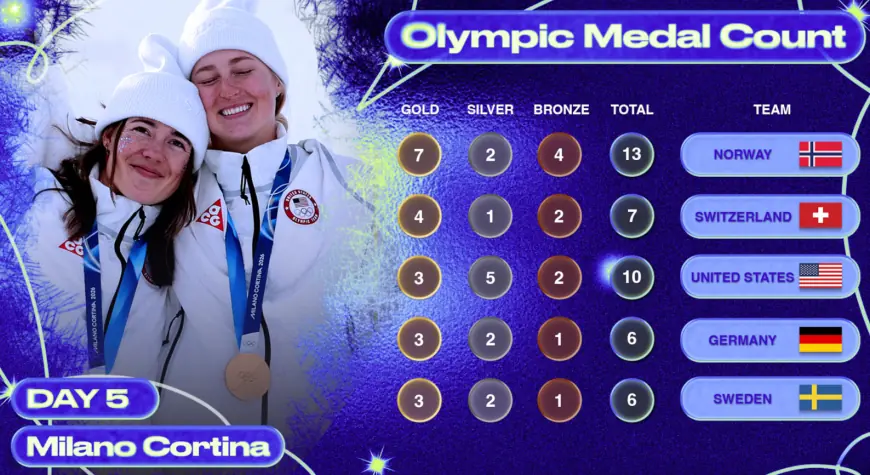
The Olympic medal count at the 2026 Winter Games is tightening into a two-track race: Norway and Italy are locked at the top on total medals, while the chase for the gold medal count is becoming a separate battle with real strategic consequences for the second week of competition.
After Wednesday’s events, updated early Thursday, February 12, 2026, ET, Norway and Italy are tied with 13 total medals each. Norway holds the edge where it matters most for many fans and federations: seven golds. The United States sits close behind with 12 total medals, including four golds, keeping Team USA within striking distance if the next wave of marquee events breaks its way.
Winter Olympics medal count: where the standings sit now
Here is the snapshot after Wednesday competition, with totals and the gold medal count in focus:
Top of the table
Norway: 7 gold, 2 silver, 4 bronze, 13 total
Italy: 4 gold, 2 silver, 7 bronze, 13 total
United States: 4 gold, 6 silver, 2 bronze, 12 total
Next group shaping the podium fight
Germany: 3 gold, 3 silver, 2 bronze, 8 total
Austria: 2 gold, 5 silver, 1 bronze, 8 total
Japan: 2 gold, 2 silver, 4 bronze, 8 total
Switzerland: 4 gold, 1 silver, 2 bronze, 7 total
France: 3 gold, 3 silver, 1 bronze, 7 total
Sweden: 3 gold, 2 silver, 1 bronze, 6 total
That mix tells you something important: one country can surge in golds without leading overall, while another can pile up bronzes and stay tied for first on totals. That’s exactly what’s happening right now.
Behind the headline: why the medal count is not a simple scoreboard
A medal table is often treated like a single race, but it’s really a bundle of incentives.
Golds are reputational currency. They drive headlines, funding arguments back home, and the narrative of “dominance.” Total medals signal depth: a system that puts athletes into contention across many events. Norway’s lead in golds reinforces a powerhouse identity, while Italy’s medal volume, boosted by bronzes, plays perfectly into host-nation momentum and crowd-driven energy.
For the United States, the balance matters. Team USA’s four golds keep the top-line story alive, but the six silvers are the real clue: the Americans are consistently in finals and on podiums, which is the best predictor of a late-Games surge if a few close finishes flip.
Stakeholders: who gains, who feels pressure
National federations are watching this table like a budget document. A strong medal count becomes leverage for coaching pipelines, facility investment, and athlete stipends. A dip becomes ammunition for internal reform fights.
Athletes and coaches feel a different kind of pressure: events that were “podium goals” become “gold expectations” once a country is close on the gold medal count. For hosts, the incentives are broader. Italy’s tally is a soft-power story as much as a sports one, shaping tourism narratives, sponsor confidence, and how these Games are remembered domestically.
What we still don’t know
The medal count is a moving target, and the most important missing pieces are still ahead:
-
Whether Norway can maintain gold efficiency as the program shifts into events where margins are razor-thin
-
Whether Italy’s depth continues across disciplines beyond early strengths
-
Whether the United States converts silvers into golds as more headline events reach finals
-
Which nations are sitting on “expected medals” based on qualifiers and seeding that have not yet cashed in
The medal table can look stable until one day of speed events, relays, or judging-heavy finals reshuffles everything.
What happens next: realistic scenarios that could change the standings
-
Norway extends the gold lead
Trigger: continued wins in endurance and technical events where Norway historically performs well.
Impact: Norway can win the narrative even if totals stay tight. -
Italy breaks the tie on total medals
Trigger: a steady stream of bronzes and a couple of gold swings in home-favored venues.
Impact: the host story becomes the defining thread of the Games’ midpoint. -
Team USA makes a gold run
Trigger: multiple podium chances landing on the top step within a 48-hour window.
Impact: the U.S. can move from “close behind” to “co-leader” fast because it already has a high base of silvers. -
A mid-table surge reshapes the top five
Trigger: Germany, Austria, or Japan strings together two to three golds across clustered events.
Impact: the standings compress, and the top becomes a multi-country scrum instead of a two-team headline.
Why it matters
The 2026 Winter Olympics medal count is more than trivia. It’s a real-time map of which sports systems are producing contenders, which hosts are translating home advantage into hardware, and which teams are one hot streak away from rewriting the Games’ story. With Norway and Italy tied on totals and the United States hovering at the doorstep, the next stretch of finals is set up to be decisive for both the overall medal count and the gold medal count race.