
























Lindsey Vonn crash report: how the gate contact triggered the loss of control, why the fall looked severe, and what’s still unconfirmed

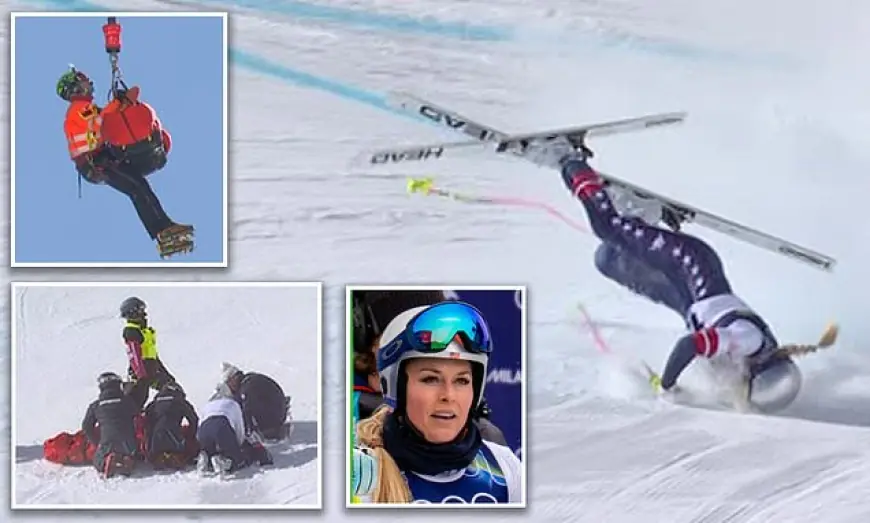
Lindsey Vonn’s Olympic downhill in Cortina ended almost as soon as it began on Sunday, February 8, 2026, when a small gate contact in the opening seconds cascaded into a high-speed loss of control and a violent tumble that required a helicopter evacuation. The footage looked especially severe because the crash unfolded in the sport’s most unforgiving zone: early in a downhill, when speed is building fast, body position is still settling, and a tiny disruption can blow up into a full ejection.
Here’s how the gate contact likely triggered the crash mechanics, why it looked so brutal on video, and what remains unconfirmed as of Sunday night (ET).
How gate contact triggered the loss of control
Downhill gates aren’t just markers; they shape the line and the athlete’s body position. In Vonn’s run, the key moment came within the first handful of turns, when she clipped a gate—described in race-side accounts as contact around the shoulder/upper body area—while carving a tight line out of the start.
That kind of contact can create a chain reaction:
-
Upper-body deflection: Even a slight hit can twist the torso and shift shoulders downhill, forcing a split-second correction.
-
Edge release: The skis’ edges are set to bite into the snow at speed. A sudden weight shift can flatten an edge, causing the skis to skid rather than carve.
-
Crossed pressure: When one ski loads more than the other unexpectedly, the skier can get “late” to the next movement. In downhill, being late by a fraction of a second is often unrecoverable.
In simple terms: the gate clip didn’t need to be dramatic to be decisive. At downhill speeds, tiny alignment errors become large trajectory errors quickly.
Why the fall looked so severe on video
Several factors make downhill crashes look worse than most sports injuries, even before the medical outcome is known.
First, speed and terrain: Vonn lost control on an opening traverse/transition area where racers are accelerating, and where the slope can include subtle rolls that amplify instability. When skis aren’t tracking cleanly, those rolls can “kick” the athlete into the air.
Second, rotation and tumble dynamics: Eyewitness descriptions noted a midair spin and a pinwheeling motion. That’s consistent with what happens when a skier catches an edge after a skid: the ski hooks, the body’s momentum continues, and the athlete is thrown into a rotating fall.
Lindsey Vonn's accident
by u/Ecstatic-Ganache921 in olympics
Third, the netting factor: Safety nets prevent skiers from sliding into hazardous terrain, but they can also make the impact look violent. The body can rebound or fold awkwardly depending on the angle and speed. On camera, that often reads as a “hard stop,” even if some energy is absorbed by snow spray and the net’s give.
Finally, the audio and stillness afterward: Accounts from the hill noted her cry of pain and a long medical response before the helicopter arrived. That combination—sound, extended treatment, and a quiet crowd—can intensify the perception of severity, even when the exact injury is not yet confirmed.
The injury context that raised the stakes
The crash landed in a week where Vonn’s health was already a central storyline. She had recently disclosed a serious left-knee injury from a crash nine days earlier, alongside ongoing issues with her knees. Going into the Olympic downhill, she was described as racing with significant support and bracing.
That context matters because pre-existing injury changes crash risk in two ways: it can limit how aggressively an athlete can make split-second balance corrections, and it can raise the probability that a fall produces a more complicated outcome.
What’s still unconfirmed
As of Sunday, February 8, 2026 (ET), several core details remain unclear and should be treated as unconfirmed until formal medical updates are released:
-
Specific diagnosis from Sunday’s crash: No publicly confirmed details on fractures, ligament damage beyond prior disclosures, or concussion.
-
Whether prior knee injuries worsened: It’s not publicly confirmed if the left knee, reconstructed knee, or other areas sustained new structural damage.
-
Return-to-competition timeline: It’s unclear whether she will be cleared to ski again during these Games or if her Olympic competition is over.
-
Full incident breakdown from officials: Public descriptions align on a gate clip and rapid loss of control, but an official technical report with precise gate number/line data has not been released in full.
What to watch for in the next 24–72 hours
The most meaningful updates typically arrive in stages: an initial evaluation statement, imaging results, then a clearer decision on treatment and return. With a high-energy crash, teams often monitor for swelling, neurological symptoms, and soft-tissue damage that doesn’t show immediately.
For now, the only responsible framing is that Vonn was airlifted for evaluation after a crash triggered by early gate contact, and the exact medical outcome has not been publicly confirmed.
Sources consulted: Associated Press, Reuters, Olympics.com, The Guardian