
























Jackie Wiles (Jacqueline Wiles) just missed an Olympic medal with fourth-place downhill

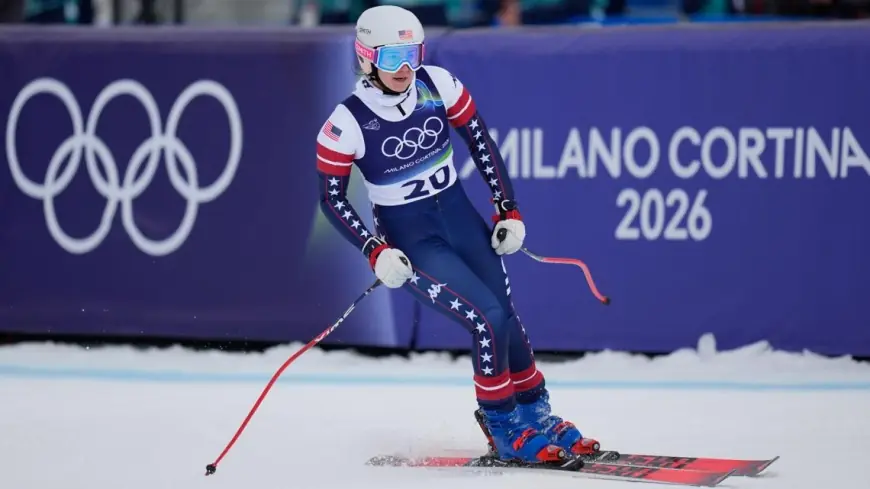
Jacqueline “Jackie” Wiles delivered one of the closest near-podium finishes of the early Milano Cortina Games on Sunday, Feb. 8, 2026, placing fourth in the women’s downhill in Cortina d’Ampezzo. In a race decided by small margins at the top, Wiles finished just outside the medals as the United States opened its Olympic alpine campaign with a headline result and a painful what-if for the speed team.
The downhill was won by American Breezy Johnson in 1:36.10, with Emma Aicher of Germany taking silver 0.04 seconds back and Italy’s Sofia Goggia claiming bronze. Wiles’ fourth-place finish put her in the thick of the fight from start to finish, but one or two small misses—often the difference between gold and fourth in downhill—proved costly.
Jacqueline Wiles’ downhill run and the margins that mattered
Downhill racing rarely offers a single “mistake” moment that explains everything. It’s more often a game of micro-compromises: a slightly lower line entering a compression, a fraction of a second lost when the ski releases late, a touch too cautious over a blind roll where others stay flatter.
Wiles’ result fit that pattern. She was fast enough to contend, clean enough to hold fourth, and close enough to make the gap to the podium feel painfully narrow. For a discipline where medals can turn on hundredths, finishing fourth can be both confirmation and frustration—proof the speed is there, and proof the podium is still a step away.
A U.S. speed-team day that still signaled strength
Even with Wiles missing the podium, the broader U.S. picture from the downhill was strong. Johnson’s win gave the team a marquee gold early in the Games, and Wiles’ fourth reinforced that the Americans have depth in speed events rather than relying on a single medal favorite.
The result also matters strategically. In Olympic alpine skiing, confidence can snowball across disciplines—downhill success often carries over to super-G, team combined formats, and the way athletes approach risk in later races. A gold-plus-fourth day is the kind of output that can reshape expectations for the next week of women’s speed events.
Training pace hinted she could contend
Wiles arrived to the Olympic downhill with signs she could challenge. In the lead-up on the same course, she posted one of the fastest training runs, putting her name in the conversation before race day.
Training times don’t always translate—conditions change, athletes test different lines, and some racers hold back to protect their legs and equipment. Still, a standout training day is often the clearest public clue that a skier is comfortable on a hill, reading terrain well, and carrying speed without chasing it. Wiles looked like that kind of skier in the lead-up, and she backed it up with a top-four finish when it counted.
Key takeaways from Wiles’ Olympic moment
-
Fourth is a statement: Wiles showed she belongs in the medal fight on the biggest stage.
-
The podium was within reach: The top of the results was tight, and tiny time losses can be the whole story in downhill.
-
More chances remain: With speed events still ahead, form and confidence can carry forward quickly.
What’s next for Jackie Wiles in Milano Cortina
The immediate question after a fourth-place downhill is whether the performance becomes a springboard. The most natural next target is women’s super-G, where a slightly different skill mix—more turning, more timing, more tactical line choice—can reshuffle the order even among the same athletes.
Downhill fourth also creates a particular kind of pressure: it validates the plan, raises expectations, and can tempt athletes into “chasing” time in the next start. The best follow-up is usually a calm one—stick to the lines that worked, trust the speed, and make the tactical adjustments that shave off those last tenths.
For Wiles, the early Olympic headline is simple: she was close. In a sport where the boundary between medal and miss can be less than a blink, that closeness is both the sting and the promise.
Sources consulted: U.S. Ski & Snowboard, Olympics.com, Associated Press, The Washington Post