























Haiti’s Winter Olympics uniform goes viral after late redesign over IOC rules

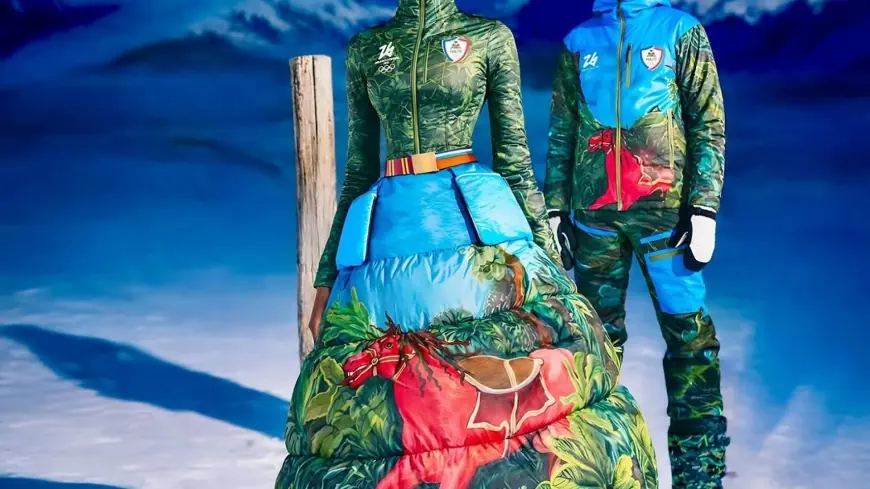
Haiti arrived at the Milano Cortina 2026 Winter Olympics with one of the most talked-about uniforms of opening week—less because of luxury materials or slick techwear, and more because the design was forced to change at the last moment. The kit, created by Italian-Haitian designer Stella Jean for Haiti’s two-athlete delegation, originally featured an image of revolutionary leader Toussaint Louverture. Olympic officials ruled the portrait violated rules that bar political symbolism on uniforms, triggering a rapid redesign completed just days before the Games’ February 6, 2026 opening ceremony (ET).
The result—an altered, hand-painted image centered on Louverture’s red horse—has turned a compliance dispute into a broader conversation about national identity, art, and who gets to define “political” at the Olympics.
What Haiti planned to wear, and why it changed
The original concept drew on a painting by Haitian artist Edouard Duval-Carrié depicting Louverture on horseback. Louverture is widely recognized as a key figure in the revolution that helped create the world’s first Black republic in 1804, making his image deeply meaningful to many Haitians at home and in the diaspora.
Olympic rules require national teams to avoid political messages and propaganda in venues and on official apparel. Officials determined Louverture’s image crossed that line. No detailed public explanation has been widely shared beyond the general neutrality rule, leaving room for frustration about how the line is drawn—and whether historical figures are being treated as “political” by default.
The new design: the rider disappears, the symbol remains
Stella Jean and her team pivoted by removing Louverture’s figure while keeping the broader scene—most notably the charging red horse—then repainting elements by hand. The updated artwork keeps the visual energy of the original, but with a conspicuous absence that viewers immediately noticed.
That absence is now part of the statement. Supporters read it as a quiet protest against erasure; critics see it as a workaround that still carries the original meaning. Either way, the redesigned uniform is doing what Olympic fashion often does at its best: telling a story without using a slogan.
Why this uniform is resonating beyond fashion
Haiti’s presence at the Winter Olympics is already unusual for a tropical nation, and this year’s context adds emotional weight. With Haiti facing severe instability and violence at home, the delegation’s visibility is being treated by many as a symbol of resilience and cultural continuity.
The uniform amplifies that message in a way that medals often cannot. Even without a podium finish, the team is appearing in global broadcast windows where viewers are asking the same questions: Who are these athletes? What is the story behind the artwork? Why was it changed?
In a Games shaped by multiple host venues and constant scrolling, a single striking visual can travel faster than a race result.
Who is wearing it, and what events they’re tied to
Haiti is represented by two athletes at these Winter Games, competing as skiers. The country’s winter-sport effort is relatively young, linked to the creation of a ski federation that grew after global support following the 2010 earthquake. One of Haiti’s most notable recent Winter Olympians, Richardson Viano, made the country’s debut at the 2022 Winter Games.
For a small delegation, the opening ceremony uniform often becomes the primary moment of mass attention. That’s why the redesign—completed so close to the start of competition—has mattered as much as the sports schedule itself.
What’s actually on the uniform: details viewers are noticing
The kit is packed with references that are easy to miss on a quick TV shot, but unmistakable up close. The most discussed elements include:
-
A hand-painted red horse set against lush tropical scenery, echoing the original artwork’s composition
-
“Haiti” written across the back against an azure-sky backdrop
-
A women’s delegation look that includes a tignon-style headwrap, a historical reference to hair-covering rules imposed during colonial times
-
Gold hoop earrings and other styling that leans into Haitian cultural continuity rather than generic winter gear
This attention to detail helps explain why the uniform has been shared so widely: it reads as intentional design, not just a last-minute patch.
What to watch next as the Games continue
The immediate question is whether Olympic authorities will clarify how they assess historical imagery—especially when it is part of a nation’s foundational story. The longer question is whether this episode encourages other delegations to lean harder into art and symbolism, knowing that restrictions can sometimes amplify attention rather than limit it.
For Haiti, the uniform has already achieved something rare: it has made a small Winter Olympics delegation impossible to ignore. Now the spotlight shifts to the athletes—competing in a setting far from the Caribbean, carrying a story painted onto a few meters of fabric.
Sources consulted: Associated Press, International Olympic Committee, The Guardian, The Washington Post