






















Turning Point USA’s “All-American Halftime Show” With Kid Rock Sparks a Culture Clash as Alternative to Super Bowl LX

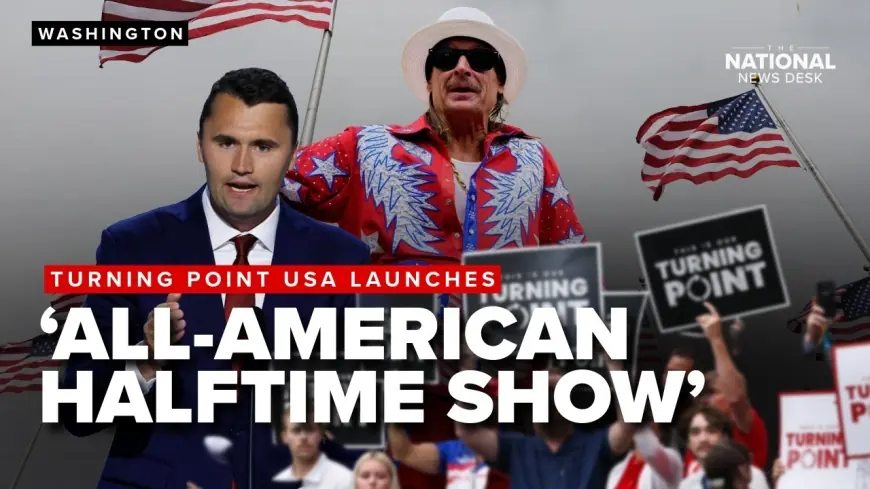
Turning Point USA is set to air its own “All-American Halftime Show” on Sunday, February 8, 2026, positioning it as an alternative to the official Super Bowl LX halftime performance. The lineup includes Kid Rock, Gabby Barrett, Lee Brice, and Brantley Gilbert, and the concept is being marketed as a values-forward counterprogram built around patriotic themes and English-language hits.
The announcement has rapidly turned into a political and cultural flashpoint, not because a separate concert is unusual in itself, but because the alternative framing is explicitly competitive: a parallel halftime meant to siphon attention from the main event and turn entertainment into a statement.
What happened: an alternative halftime show with a country-and-rock lineup
Turning Point USA has promoted the “All-American Halftime Show” as a coordinated broadcast-time event, timed to coincide with the Super Bowl halftime window. Kid Rock is the headliner, supported by three country acts with major radio presence and large touring audiences.
As the show gained traction online, attention shifted from logistics to controversy. Critics pointed to the organization’s political branding and to Kid Rock’s past catalog, including renewed focus on “Cool, Daddy Cool,” an older track whose lyrics have been criticized for sexual content involving young women. The resurfacing of that song has added a second layer of scrutiny: the alternative halftime show is now being argued as both a cultural rebuttal and a reputational risk.
Behind the headline: why this is happening now
This is a classic incentive alignment between politics, media, and the attention economy.
Turning Point USA benefits from a high-visibility moment that can recruit supporters, drive donations, and dominate conversation on a day when the whole country is watching something. The performers benefit from massive exposure to a motivated audience, plus the halo of appearing in an event framed as a national “moment,” even if it is unofficial. And the broader political ecosystem benefits from turning a sports entertainment staple into a proxy debate about language, identity, and who “belongs” at the center of American pop culture.
The alternative halftime concept also reflects a deeper trend: as live sports become one of the last remaining mass-audience events, they become irresistible terrain for cultural signaling.
Stakeholders: who gains, who loses, and who has leverage
The stakeholders are not just the artists and the organizer.
Advertisers and sponsors, even those not formally attached to the alternative show, face brand-safety questions when a performance becomes part of a political argument. The NFL and the official halftime producers face a parallel risk: the alternative show is designed to reframe the main halftime as divisive, even before a note is sung. Viewers and fans become the real leverage point, because the only “win” in counterprogramming is attention.
The artists also carry asymmetrical risk. A headliner like Kid Rock can absorb controversy because it often strengthens his brand with core fans. For the country artists, the trade-off is different: broader audiences can mean broader backlash, and the “why did you do this” question can linger long after the broadcast.
What we still don’t know
Several key details will determine whether this becomes a one-night stunt or a repeatable template:
-
How and where the alternative show will be distributed and whether access is free or gated
-
Whether it is live, pre-taped, or a hybrid production
-
Whether the performers make explicit political remarks, or keep it strictly musical
-
What the viewership looks like beyond the loudest online communities
-
Whether any legal or commercial friction emerges from branding that heavily references halftime and the Super Bowl moment
These missing pieces matter because the entire premise relies on scale. Without meaningful reach, it is just another concert. With reach, it becomes a new kind of political media product.
Second-order effects: what this could change
If the alternative halftime show draws meaningful audiences, it encourages more parallel events around major sports broadcasts: not just concerts, but coordinated “watch this instead” programming built to capture identities and grievances. That could fragment the shared experience of big games further, and it could raise the temperature around future halftime headliner choices, making them even more politicized than they already are.
It could also reshape how artists think about sponsorship and booking. If political alignment becomes a bigger part of performance context, managers may start treating large events like brand partnerships, requiring clearer risk mapping before signing on.
What happens next: realistic scenarios and triggers
-
A strong audience turnout that prompts Turning Point USA to repeat the concept, triggered by high engagement metrics and donor conversion
-
A backlash cycle centered on lyrics and past behavior, triggered by viral clips and renewed scrutiny of older songs
-
A quieter outcome where the show mostly reaches existing supporters, triggered by limited distribution or low mainstream pickup
-
Public distancing or clarification statements from supporting acts, triggered by fan pressure or brand concerns
-
Copycat counterprogramming from other ideological groups, triggered by proof that attention can be redirected during major live events
Why it matters
This is not simply a “Kid Rock halftime show” story. It’s a story about how a single cultural platform can be contested in real time. The Super Bowl halftime has become a symbolic stage, and Turning Point USA is attempting to turn that symbolism into an organizing tool. Whether the “All-American Halftime Show” becomes a footnote or a new annual phenomenon will depend on one thing above all: whether viewers treat it as entertainment, a political statement, or both.