






















Trump shares video depicting Obamas as primates, triggering renewed backlash

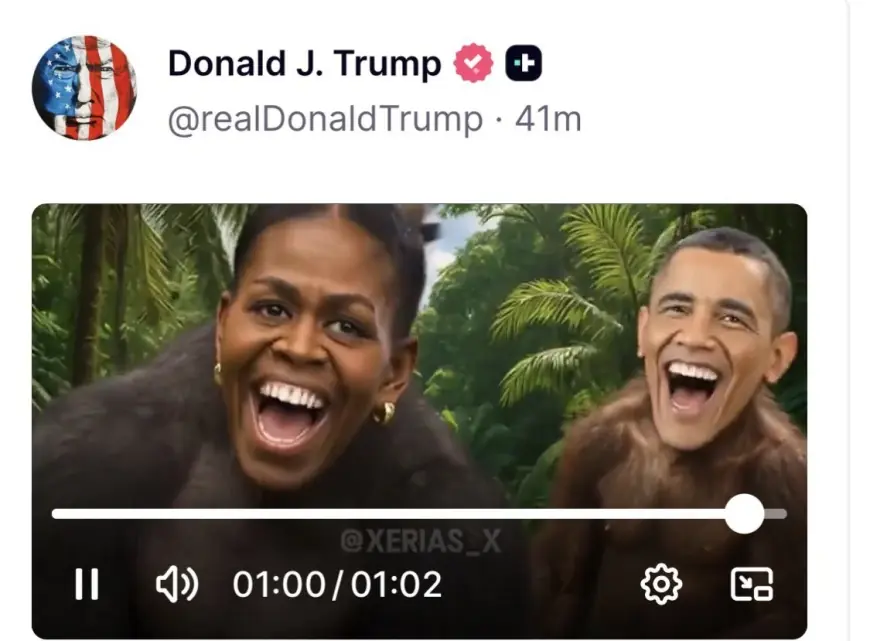
President Donald Trump posted a late-night video that included racist imagery portraying Barack Obama and Michelle Obama as primates, igniting swift condemnation from lawmakers and civil-rights advocates and forcing the White House into damage-control mode. The post landed during the first week of Black History Month and quickly became the latest flashpoint over how the president uses viral-style media to amplify political attacks and election conspiracies.
The one-minute clip circulated widely after appearing on Trump’s social-media feed late Thursday, February 5, 2026, and remained a focal point of political debate through Friday, February 6, 2026 (ET).
What was in the Trump Obama video
The video was framed around claims that the 2020 election was compromised, rehashing allegations about voting systems that have been rejected repeatedly in courts and by election officials. In the final seconds, it cut to a short sequence showing the Obamas’ faces edited onto primate bodies in a jungle setting, set to a pop-culture soundtrack.
Trump reposted the video without additional context or a caption. The lack of commentary did not blunt the reaction, largely because the imagery echoes a long-standing racist trope historically used to dehumanize Black people.
Immediate reaction from officials and allies
Democratic officials publicly condemned the post as overt racism and pressed Republicans to denounce it as well. The sharpest political significance came from criticism that crossed party lines: Senator Tim Scott, a prominent Black Republican, labeled the content racist and urged it to be taken down.
The White House response took a different tack. The press secretary dismissed the criticism as manufactured outrage and framed the post as a meme meant to portray Trump as a dominant figure while mocking Democrats. That defense did little to calm the debate, since the disputed portion of the clip centers specifically on the Obamas and uses imagery widely recognized as racist.
Why the post is a bigger story than one clip
This incident is part of a broader pattern in which provocative, edited, or AI-assisted content is used to generate attention and shape narratives faster than traditional political messaging. In recent months, Trump’s feed has featured multiple meme-style attacks, including content that depicts political opponents in fictional scenarios.
The controversy also lands amid heightened scrutiny of manipulated media in politics. Even when a video is presented as “just a meme,” it can carry real-world consequences: it normalizes dehumanizing stereotypes, accelerates harassment, and pressures institutions to respond to false or inflammatory claims.
How this affects the Obama-Trump dynamic
Barack Obama remains one of Trump’s most potent political foils, even years after leaving office. Clips targeting Obama tend to travel quickly because they tap into a long-running cultural and partisan argument over race, legitimacy, and power. Adding racist imagery escalates that dynamic from standard partisan provocation into a dispute over basic norms.
The post also reignited online chatter around older Trump-Obama content—earlier doctored clips, recycled claims of wrongdoing, and calls for investigations—creating a loop where a new controversy revives old narratives and pushes them back into circulation.
What to watch next
Several practical questions will shape what happens from here:
-
Removal or escalation: Whether the president leaves the post up, deletes it, or doubles down with additional content.
-
Congressional action: Whether lawmakers pursue any formal step beyond public condemnation, such as hearings or official letters tied to racism, incitement, or manipulated media.
-
Platform enforcement: Whether the company hosting Trump’s posts applies any policy action, labeling, or limitation.
-
Campaign implications: Whether Republican leaders treat this as a one-off embarrassment or a line they are willing to challenge publicly, especially as the party looks toward midterm strategy.
For now, the political effect is immediate and straightforward: the video has shifted a news cycle toward questions of racism and responsibility, while reinforcing concerns that meme-driven messaging is becoming a routine tool of presidential communication rather than an occasional outlier.
Sources consulted: Associated Press, The Wall Street Journal, CBS News, Axios