

























Lindsey Vonn injury update after crash leaves Olympic plans in question

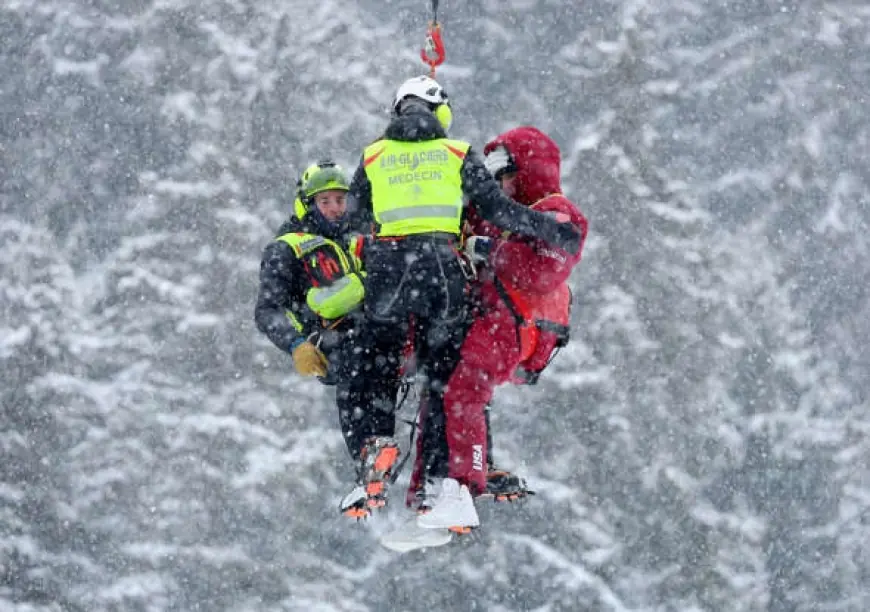
Lindsey Vonn’s latest injury scare has thrown a sudden question mark over her run-up to the 2026 Winter Olympics after a high-speed crash in her final pre-Games downhill. The 41-year-old American, often searched as “Lindsay Vonn,” was taken for further medical evaluation with concern centered on her left knee, turning what was meant to be a final tune-up into a day-to-day wait for clarity.
What happened in the Lindsey Vonn crash
The incident unfolded on Friday, January 30, 2026 (ET) during a women’s downhill race in Crans-Montana, Switzerland, when Vonn lost control after a jump and slid into the safety netting. Her protective airbag deployed on impact. She received immediate on-slope attention, then made her way down carefully before being transported for additional checks.
Race conditions deteriorated quickly, and the event was ultimately canceled after a string of early crashes across the first set of starters, amplifying concern about visibility and the safety margin on the course.
Lindsey Vonn injury update: what’s known so far
Vonn has described the injury as involving her left knee and has said she is undergoing further exams with her medical team. Specific imaging results have not been publicly confirmed, and no definitive return-to-racing timeline has been announced as of Monday, February 2, 2026 (ET).
What is clearer is the immediate impact on preparation: Vonn sat out the next scheduled speed race (a super-G) over the weekend following the crash, prioritizing recovery and evaluation rather than pushing through another start.
For anyone asking “vonn” status in plain terms: she has not been ruled out of the Olympics, but the decision hinges on what the follow-up tests show and how the knee responds over the next several days.
How the timing affects Groundhog-week Olympics buildup
The crash came at the worst possible moment on the calendar: the Olympics are set to begin later this week, and the women’s speed schedule arrives quickly once competition starts. In alpine skiing, even minor knee instability can be decisive—especially for downhill, where racers absorb repeated high-force compressions and sharp edge changes at speed.
Because of that, the difference between “sore but stable” and “structurally compromised” matters more than pain alone. Teams typically look at swelling, range of motion, stability tests, and whether the athlete can load the joint confidently—then decide whether a start is realistic or too risky.
Safety questions after multiple early crashes
The day in Crans-Montana is also being discussed as a broader caution sign for pre-Olympic speed racing. With several athletes crashing in quick succession, the cancellation underscored how rapidly conditions can tip from “challenging” to “unpredictable,” especially when visibility drops and racers lose the ability to read terrain transitions at speed.
Officials have defended the decision-making around course safety, while others have pointed to the pattern of early crashes as evidence the margin had narrowed too far. Regardless of where that debate lands, the outcome was unavoidable: the headline shifted from results to athlete health, with Vonn at the center of the news cycle.
What to watch next for the injury update
The next updates are likely to be practical rather than dramatic: confirmation of test results, whether Vonn resumes training on snow, and whether she can tolerate speed turns without guarding the knee.
Key signals to watch over the coming days:
-
Training status: returning to full-speed training is usually the clearest green light.
-
Event entries: whether she remains entered in early Olympic speed events as start lists firm up.
-
Team messaging: language shifting from “evaluating” to “cleared” (or to “withdrawing”) tends to mark the real decision point.
For now, the most accurate summary is simple: Lindsey Vonn’s injury update remains incomplete, but the window to decide is short, and every day without full-speed training raises the stakes for a safe start.
Sources consulted: Associated Press, Reuters, International Olympic Committee, The Wall Street Journal