






















Toronto Earthquake Questions Spike After a Late-Night Ontario Tremor Near Orillia Registers Around Magnitude 3.7

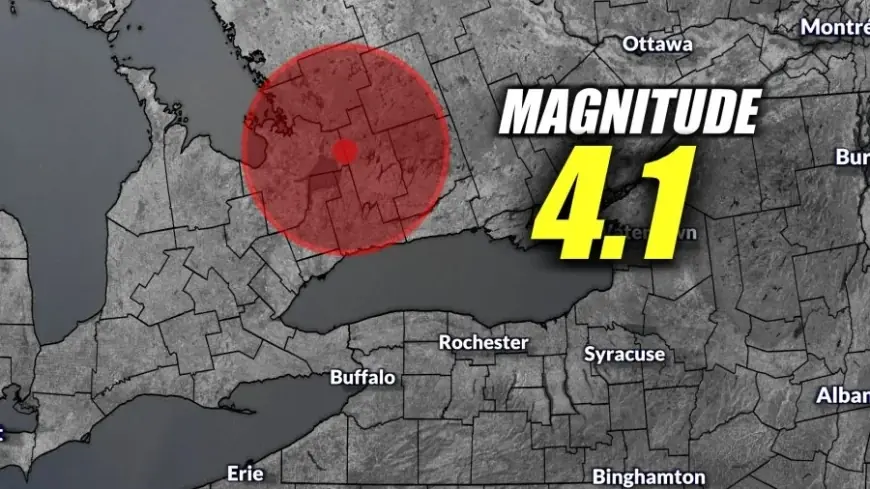
People across southern Ontario flooded social feeds with the same startled question late Tuesday night: was that an earthquake. The answer is yes. A shallow earthquake centered near Orillia was recorded at 10:59 p.m. ET on Tuesday, January 27, 2026, and was felt across a wide swath of the region, including parts of the Greater Toronto Area.
The quake was measured at magnitude 3.7 by Canada’s national seismic monitoring program, while a separate U.S. monitoring agency posted an estimate of magnitude 4.1, a normal kind of variance that can happen when different networks process early data using different methods. No damage reports were expected, and early assessments described the shaking as light.
What happened and where it was located
The epicenter was identified as about 23 km east-southeast of Orillia, roughly 43 km east-northeast of Barrie, and about 99 km north-northeast of Toronto. The quake was classified as very shallow, only a few kilometers deep, which is one reason people can notice it even when the magnitude is relatively modest.
Residents from Simcoe County down through Toronto and into parts of Durham and other surrounding areas reported classic “small quake” sensations: a quick jolt, a brief rolling motion, rattling dishes, and pets reacting before people fully registered what was happening.
Was there an earthquake “today” in Ontario
Because searches like “earthquake Toronto today” and “Ontario earthquake just now” are spiking, the timing matters:
-
The quake occurred Tuesday night, January 27, 2026 at 10:59 p.m. ET.
-
If you felt shaking on Wednesday or Thursday, you may be noticing aftereffects such as settling snowbanks, building vibrations from plows and heavy trucks, or temperature-driven ground shifts.
That said, small aftershocks are possible after any quake, even if they are typically too small to feel. Monitoring updates over the next day or two usually clarify whether any follow-on events were recorded.
Earthquake vs frost quake: why the confusion is peaking right now
Southern Ontario is coming off an intense snow-and-cold stretch, and that’s fueling another question in the search surge: “frost quake.”
A frost quake, also called a cryoseism, is not a tectonic earthquake. It happens when water in the ground freezes and expands rapidly, cracking soil or rock near the surface. Frost quakes can feel like a sudden bang or jolt and are most common during rapid temperature drops, especially after wet weather or melting.
This Orillia-area event, however, was recorded as a true seismic earthquake. The key difference is depth and signal: a tectonic quake is generated by movement along a fault at depth, while a frost quake is a shallow surface phenomenon and often has a different vibration signature.
How big is a magnitude 3.7, and should people be worried
A magnitude 3.7 is considered a minor earthquake. It can be widely felt, especially at night when background noise is low, but it rarely causes structural damage. The “lightly felt” assessment aligns with what most people described: short duration, modest shaking, and little to no impact beyond surprise.
Still, earthquakes in stable continental regions like Ontario can travel farther than people expect because older bedrock transmits seismic waves efficiently. That is why a quake centered well north of Toronto can still be noticed in the GTA and beyond.
Behind the headline: why a small Ontario quake becomes a big story
Context matters. Ontario does not experience frequent damaging earthquakes, but it does have a well-documented history of occasional intraplate quakes. When one hits near major population centers, it cuts through the usual weather-driven news cycle instantly.
Incentives shape the reaction:
-
People want immediate clarity and reassurance, especially after weeks of winter stress.
-
Local agencies want accurate public reporting without fueling panic.
-
Social platforms reward dramatic interpretations, which can inflate uncertainty.
Stakeholders are broader than the people who felt it:
-
Transportation agencies that manage bridges, highways, and rail infrastructure
-
School boards and bus operators already stretched by winter conditions
-
Property managers dealing with safety calls and building checks
-
Emergency services that must distinguish real incidents from false alarms
Second-order effects show up quickly: rumor loops, “another quake incoming” speculation, and confusion between earthquake activity and cold-weather ground cracking.
What we still don’t know
Even when a quake is confirmed quickly, several details typically evolve over the first 24 to 72 hours:
-
Whether the magnitude estimate is refined upward or downward
-
Whether the depth estimate changes as more stations report
-
Whether any small aftershocks are detected
-
Whether any minor damage reports emerge, particularly in older masonry or plaster interiors
The fact that early estimates differed between monitoring systems is not unusual, but it does keep the story active as people watch for updates.
What happens next: realistic scenarios to watch
-
Refinement, not escalation
Trigger: updated processing narrows the magnitude and depth without changing the “minor, lightly felt” conclusion. -
A small aftershock that some people notice
Trigger: a follow-on tremor in the same area, often smaller and brief. -
No aftershocks, but continued “did you feel it” reporting
Trigger: people compare experiences across neighborhoods and time zones, extending the conversation. -
More frost-quake confusion during the deep freeze
Trigger: rapid temperature drops produce loud cracks and jolts that feel quake-like. -
Infrastructure checks become routine messaging
Trigger: agencies remind the public what to do after a quake, even when damage is unlikely.
For most residents, the practical takeaway is simple: this was a real earthquake, it was small, and serious impacts are not expected. The bigger lesson is how quickly a rare event can ripple through a region already on edge from snow, ice, and extreme cold.