




















Craig Berube’s Head Injury: Maple Leafs Coach Reveals Gym Accident Behind the Stitches and Black Eye

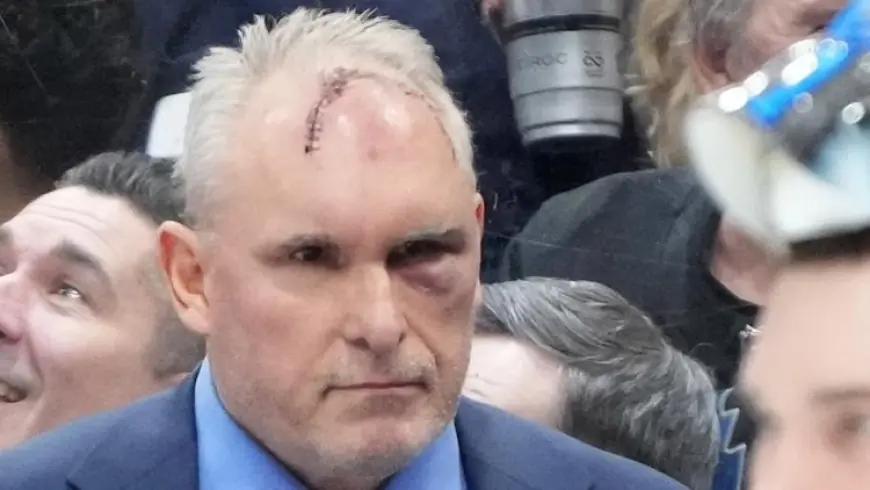
Toronto Maple Leafs head coach Craig Berube drew instant attention this week after showing up with a prominent row of stitches across his forehead and a bruised, darkened left eye. The visuals were startling enough that “what happened to Berube’s head” became the only question many fans wanted answered.
Berube addressed it directly: he said he suffered a gym accident on Thursday, January 22, 2026 (ET), called it a “bad accident” and “my fault,” and insisted he was fine to keep coaching. He declined to share the specific mechanics of what happened, but later indicated the cut required close to 50 stitches, an unusually high number even for a deep scalp wound.
What happened to Craig Berube
The confirmed outline is straightforward:
-
Berube was injured in a workout-related accident the day before he first appeared publicly with the injury.
-
He showed up the next morning with a large stitched wound on his scalp and a black eye, then proceeded with normal team duties.
-
He repeatedly described it as self-inflicted in the sense of responsibility, saying it was “stupid” and “on me.”
-
He kept the details vague, choosing not to explain exactly what piece of equipment or movement caused the impact.
-
In follow-up comments, he said the injury required close to 50 stitches, and he reiterated that he was okay.
That is why fans keep searching for “gym accident” and “forehead injury” together: there was no on-ice incident, no fight, and no collision behind the bench. It was off-ice, routine life, sudden consequence.
Why the details are still unclear
Berube’s decision not to spell out the exact sequence has only intensified curiosity. In a normal workplace, “I hit my head in the gym” would be enough. In a high-profile sports market, vague answers function like oxygen for speculation.
There are also sensible reasons for the restraint:
-
Privacy and liability: if the accident happened in a facility connected to the team or a partner, there are obvious reasons to keep specifics limited.
-
Health and optics: head injuries trigger concussion questions immediately, and many people prefer to avoid turning a minor medical issue into a daily storyline.
-
Control of narrative: Berube’s brand is toughness and blunt accountability. His message was basically: it happened, it looks ugly, I’m working.
Behind the headline: what this says about Berube, the Leafs, and hockey culture
The reaction to Berube’s injury landed in a familiar hockey tension: toughness versus modern health awareness.
Context: Hockey has long celebrated grit, and Berube embodies that ethos. His career and coaching persona are built on hard edges, demanding standards, and accountability. A stitched-up forehead fits the mythology, even when it comes from a weight room and not a rink.
Incentives:
-
For Berube, downplaying drama protects his authority. A coach who looks rattled becomes a storyline. A coach who shrugs it off signals stability.
-
For the team, normalcy is the goal. Toronto lives under constant scrutiny, and any distraction can swell into a week-long sideshow.
-
For the league, public head injuries create uncomfortable questions. Even when someone says they’re fine, the public now expects visible seriousness about symptoms and recovery.
Stakeholders: players and staff watch how a coach responds to adversity because it sets the emotional temperature of the room. Fans and media interpret the response as a clue about team culture. Medical staff have the quiet job of ensuring “fine” is truly fine, not just said on reflex.
Second-order effects: a moment like this can become a weird morale device. Teammates often rally around a coach who shows up, stitched and bruised, and still runs the day. But it also risks reinforcing the idea that powering through head-related incidents is admirable by default, which is exactly the message modern sports medicine is trying to soften.
What to watch next
Most signs point to this being a frightening-looking but manageable injury, and Berube has continued his routine. Still, a few practical things will shape the next headlines:
-
Any missed practices or games
Trigger: lingering symptoms like headaches, dizziness, or light sensitivity. -
More clarity on medical evaluation
Trigger: questions about concussion protocols intensify if he appears slowed or less present. -
The team’s on-ice performance during the distraction window
Trigger: if Toronto struggles, the story can morph from “coach got hurt” to “everything is going wrong.” -
Whether Berube eventually explains it
Trigger: sometimes a coach offers a quick detail later to shut down rumor cycles.
For now, the most accurate answer to “what happened to Craig Berube’s head” is also the simplest: a gym accident, a deep cut requiring close to 50 stitches, a black eye, and a coach determined to treat it as an inconvenience rather than a crisis.