Meta Stock Price Swings After Meta Earnings Beat: Investors Focus on 2026 AI Spend and What the Earnings Call Really Signaled


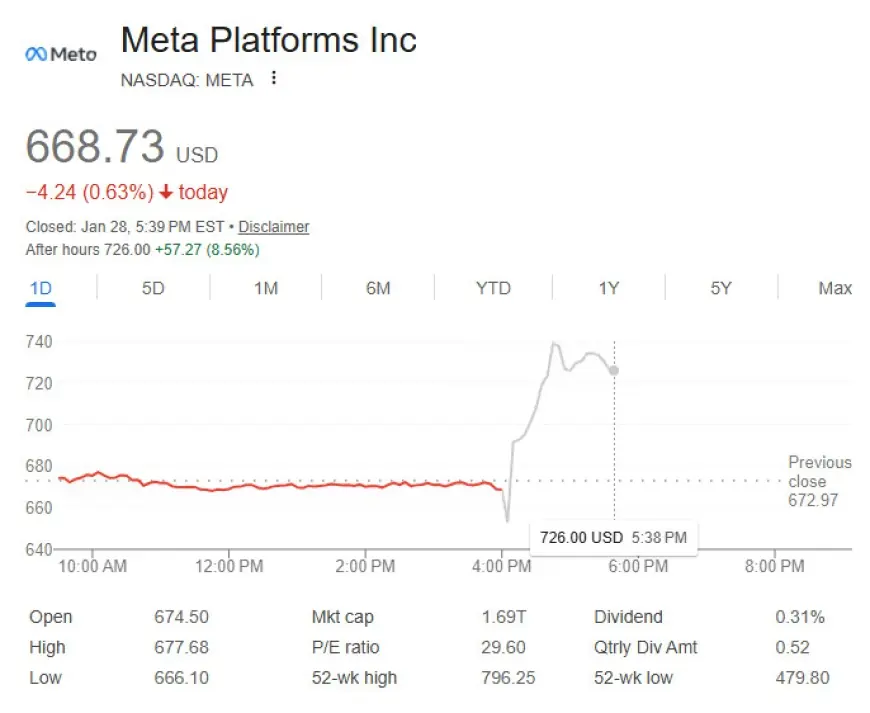
Meta stock saw sharp volatility after Meta earnings landed late Wednesday, January 28, 2026, with investors balancing a strong advertising-driven quarter against a major step-up in spending for AI infrastructure and talent. As of 5:08 p.m. ET Wednesday, Meta stock was around $668.73 per share, down about 0.9% from the prior close after trading in a wide range roughly between $637.90 and $742.66 during the session and after-hours period.
The headline result was a beat. The bigger debate is whether Meta’s 2026 spending plan is the kind of “invest now, profit later” move that markets reward—or a margin squeeze that could cap near-term upside even if revenue stays hot.
Meta earnings: the key numbers from the quarter and full year
Meta’s fourth-quarter performance was powered by its core advertising machine:
-
Q4 revenue: $59.893 billion, up 24% year over year
-
Q4 diluted EPS: $8.88, up 11% year over year
-
Family daily active people: 3.58 billion on average in December 2025, up 7% year over year
-
Ad impressions: up 18% year over year in Q4
-
Average price per ad: up 6% year over year in Q4
For the full year:
-
2025 revenue: $200.966 billion, up 22% year over year
-
2025 net income: $60.458 billion, down 3% year over year
-
2025 operating income: $83.276 billion, up 20% year over year
That “revenue up, net income down” mix matters. It reflects how quickly costs rose and how tax-related and below-the-line items can change the optics of profitability even when operations are strong.
The Meta earnings call: why spending stole the spotlight
Meta hosted its earnings call at 4:30 p.m. ET on January 28, and the message investors zeroed in on was not the quarter’s beat—it was the scale of what comes next.
Meta guided to:
-
2026 total expenses: $162 billion to $169 billion
-
2026 capital expenditures: $115 billion to $135 billion
That is a dramatic escalation from 2025’s full-year capital spending of $72.22 billion. Management framed it as an all-in build for AI capacity and a push to expand infrastructure fast enough to support new models, products, and increasingly AI-driven ad systems.
In plain English: Meta is signaling that the constraint is no longer ideas—it is compute.
Meta stock: why a strong quarter can still lead to choppy trading
When a mega-cap company beats on revenue and earnings, investors usually ask a simple follow-up: “What did you have to spend to get it, and what will you have to spend to keep it?”
Meta’s answer is: a lot more.
That creates two competing narratives:
-
Bull case: the ad business is throwing off enough cash to fund a multi-year AI buildout, and AI improves targeting, measurement, and automation in ways that keep advertisers spending.
-
Bear case: capex and expense growth outrun near-term monetization, compressing margins and making the stock more sensitive to any slowdown in advertising demand.
The wide trading range is the market trying to price those narratives simultaneously.
Behind the headline: incentives, stakeholders, and what’s really at stake
Context: Meta is attempting to do two hard things at the same time: defend its core advertising dominance and build a next-generation AI platform that changes how users create, search, message, and shop across its apps.
Incentives:
-
Meta wants to lock in AI scale early because the first companies to secure durable compute advantages often dictate the pace of product releases.
-
Investors want growth, but they also want cost discipline—especially after prior eras where ambitious bets took years to justify.
-
Advertisers want performance and predictability; Meta is selling the idea that AI-driven tools deliver both.
Stakeholders:
-
Users, whose feeds and recommendations are increasingly shaped by models
-
Advertisers, who fund the engine and respond quickly to ROI changes
-
Competitors in short-form video, messaging, and AI assistants
-
Regulators, particularly around advertising practices and youth-related scrutiny
-
Cloud and infrastructure partners, who benefit when capex rises but also become part of the operational dependency chain
Second-order effects: A capex wave of this size can ripple into the broader AI supply ecosystem, from data-center buildouts to power demand, and it raises the bar for smaller rivals who cannot match that scale.
What we still don’t know
Several missing pieces will determine whether this is a “spend into strength” moment or a “spend into doubt” moment:
-
How quickly Meta can turn new AI capabilities into incremental revenue rather than just higher costs
-
Whether Reality Labs losses remain stable as promised or widen again
-
How advertising demand holds up if the economy cools or budgets tighten
-
How legal and regulatory outcomes reshape product design, targeting, and measurement
-
Whether the company’s rising headcount and compensation spend materially improve execution pace
What happens next: realistic scenarios and triggers
-
Meta stock stabilizes and grinds higher
Trigger: evidence that AI spend is lifting ad performance and revenue without accelerating costs further. -
Meta stock remains volatile around each update
Trigger: spending keeps climbing and investors treat every quarter as a referendum on payback timing. -
A valuation squeeze despite growth
Trigger: expenses land near the top of guidance and operating margin declines more than expected. -
A renewed rally
Trigger: clear signals that AI products are monetizing beyond ads, expanding total revenue streams. -
A sentiment turn lower
Trigger: ad growth decelerates while capex remains elevated, tightening the narrative that spending is “too early” or “too much.”
For now, the simplest read is this: Meta earnings showed the core business is strong, but Meta’s earnings call made clear 2026 is being treated as an infrastructure sprint. Meta stock will likely trade less on whether AI is the future and more on whether Meta can prove it can buy that future without overpaying for it.