



When an artist exits a tour after fan backlash, the decision is rarely about one angry comment section. It is usually a calculation involving brand identity, audience trust, ticket demand, sponsor comfort, political optics, contractual exposure, and the long memory of the internet.
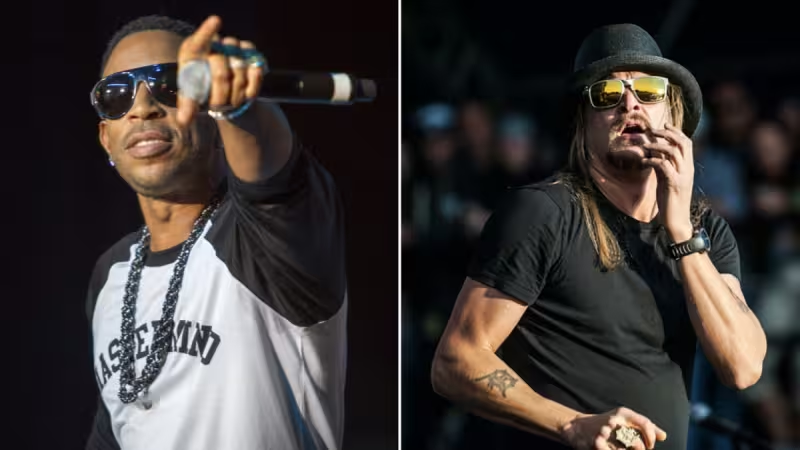
The Ludacris and Kid Rock controversy is a useful modern example. Ludacris was initially listed on the 2026 Rock the Country traveling festival lineup, an event associated in the public conversation with Kid Rock, Jason Aldean, patriotic branding, and conservative-coded entertainment culture. After fans criticized Ludacris for appearing to align himself with a politically charged bill, his representative said the listing was a “mix-up” and that he was not supposed to be on the lineup. His name was removed from the festival’s materials.

The episode showed how quickly a tour booking can become a referendum on an artist’s values. To one audience, a festival is just a paid performance. To another, it is an endorsement. In the current entertainment economy, that distinction can determine whether an appearance helps an artist reach new listeners or damages years of carefully managed identity.
Leaving a tour can cost money. Staying can cost more.
The Ludacris Tour Controversy Explained
The controversy around Ludacris and Rock the Country did not begin with a new song, a political speech, or an onstage incident. It began with a lineup.
Rock the Country had been promoted as a traveling country festival built around patriotism, rural audiences, rock-country crossover acts, and a celebration tied to America’s 250th anniversary. Kid Rock, one of Donald Trump’s most visible celebrity supporters, was a major figure in the event. Jason Aldean, another artist strongly associated with conservative audiences, was also part of the bill. The festival’s public language leaned into hard-working, faith-oriented, patriotic imagery.
For Ludacris, the optics were complicated. His career spans Atlanta hip-hop, pop crossover, film, television, and mainstream brand partnerships. He is not generally understood by his fan base as part of the MAGA-coded entertainment ecosystem. So when his name appeared alongside Kid Rock and other politically identified performers, some fans read the booking as a public alignment.
His team’s response was to distance him from the appearance. A representative said “lines got crossed,” framing the situation not as a political reversal but as a booking error. That language mattered. It allowed the artist to exit without directly attacking the festival, its audience, or other performers. It also gave fans an explanation that preserved his existing brand: he was not choosing a political stage; his name had been placed there incorrectly.
Whether every fan accepted that explanation is less important than the business lesson. In today’s touring market, a lineup announcement is not neutral. It is content. It is instantly screenshotted, debated, politicized, and fed into the broader story audiences already believe about each artist.
Why Fan Backlash Matters Financially
Fan backlash matters because artists do not sell only music. They sell identity.
A touring artist’s revenue depends on trust: trust that fans will buy tickets, stream music, purchase merchandise, follow social accounts, defend them in public, and support future projects. A single controversial booking can put that trust under pressure, especially if the backlash comes from an artist’s core audience rather than casual observers.
The financial risks begin with ticket sales. If an artist’s fans believe a tour appearance conflicts with the artist’s values, they may not buy tickets. If the audience of the event believes the artist is hostile to them, they may also stay away. That creates the worst-case scenario: the artist alienates one audience without successfully gaining another.
Sponsorship is another concern. Brands are often more risk-averse than fans. A corporate sponsor may tolerate artistic edge, but it does not want to become the next target of a boycott campaign. If a tour becomes politically toxic, sponsors may ask for reassurances, reduce promotion, or avoid future deals with the artist.
There is also the question of audience demographics. Ludacris has a multigenerational audience that includes hip-hop fans, nostalgia-driven millennial listeners, Fast & Furious viewers, and mainstream consumers who know him through television and advertising. A politically polarizing appearance could complicate that broad appeal.
In touring, broad appeal is valuable. It creates flexibility: private events, festivals, brand campaigns, nostalgia tours, film promotion, and crossover bills. A sharply political association can narrow that field. For some artists, narrowing the field is the strategy. For others, it is a liability.
The Economics Of Touring
Touring is one of the most important revenue engines in music, especially in an era when streaming pays unevenly and recorded music often functions as promotion for live performance.
A tour is also a high-cost business. Artists, managers, agents, promoters, insurers, venues, vendors, security teams, travel coordinators, production crews, lighting designers, sound engineers, bus companies, hotels, and local labor all sit inside the same financial machine. Every date involves fixed costs before a single ticket is scanned.
That means a controversy can affect more than reputation. It can affect margins.
If backlash depresses demand, promoters may have to discount tickets. If the lineup changes, early buyers may demand refunds. If sponsors become nervous, marketing budgets can shrink. If venues face local political pressure, permits and community relations can become more difficult. If an artist withdraws, the promoter may need to replace them quickly, often at a premium.
For the artist leaving, there may be contractual penalties. Festival and tour agreements often include cancellation clauses, force majeure language, morality provisions, exclusivity rules, and approval requirements. If the artist exits without a contractually protected reason, they may owe money or damage relationships with agents and promoters.
But contracts are only one part of the equation. The larger question is lifetime value. An artist may decide that losing one payday is preferable to weakening the connection with their core fan base. In that sense, leaving a tour can be a form of brand protection.
For a superstar, the calculation may be strategic. For a developing artist, it can be existential. A young act cannot afford to become known primarily for the wrong controversy. A mid-career artist cannot always afford to alienate the fans who still buy hard tickets. A legacy artist may decide that the controversy is worth it because their audience expects political alignment.
Touring decisions are rarely just artistic. They are balance-sheet decisions dressed in cultural language.
Political Branding In Entertainment
Politics has always existed in popular music. Folk, punk, country, hip-hop, soul, rock, reggae, and metal have all carried political messages. What has changed is the way politics now attaches itself not only to lyrics but to venues, lineups, sponsors, cities, festivals, playlists, brand partners, and even silence.
An artist does not have to make a speech to become politically legible. Appearing on the wrong bill can be enough.
For Kid Rock, political branding is central to the modern stage persona. The association with conservative populism, patriotism, and Trump-era culture is not incidental; it is part of the audience relationship. For Jason Aldean, political and cultural debates around country music have also become part of the public frame around his career. In that environment, any artist sharing a bill risks being interpreted through the dominant brand of the event.
That creates a challenge for artists whose appeal depends on crossing cultural lanes. Hip-hop and country collaborations have become more common, and genre walls are weaker than they were a generation ago. But political walls are often stronger. A genre crossover can be read as creative. A political crossover can be read as betrayal.
The same appearance can carry different meanings depending on the artist. A country singer with a conservative audience may gain credibility from a patriotic festival. A rapper with a more politically diverse or progressive-leaning fan base may face suspicion. A pop artist may be judged by sponsors. A legacy act may be judged by nostalgia audiences that do not want politics attached to the music.
This is why “just play the show” no longer works as a universal answer. The stage itself can be interpreted as a statement.
Historical Examples Of Artists Leaving Tours
The Ludacris episode belongs to a longer history of artists, festivals, and tours disrupted by politics, backlash, or reputational risk.
The Chicks remain the defining modern example of music backlash reshaping a career. In 2003, after Natalie Maines criticized President George W. Bush onstage in London before the Iraq War, the group faced country-radio boycotts, declining sales, threats, and sponsorship fallout. The controversy did not simply affect one tour; it changed their relationship with the country music establishment for years.

That case is important because it showed how audience politics can override commercial success. The Chicks were one of the biggest acts in country music. Yet their core radio ecosystem and parts of their audience turned against them quickly. For artists watching from the sidelines, the message was clear: political misalignment can carry real business consequences.
More recently, festival withdrawals have become common when performers believe an event’s political or financial associations conflict with their values. In 2025, multiple DJs and electronic artists withdrew from London’s Field Day after boycott pressure related to the festival’s ownership ties. Resident Advisor reported that Midland, Spray, Roza Terenzi, Regularfantasy, and others dropped from the lineup amid pressure tied to KKR’s acquisition of the festival’s parent company.
In 2026, several acts withdrew from Freedom 250 events in Washington, D.C., after performers said the concerts had been presented as nonpartisan but became associated with Trump-linked political programming. The Associated Press reported that artists including Martina McBride, Young MC, Morris Day, and the Commodores pulled out or distanced themselves from the event.
Another contemporary example involves M.I.A. and Kid Cudi’s tour. M.I.A. was removed from the Rebel Ragers Tour after onstage political comments reportedly drew backlash from the audience; she later sued, alleging breach of contract. That dispute underscores a different side of the issue: leaving or being removed from a tour can lead to litigation, not just headlines.
These cases are not identical. Some involve artists withdrawing voluntarily. Some involve removal by promoters or headliners. Some center on war, some on presidential politics, some on ownership, some on public remarks. But they share a common structure: the live music business becomes a battleground over association.
Reputation Management In The Social Media Era
In the pre-social media era, a controversial tour booking might have spread through local radio, fan clubs, entertainment columns, and message boards. Today, the cycle can move in minutes.
A lineup poster drops. Fans zoom in. A few accounts post disbelief. A political framing takes hold. The artist’s latest Instagram post fills with comments. Screenshots migrate to X, TikTok, Reddit, Facebook, and entertainment sites. The controversy becomes searchable before the artist has spoken.
At that point, silence becomes risky. But responding is risky too.
If the artist apologizes, critics may call it damage control. If the artist says nothing, fans may assume the booking was intentional. If the artist attacks the backlash, the story escalates. If the artist blames a “mix-up,” as Ludacris’ team did, the response must be fast enough to prevent the association from hardening into public memory.
Social media also collapses context. A festival with dozens of artists can be reduced to one political label. A performer may have agreed to a specific date without reviewing the full positioning of the event. An agent may have handled the booking. A management team may have approved an offer without anticipating the cultural reading. None of that matters once fans decide the appearance means endorsement.
Reputation management now requires pre-announcement risk assessment. Artists and their teams have to ask: Who else is on the bill? What has the headliner said publicly? What does the festival’s marketing language imply? Who owns the event? Which sponsors are attached? Which communities may object? Which fan accounts are likely to amplify criticism? What is the exit plan if the reaction turns negative?
The best crisis response is prevention. By the time a lineup becomes a controversy, every option is already expensive.
What Artists Consider Before Staying Or Leaving
Before leaving a tour, an artist’s team usually weighs several questions.
The first is contractual exposure. Can the artist exit without a penalty? Was the appearance formally confirmed? Was the announcement premature? Did the promoter misrepresent the event? Is there a morality clause or approval right that can be invoked?
The second is fan alignment. Is the backlash coming from the artist’s true base or from people who were never likely to support them? Artists can survive criticism from outside their audience. They have a harder time surviving distrust from inside it.
The third is sponsor risk. If the artist has brand deals, film projects, television appearances, or family-friendly partnerships, a politically charged booking may create complications beyond music.
The fourth is future touring value. An artist may accept one controversial booking for a large fee, but the reputational cost can affect future festival invitations, corporate events, international dates, and collaborations.
The fifth is authenticity. Some artists are willing to absorb backlash because the appearance reflects who they are. Others leave because staying would communicate something false. Audiences may forgive unpopular views more easily than they forgive perceived inauthenticity.
The sixth is safety. In politically charged environments, threats against artists, crews, venues, or fans can change the calculus quickly. A show that becomes a symbolic battleground is not just a public-relations issue; it is an operational risk.
The seventh is narrative control. If an artist leaves quickly, the explanation can remain narrow. If the controversy drags on, the story grows. In Ludacris’ case, the “mix-up” explanation gave his team a clean narrative: he was not meant to be involved.
The final consideration is long-term identity. Artists spend years building a public self. A single tour announcement can confuse that identity. Leaving may be costly, but confusion can be costlier.
FAQ
Why do artists leave tours after fan backlash?
Artists leave tours when the reputational, financial, political, or safety risks of staying become greater than the value of the performance. Backlash can affect ticket sales, sponsorships, fan loyalty, and future bookings.
What happened with Ludacris and Kid Rock’s Rock the Country festival?
Ludacris was listed on the 2026 Rock the Country festival lineup, which was associated publicly with Kid Rock and other politically conservative-coded performers. After fan backlash, his representative said the listing was a mix-up and that he was not supposed to be part of the event. His name was removed.
Why was the lineup controversial?
The controversy centered on political association. Kid Rock is closely identified with Donald Trump and conservative entertainment culture. Some fans viewed Ludacris’ presence on the lineup as an implied endorsement of that environment.
Do artists lose money when they leave a tour?
They can. Depending on the contract, an artist may face cancellation penalties, lost fees, crew costs, or strained relationships with promoters. But leaving can still be financially rational if staying threatens larger revenue streams.
How do sponsors influence touring decisions?
Sponsors want visibility without reputational danger. If a tour becomes politically toxic, sponsors may reduce support, pressure promoters, or avoid future partnerships with involved artists.
Is fan backlash always powerful enough to change a tour?
No. Backlash matters most when it comes from the artist’s core audience, affects ticket demand, draws sponsor concern, or creates a wider reputation crisis. Some artists benefit from controversy if it strengthens their bond with their base.
How has social media changed these controversies?
Social media accelerates the cycle. Lineup announcements are instantly analyzed, criticized, reframed, and distributed. Artists have less time to respond before a narrative becomes fixed.
Are political controversies more common in music now?
They are more visible. Music has always been political, but social media and polarized audience identities make political associations easier to detect and harder to ignore.
What historical example best explains the risks?
The Chicks’ 2003 backlash remains one of the clearest examples. Their criticism of President George W. Bush led to country-radio boycotts, reduced commercial support, and a long-term rupture with parts of the country music establishment.
What should artists do before joining a tour or festival?
They should review the full lineup, event branding, sponsor list, ownership, political associations, audience demographics, and cancellation terms. A booking is no longer just a booking; it is a public association.



