



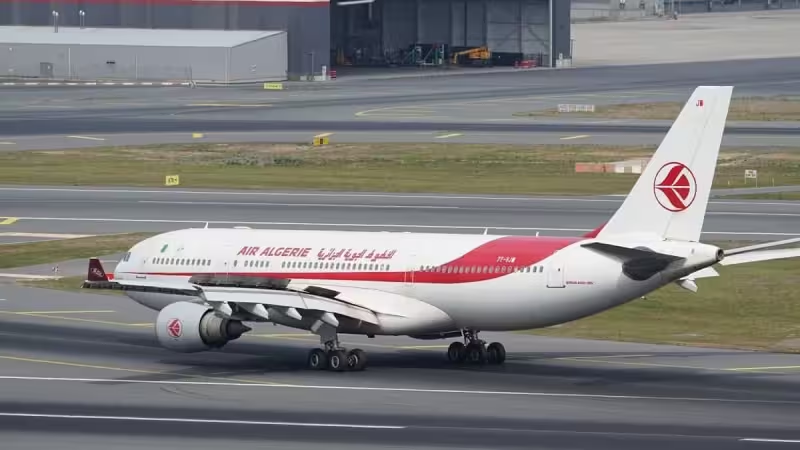
Air Algérie operated its first direct flight between Manchester and Algiers on 14 June and has begun a twice-weekly service, creating the first nonstop link between northern England and Algeria’s capital.
The route gives travellers from the north of England a new one-stop corridor to sub-Saharan Africa via Algiers, with connections on offer to Johannesburg, Abuja, Dakar and Douala through the carrier’s hub.

Those operational details come as demand between Africa and Manchester has climbed sharply: Tom Bingham said traffic reached 1.5 million passengers in 2025, a jump of 17 percent from 2024 and a 66 percent rise since 2023. He described the new link as strengthening business travel, tourism and ties for diaspora communities in the north, and said it expands onward options for those transiting through Algiers.
Air Algérie’s Manchester launch follows an April announcement by chief executive Hamza Benhamouda that the carrier planned five new routes in 2025 as part of a wider international expansion. The airline has publicly framed those moves around a push to make Algiers a hub for traffic between Africa and major world destinations.
The immediate consequence for travellers is practical: two flights a week now connect Manchester with Algiers, shortening journeys that previously required a change elsewhere and offering fresh scheduling choices for business travellers, holidaymakers and families travelling to and from North Africa.
Yet the launch arrives against a backdrop of rapidly rising traffic into Manchester. The scale of growth highlighted by Bingham — the 1.5 million figure and double-digit gains year-on-year — underlines why the market matters now and why carriers are rethinking routes into northern England.
That contrast is also the story’s friction. Air Algérie is adding capacity at a moment when passenger volumes between Africa and Manchester have already expanded sharply; the airline has not published an estimate of how many passengers it expects to carry on the new Manchester–Algiers link or when, if at all, it might increase frequency beyond two weekly flights.
Operationally, the move is consistent with Air Algérie’s stated strategy of using Algiers as a connecting hub. But whether two weekly rotations will be sufficient to meet a market that grew to 1.5 million passengers in 2025 — and whether the carrier will accelerate frequency or add aircraft on the Manchester sector — are open questions that will determine if the new service is a tactical route or the start of a larger footprint in the north of England.
Air Algérie will continue operating the twice-weekly service while it integrates the link into its network; the airline’s April pledge of five new routes in 2025 remains the clearest sign that more international connections could follow. The immediate question now is whether Air Algérie will scale the Manchester frequency to match demand and to support its ambition for Algiers as a pan‑African hub.



