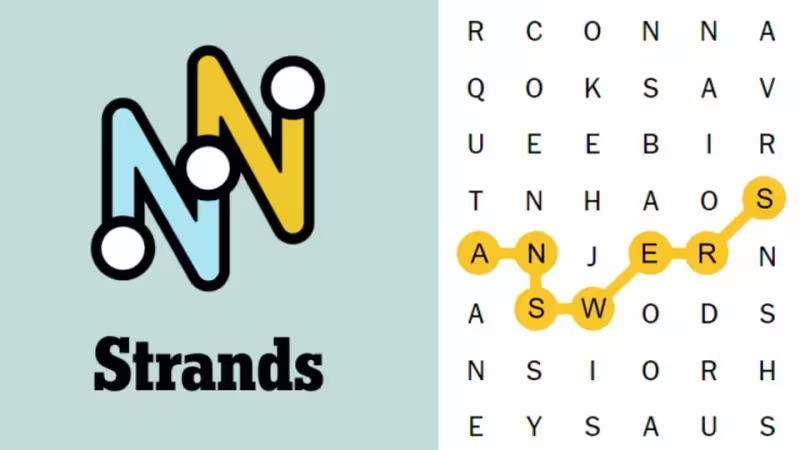
’ Strands puzzle for Sunday, June 14, leaned into bloodlines and history eras, with a theme built around peerage titles. For solvers looking up Strands hint today, the puzzle’s answer set pointed straight at European nobility rather than a simple everyday category.
Strands is the Times’ daily word-search-style game, still in beta, played on a six by eight grid of letters. The goal is to find a group of words that share something in common, and the special word, or spangram, spells out that common thread while linking two opposite sides of the board. Theme words stay highlighted in blue when found, and the spangram turns yellow.

That structure matters because Strands is never just a standard search-and-circle puzzle. The Times says some themes are fill-in-the-blank phrases, steps in a process, items in the same category, synonyms or homophones. In other words, one day can feel straightforward and the next can ask solvers to think laterally. Editor Tracy Bennett has said she plans to throw Strands solvers curveballs every once in a while, and Sunday’s puzzle fits that idea: it was described as fancy and knowledge-based, but the broader game can just as easily hinge on a simple word relationship.

The peerage clues gave the game its shape. Marquess is a high-ranking European nobleman, immediately below a duke and above an earl. Viscount is a hereditary title of European nobility and ranks fourth in the peerage system, directly below a count or earl and directly above a baron. Those definitions help explain why the puzzle felt more specialized than a typical category hunt: the theme depended on knowing where titles sit inside a hierarchy, not just spotting a shared vocabulary pattern.
For players, that is the tradeoff with Strands. The game remains a daily puzzle, so the rules stay the same even when the clues do not. Some days reward broad word knowledge. Others, like June 14, reward familiarity with titles, history and the way the Times likes to disguise a common thread. The next Strands puzzle arrives the following day, and the only thing that is certain is that the clue style can shift again.
The open question from Sunday is the one solvers care about most: the full spangram and complete answer list were not part of the brief here, so the day’s theme can be identified more easily than the full board. But the pattern is clear enough. When Strands reaches for a fancy topic, it can still hide behind the same small grid and the same daily routine.