



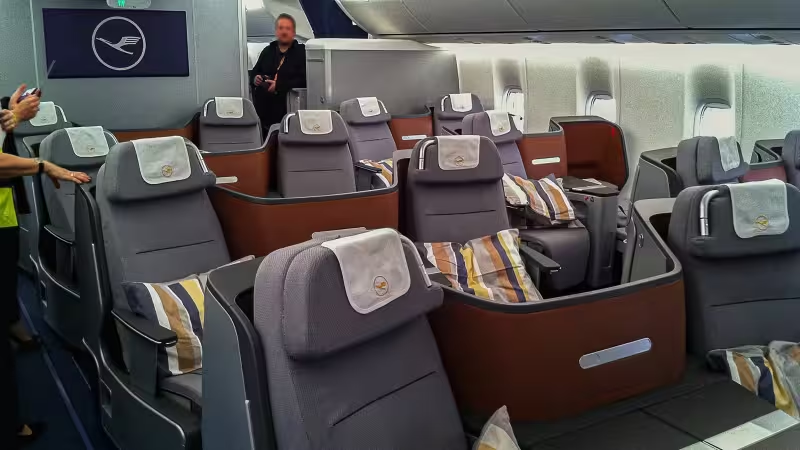
The Boeing 747 airplane is effectively retiring from passenger service after more than half a century: the first 747 entered service in 1970, Boeing built 1,574 of them, and the manufacturer stopped production in 2023.
The decline is not theoretical. Two 747s still serve as Air Force One, but in commercial fleets the type has been pared back to a handful of operators. Lufthansa is today the largest passenger operator, with 26 747s in service — eight 747-400s and 18 747-8s — and it plans to replace the older 747-400s with the Boeing 777-9. Lufthansa will shrink its 747-8 fleet to 17 after two aircraft are sold to the United States Air Force. Air China currently flies nine 747s; two of its 747-8s are used as presidential transports, and the airline deploys five 747-8s and seven 747s overall for commercial services.

Where the remaining passenger 747s still fly matters because it shows the plane’s narrowed role. Air China limits 747-8 international service to Beijing–Frankfurt, Beijing–New York-JFK and Beijing–Washington-Dulles. Lufthansa’s summer 2026 schedule continues to list 747-400 service to Toronto, Vancouver, Bengaluru, Singapore, Boston and Houston, and 747-8 flights to Buenos Aires, São Paulo, Tokyo-Haneda, Mexico City, Johannesburg, Chicago-O’Hare, Los Angeles, Newark and San Francisco.
The 747 now survives in passenger service as a premium, niche product. The 747-8 carries a first-class cabin that Lufthansa sells for one-way fares ranging roughly from $8,000 to over $16,000; Air China’s first-class fares on long-haul 747-8 routes run from about $14,000 to nearly $20,000. Those prices underline that airlines keep the type where a combination of capacity, brand cachet and premium cabins still make business sense.
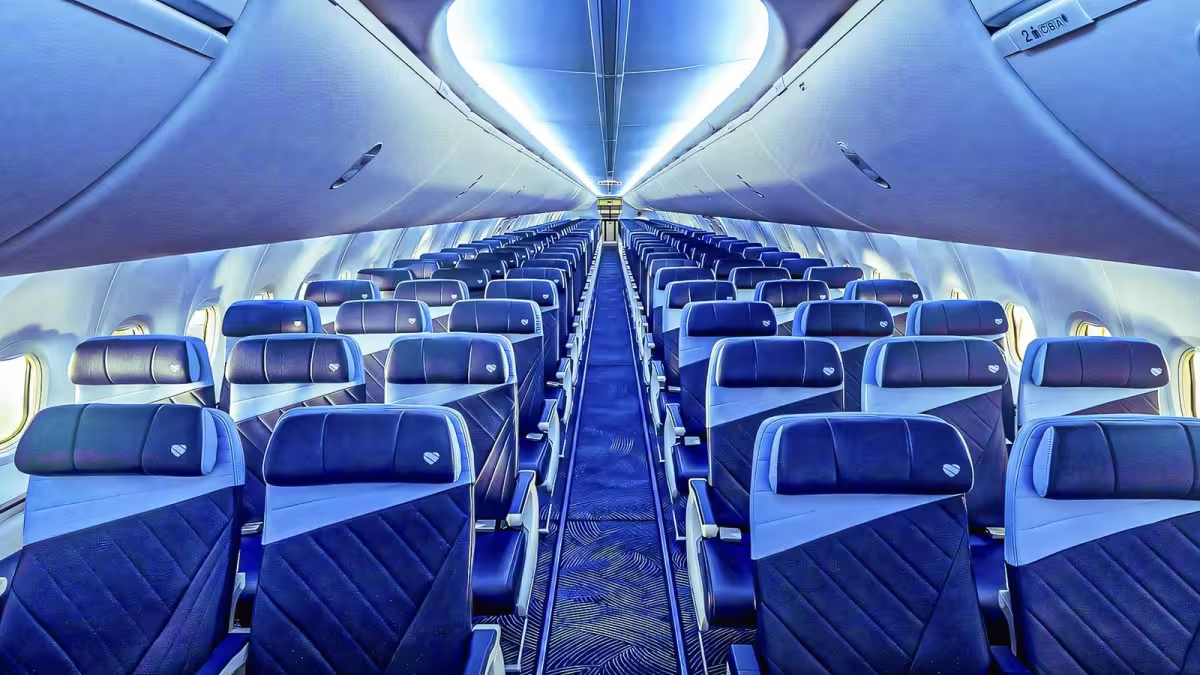

The mechanics behind the retreat are straightforward: twin-engine long-haul jets have cut fuel burn and operating costs enough that airlines prefer smaller, more efficient types for most international routes. Yet the story has an awkward counterpoint — cargo operators still prize the 747 because no direct, same-capacity replacement is in service. That mismatch is the core friction: obsolete as a passenger workhorse, the airplane remains uniquely useful for heavy cargo missions.
The contrast plays out on the ground as plainly as it does on schedules. Pinal Airpark in Marana, Arizona, is where airplanes go to die or wait for a new life. There a white 747 sits with its wings sheared off and passenger doors open to dust and wind — a visible symbol of the type’s commercial retreat. Jim Petty, who spends time at the airpark watching the older jets, said he expects that someday there will be only one passenger 747 left.
Practically, the passenger inventory will continue to shrink. Lufthansa’s announced replacements and sales already reduce the global pool; Air China’s mix of presidential and commercial 747s keeps a modest international presence. Meanwhile, freight demand and the absence of a like-for-like freighter successor mean many 747s will live longer in cargo service than they did in airlines’ passenger cabins.
The most consequential unanswered question is simple and immediate: after scheduled retirements, sales and government conversions complete, how many passenger-configured 747s will still be flying? The answer will determine whether the 747’s exit is a quiet fading — a handful of ceremonial or premium routes preserved — or an abrupt end marked by a single surviving passenger airplane. That count will also decide which carrier, if any, gets credit for keeping the final commercial 747 aloft.



