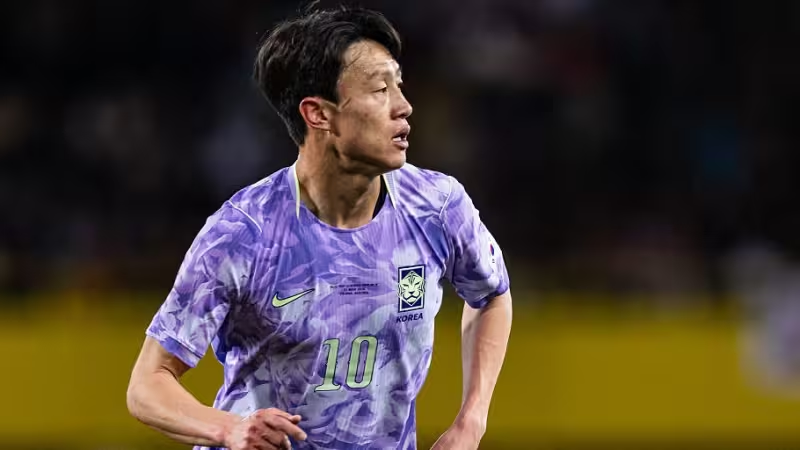
Lee Jae-sung finished the 2025/26 season the hard way — appearing in every Bundesliga match he was available for — and he arrives at the 2026 World Cup on the back of a second half of the club campaign that turned heads across Germany and beyond.
The numbers explain the attention. The 33-year-old ended the year with six goals and four assists for Mainz, logged 1,943 intensive runs and added moments of real polish — a headed goal in a 2-2 draw at Bayern Munich in the first game after Urs Fischer took charge, and a last-minute winner against Fiorentina in a November Conference League tie. Internationally he brings durability and experience: 105 caps and 15 goals for South Korea, five of those strikes coming in World Cup qualifying.

Those outputs are precisely why South Korea coach Myung-bo Hong has been explicit about experimenting with Lee higher up the middle. Hong has said he wants to try the Mainz midfielder alongside Hwang In-beom in central midfield, describing Lee as a very gifted player — a clear signal that Lee is being considered for a role that could reshuffle South Korea’s engine room in Canada, Mexico and the United States.
Mainz’s season under Urs Fischer helps explain how Lee arrived here. Fischer took over last December and the club finished 10th in the Bundesliga while reaching the last eight of the UEFA Conference League — the first European quarter-final in Mainz’s history. Lee’s contributions included the goal at Bayern in Fischer’s first game and that dramatic Conference League winner in November, evidence that he was central to Mainz’s uplift rather than a background figure.
Lee’s international résumé adds weight to the discussion. He made his South Korea debut on 27 March 2015, played every minute of his country’s group campaign at the 2018 World Cup and helped the team reach the round of 16 in 2022. That combination of tournament experience and recent club form makes him one of the few South Korean midfielders whose domestic season can be read directly as preparation for an expanded role at the Finals.
Still, there is a complicating voice in the room. Fischer has stressed that Lee can physically sustain heavy workloads — he can play three times a week without obvious issues — but he also warned the player sometimes needs protecting from himself. That comment underlines the balancing act: Lee’s capacity to cover ground and press relentlessly is an asset, but it requires management if he is to last through a compressed World Cup schedule while delivering the tactical intelligence Hong would need from a true central pairing with Hwang.
For South Korea the practical decision is imminent. Lee’s club season established him as a durable, productive option; his international record makes him a natural candidate for a starting berth. What remains unresolved is whether Hong will slot him into a bona fide central midfield partnership with Hwang In-beom or keep him in a more advanced, roaming role where his forward runs and late goals have often mattered most.
The next public answer comes in June when squads finalise and South Korea’s preparation matches give shape to Hong’s plan. Until then, Lee’s 2025/26 form and his ability to sustain heavy minutes present both an invitation and a responsibility: he has forced the question — now South Korea must decide how to deploy the player who has done more than show up, he has reshaped the problem Hong needs to solve for the 2026 World Cup.