



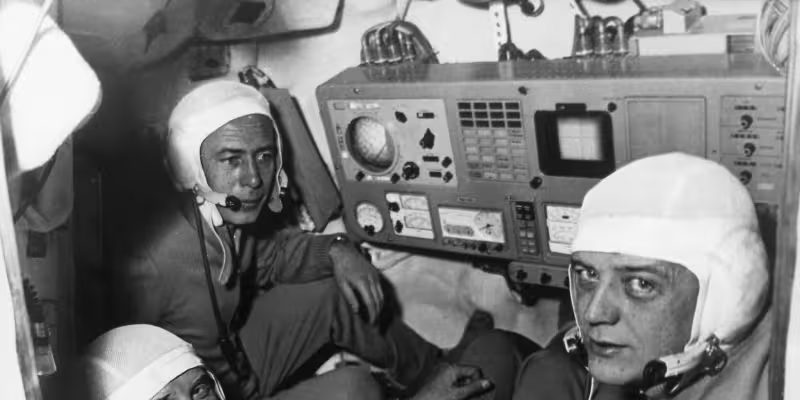
In 1971 the Soyuz 11 mission completed a successful docking with Salyut 1, the world’s first space station, yet ended in tragedy when all three crew members died after the mission returned to Earth.
Salyut 1 had been launched on April 19, 1971, and Soyuz 11 followed the next step: a crewed occupation of the new station. The spacecraft reached and docked with Salyut 1, and the three men aboard — Georgi Dobrovolsky, Vladislav Volkov and Viktor Patsayev — carried out the mission that would have been a major Soviet milestone. Dobrovolsky, Volkov and Patsayev instead became the first, and to date only, men to die in space. Volkov’s casual last remark, later quoted as "We’ll meet tomorrow, get the cognac ready," now reads like an awful private line before national mourning.

The immediate weight of Soyuz 11 came from those contrasts: a successful visit to the world’s first space station and the sudden, fatal end that followed. The flight came after Soyuz 10 had reached Salyut 1 but been unable to board because of a mechanical issue; Soyuz 11 managed to enter and occupy the station. The loss of three veteran cosmonauts stunned the Soviet program and the wider space community and left an unmistakable human and political imprint.
Placed against Cold War competition, the Soyuz 11 tragedy became part of a larger shift in how the two superpowers approached space. The deaths were one factor that softened the rhetoric of the Space Race and helped propel a move toward cooperation that culminated in the Apollo‑Soyuz Test Project in July 1975 — the first international crewed flight linking U.S. and Soviet spacecraft and what observers have called the real end of the Space Race.
There is an additional twist that underlines how narrowly the mission’s human cast changed: Valeri Kubasov had been scheduled to fly on Soyuz 11 with Alexei Leonov and Pyotr Kolodin, but a pre‑mission medical exam detected a swelling in Kubasov’s lung that doctors suspected might be tuberculosis. The original trio was pulled and replaced by their backups — Dobrovolsky, Volkov and Patsayev — who then flew the mission. That personnel swap is a stark reminder of how small medical and administrative decisions can redirect history.
Readers often ask what happened to the crew after landing. The verified record is blunt: the mission ended with the deaths of all three men following their return. Beyond that conclusion, the primary contemporary facts provided here do not supply a complete technical account of what failed or when during the reentry and recovery sequence the fatal event occurred; the specific mechanism behind the tragedy is not laid out in the material used for this account.
The human toll and the unanswered technical questions together forced changes in Soviet procedures and in public attitudes inside and outside the USSR. Investigations and program adjustments in the years after Soyuz 11 contributed to an emphasis on safety that informed later missions and collaboration. The Apollo‑Soyuz Test Project in July 1975 became the next major milestone in crewed flight between the two blocs, a diplomatic and operational step that would have been hard to imagine in the immediate aftermath without the shock of 1971.
The single most consequential unanswered question left by the record used here is straightforward and unforgiving: what exact failure killed Dobrovolsky, Volkov and Patsayev after a mission that had met its objectives? That gap — the missing technical explanation of how success turned to catastrophe — is the piece of the story that matters now, because the human and diplomatic consequences flowed directly from an event whose internal mechanics remain the mission’s most significant unresolved fact.



