



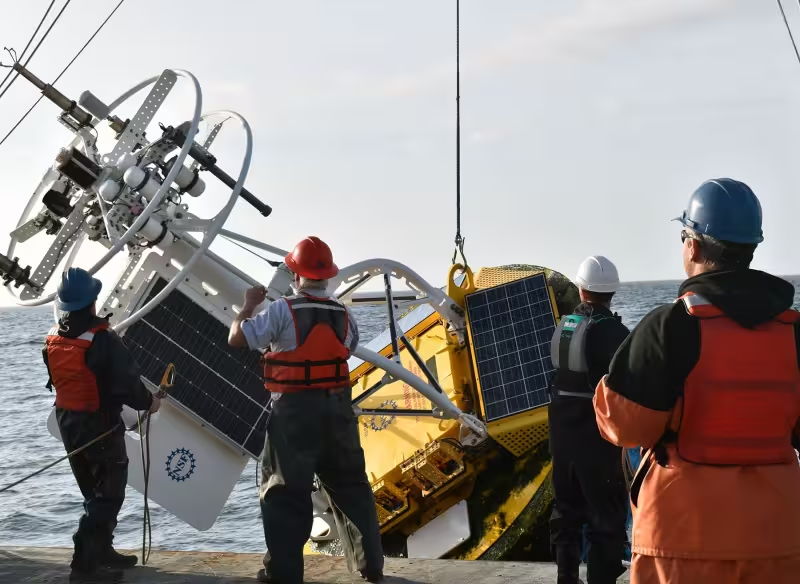
The U.S. National Science Foundation has told its partner Woods Hole Oceanographic Institution that it will remove hundreds of ocean monitoring instruments from four Ocean Observatories Initiative sites in the Atlantic and Pacific, beginning with the Endurance Array off Oregon and Washington, whose descoping has already started and is expected to be completed this month.
The network affected is the $386 million Ocean Observatories Initiative, completed in 2016 with an anticipated 25‑year life span and built to provide sustained measurements used to track climate variability, biogeochemical cycles, marine food webs, coastal ecosystems and features such as the Atlantic Meridional Overturning Circulation.

Woods Hole has been a major partner since OOI’s inception, designing, constructing, deploying and maintaining the instrument arrays that feed the OOI Data Center. The instruments slated for removal are described in agency communications as numbering in the hundreds and spread across four sites in the Atlantic and Pacific basins, though NSF has not published an inventory.
In a May 8, 2026 communication to Woods Hole, NSF said it planned to “adjust the scope of its support for select elements of the Ocean Observatories Initiative.” The agency also stated plainly: “NSF is not cancelling the Ocean Observatories Initiative,” and added that “All previously collected OOI data will remain accessible through the OOI Data Center.” The agency framed the change as aligning with a wider strategy to prioritize evolving scientific priorities and emerging technologies.

The decision follows precedent within the same program. Two arrays were discontinued during the previous decade: the Global Argentine Basin Array in the South Atlantic was ended in 2018 after three years of data collection, and the Global Southern Ocean Array was removed in 2020 after five years of use. Those earlier shutdowns demonstrate that the program’s footprint has already contracted once before.
The immediate practical consequence will fall on researchers who rely on continuous OOI streams for long‑term records — studies of ocean climate variability, biogeochemical cycles, marine food webs, fisheries and circulation features such as the AMOC. While NSF assures users that historical data will remain accessible, the agency has not detailed which sensors, platforms or measurement capabilities will be taken offline, or how gaps in time‑series and spatial coverage will be mitigated.
Jim Edson, who has been tracking the network’s changes, said the “descoping process” of the Endurance Array off the coast of Oregon and Washington has already begun and is expected to be completed this month. The other three sites affected by NSF’s decision are scheduled for decommissioning in 2027.
The largest unresolved question is operational and scientific: which specific instruments and capabilities will be lost when the four sites are descaled and decommissioned. That inventory — and an assessment of how its loss will affect ongoing time‑series and experiments — has not been released, leaving labs and funding agencies uncertain how to adapt experiments, ship time and complementary observing systems.
NSF’s stated preservation of previously collected data narrows one worry but does not answer another: stopping active measurements changes what can be learned going forward. With Endurance coming offline this month and the remaining sites slated for 2027, the community faces a compressed timeline to document what will remain, reassign monitoring responsibilities, and decide whether to build replacement capacity elsewhere.



