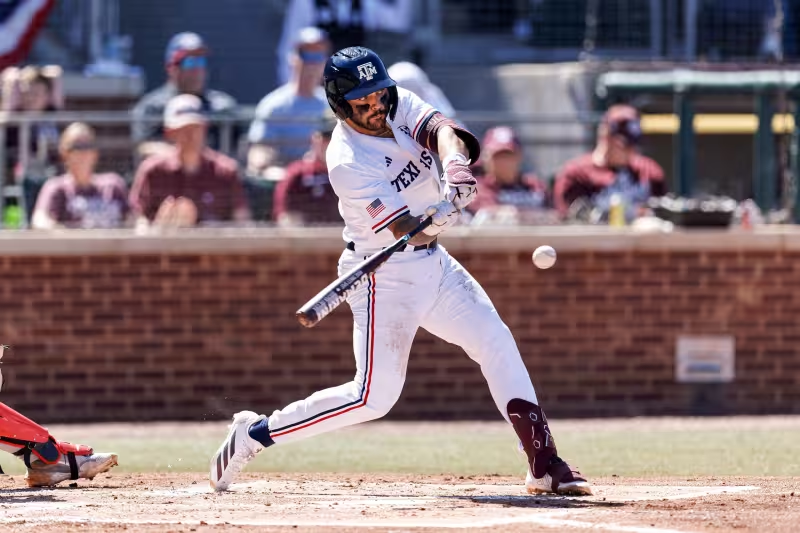
The 2026 NCAA baseball tournament begins Friday, May 29, and Texas A&M opens the College Station Regional at Blue Bell Park hosting Lamar, Texas State and USC — a start that places the Aggies’ offense squarely under the spotlight as the driver of their postseason hope.
People are searching Texas A&M baseball this week because the team enters the tournament with one of the country’s most dangerous lineups: the Aggies sit sixth nationally in runs per game, home runs and wOBA, numbers that vault them into the conversation as a genuine College World Series contender if the bats keep producing.

That production is not hypothetical. Chris Hacopian, Caden Sorrell and Gavin Grahovac headline a group that consistently forces opponents to pitch around the middle of the order; Bear Harrison, Nico Partida and Jorian Wilson add above-average power that turns marginal counts into run-producing innings. Texas State, which the Aggies will see again in College Station, finished the season with 111 home runs — seventh most nationally — and brings its own punch. USC arrives with top-end arms and experience, making the regional less an easy draw than a gauntlet stacked against a team that wins with offense.
USC’s pitching profile underlines that point. The Trojans ranked fifth nationally in ERA and fourth in WHIP, and they’ll trot out starters and relievers with bona fide swing-and-miss stuff — Mason Edwards is viewed as frontline, and Grant Govel and Adam Troy provide high-end starter and relief support. Texas State counters with Wade Cooper’s swing-and-miss quality and Cade Smith’s knack for pounding the strike zone, so Texas A&M’s offense will not face a weekend of soft tossers.
That’s where the paradox arrives. Texas A&M ranks in the top 10 in Stuff+, an analytical measure of pitch quality, yet the staff’s run-prevention numbers sit well below elite: outside the top 75 nationally in ERA and outside the top 140 in FIP. In short, the raw stuff is there, but the results have not consistently followed. That split — eye-popping offense versus surprisingly pedestrian pitching metrics — is the clearest hinge on which the Aggies’ postseason fate turns.
Michael Earley has framed the club’s approach around that uncertainty. After the selection show he said the program is treating the regional like a fresh start, arguing that both his team and their opponents are different now than when they met earlier in the year. That line of thinking matters because Texas A&M already played Lamar and Texas State this season; familiarity is real, but so is the idea that past scores do not settle the question heading into a two-week sprint where pitching depth becomes decisive.
The consequence is immediate: Texas A&M’s offense gives the Aggies a path to Omaha that few programs can match on raw run creation, but the pitching staff will be tested every time the lineup’s high variance meets the steady work of good college arms. Regionals are a short series of high-leverage innings, and converting Stuff+ into suppressed runs — strand runners, limit damage, navigate short rest — is a different skill than piling up strikeouts in the regular season.
What comes next is simple and stark. Texas A&M hosts the first games at Blue Bell Park on May 29, and the most consequential question for fans and pundits is no longer whether the bats will show up; it is whether the rotation and bullpen can turn underlying pitch quality into the run prevention a deep postseason run requires. If they do, the Aggies’ lineup gives them a realistic shot at Omaha; if they don’t, even the country’s most dangerous offense may have a very short stay in College Station.