



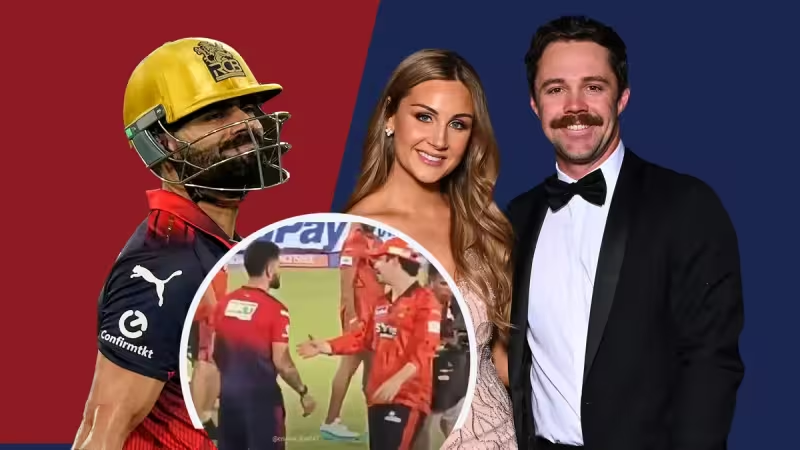
Virat Kohli walked past Travis Head’s outstretched hand at the end of an Indian Premier League match and did not shake it, an ending that immediately reverberated through the cricket world.
The picture was simple: one player with a hand out, the other moving on. The article says Kohli walked past another player who had his hand outstretched at the end of a match, and that refusal to shake hands sent a message to tens of millions of fans and young aspiring cricketers watching around the world.

Numbers and words landed with weight. Kohli himself has said, "I can confidently say 99 per cent of cricketers and sportspeople shake hands at the end of a game." He added, "That’s the key word too - game." Those two lines matter here because they frame what a handshake is supposed to be: a tiny ritual that marks the conclusion of competition, not the continuation of it.
The article says Kohli had the opportunity to squash the situation immediately with one simple gesture. That missed opportunity is what made the moment larger than the handshake itself. A refusal at the edge of a pavilion becomes more than a private decision when cameras and social feeds amplify it; the article says the ending added more fuel to the fire, turning a small on-field exchange into a headline and a talking point for hours.
Context matters and comes after the fact: the expectation that athletes shake hands after matches is a settled norm in sport. The piece says Kohli is one of the biggest names in cricket and one of the most recognisable athletes in the cricket world; when a player of his stature moves without the conventional courtesy, it lands differently than if a lesser-known figure did the same. The instant visibility means the gesture — or the lack of it — teaches as much as a speech ever could.
That visibility creates friction. The piece says moments like that can validate the worst and most despicable behaviour from supporters, and the ending here exposed that risk. Kohli’s refusal did not sit in isolation: the article refers to Kohli’s frosty handshake with Tim Paine in Perth in 2018, a prior instance that reminds observers this was not an entirely new pattern. Taken together, the two episodes sharpen the question of what elite players owe the game’s broader culture at the final whistle.
There is a direct tension between individual feeling and the public consequences of symbolic acts. The article says the incident sent a message to tens of millions of fans and young aspiring cricketers watching around the world, and that makes the moment consequential beyond the field: gestures get taught, repeated and, in some corners, celebrated. The article says moments like that can validate the worst and most despicable behaviour from supporters — a blunt line that explains why a single refused handshake matters.
In conclusion: Kohli, by passing without the customary clasp, did more than decline an exchange — he declined a chance to defuse a flashpoint. The facts in this account point to a simple verdict supported by the reporting here: when the most recognisable figures in sport skip small courtesies, the consequence is predictable and immediate — fuel for division, not a cooling of tempers. The handshake would have been a single, private gesture that calmed a public moment; walking past ensured the moment kept burning.



