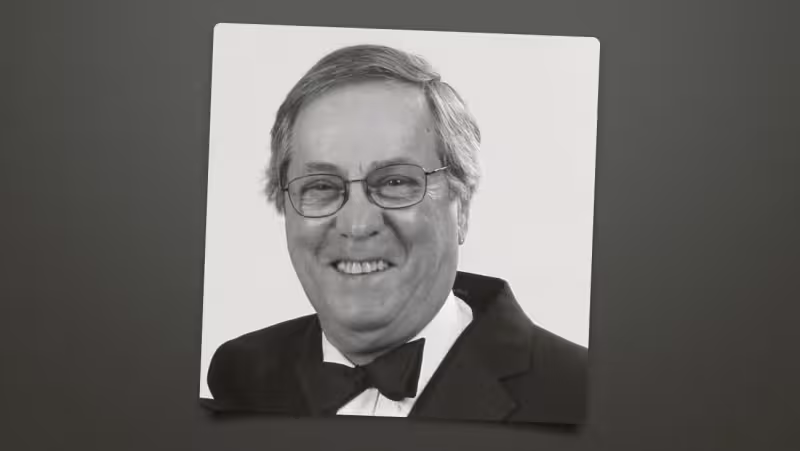
Howard Storm, a television director whose credits ranged from Mork & Mindy to Full House, died Tuesday at age 94 at his home in Beverly Hills of natural causes.
Storm was best known to many viewers for his work on Full House; he directed three episodes of that series. But the numbers behind his name show a career far broader than a single sitcom credit: he directed 59 episodes of Mork & Mindy, including the one-hour pilot, eight episodes of Laverne & Shirley, six episodes of Rhoda and three episodes each of Angie and Everybody Loves Raymond. He also directed two episodes of Taxi and made the leap to features with the 1985 film Once Bitten.

Storm’s television résumé began on stage. He started as a stand-up comedian, toured as the opening act for Andy Williams and appeared on The Merv Griffin Show over a dozen times. His move behind the camera followed a period working with Woody Allen — he was an assistant on Bananas and Take the Money and Run in the 1970s — and he made his official directorial debut on a 1975 episode of Rhoda.
Those facts underline why Storm’s death matters today: he helped shape the rhythms and looks of sitcoms that remain in syndication and streaming, and his work stretched from the era of Desilu into the multi-camera sitcoms of the 1980s and 1990s. In 1959 he signed a contract with the Desilu Workshop, an early stepping stone for television directors. From the one-hour pilot of Mork & Mindy to his episodes on Full House and Everybody Loves Raymond, Storm’s fingerprints sit on shows familiar to several generations of viewers.
Storm spoke often about a life set on show business. "I knew from the age of two that I wanted to be in show business," he once said. He traced a path from a New York childhood to national television, and he carried a comic’s bluntness—"Lucy didn’t like me," he said, a remark that captures the mixture of affection and rivalry he remembered from working in television’s old studio system.
There is an awkward fact in his obituary: he is often described as best known for Full House, yet he directed only three episodes of that series. That shorthand captures how modern audiences remember a few prominent credits while overlooking the bulk of his work. The contrast is striking: three episodes on one late network sitcom versus 59 episodes on another show where he helped set the tone from the pilot onward.
Storm’s career also followed a clear arc through television’s changing production lines. A native New Yorker born Howard Sobel on the kitchen floor of an apartment on the Lower East Side, he came up in vaudeville-inflected circles and then found a place in television during the Desilu years. He developed a long association with writer-producer Garry Marshall and worked across formats, from multi-camera sitcoms to feature film direction.
Howard Storm’s death closes a chapter on a director who moved fluidly between stand-up rooms, variety shows and sitcom soundstages. While many viewers will recall the handful of Full House episodes bearing his credit, his more consequential achievement — and the one that will matter to television historians — is the body of work that includes 59 Mork & Mindy episodes and the pilot that launched it.
In the end, the simplest judgment fits the facts: though Storm may be remembered today by some for Full House, his enduring legacy is the steady, shaping presence he provided across decades of American television.