
























Scientists Warn of Imminent Gulf Stream Shift, Ocean Current Collapse

Researchers report new evidence that links weakening deep-ocean circulation to a measurable shift in the Gulf Stream. The findings rely on high-resolution ocean modeling and satellite observations.
AMOC and the Gulf Stream explained
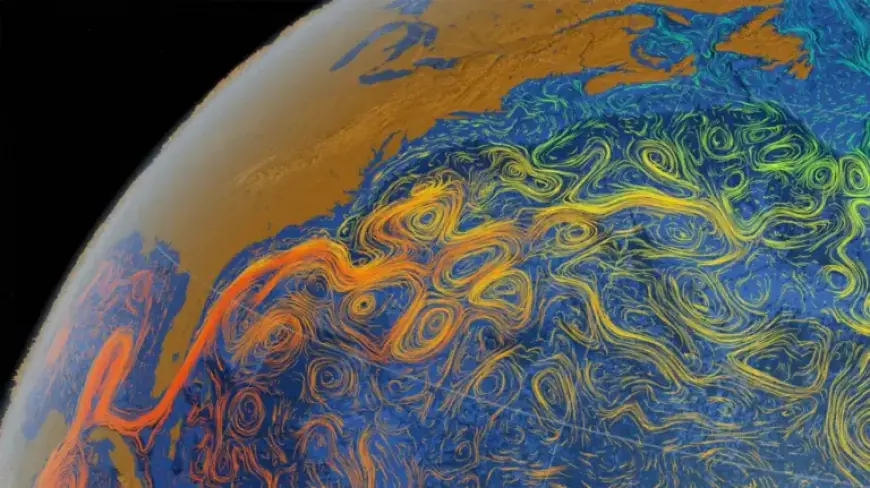
The Atlantic Meridional Overturning Circulation, or AMOC, moves warm surface water north. Cold, dense water sinks and returns south along the ocean floor.
The Gulf Stream is the fast surface limb of that system. It flows from the Gulf of Mexico up the U.S. East Coast before turning east near North Carolina.
New modeling study and observations
Utrecht University scientists René van Westen and Henk Dijkstra led the research. Their work appears in Nature Communications Earth & Environment.
The team used an ocean model with roughly 10-kilometer resolution. That is finer than the more common 100-kilometer grids. The higher detail better captures the Gulf Stream’s structure and bulge.
Simulations predict that a weakening AMOC should pull the Gulf Stream northward. Satellite data indicate the current has shifted north by about 50 kilometers over the past 30 years.
Mechanism behind the shift
The study points to the Deep Western Boundary Current as a key driver. This cold, salty, southward flow runs along the seafloor off North America.
Under stronger conditions, that deep current tugs the Gulf Stream southward. If it weakens, the surface current can migrate northward.
Abrupt jump and possible collapse
In long simulations, the Gulf Stream slowly drifted north for centuries. Then it abruptly jumped more than 200 kilometers north in just two years.
About 25 years after that jump, the modeled AMOC collapsed. The authors stress this is an idealized scenario, not a prediction with a set timeline.
Evidence and uncertainties
Continuous direct measurements of AMOC date back only to 2004. That record is short for detecting long-term trends with confidence.
Historical reconstructions suggest AMOC may have weakened roughly 15 percent since 1950. Those reconstructions differ from direct instrument data.
Consequences and preparedness
Previous studies show AMOC failure could cool parts of Europe, even amid global warming. Some models indicate extreme winter cold episodes could occur.
Such shifts would affect agriculture, infrastructure, and energy demand. A sudden Gulf Stream jump could signal a late-stage warning.
The study notes that such a late warning might not stop a collapse. It could, however, allow time for adaptation and preparedness measures.
Watching the surface as a proxy
Because AMOC is hard to measure directly, the Gulf Stream path offers a practical proxy. Satellites can track that path continuously.
Researchers argue that a rapid, unusual northward shift could act as an early alarm. Filmogaz.com will follow further developments and related research.
Headlines such as “Scientists Warn of Imminent Gulf Stream Shift” and “Ocean Current Collapse” capture the growing scientific concern. Continued monitoring remains essential.