























Samsung’s Unpacked push shifts who benefits first — privacy-minded buyers and power users get the biggest changes

The immediate impact falls on buyers who prioritize privacy and on users who want stronger on-device AI: samsung’s Galaxy S26 lineup focuses on software-driven upgrades and a display-level privacy feature meant to change how people use phones in public. Preorders are open now and the new models, plus fresh earbuds, head into official sales on March 11, so early adopters and business users will feel the effects first.
Samsung’s audience-first pivot: who will notice the change fastest
Privacy-conscious commuters, mobile professionals handling sensitive apps, and anyone who streams or shoots moving subjects are among the groups that stand to notice differences immediately. The phones are being marketed around optimization and AI enhancements that purportedly boost on-device processing, and the Ultra’s Privacy Display is targeted at preventing side glances in public settings.
Product lineup, availability and the quick timeline
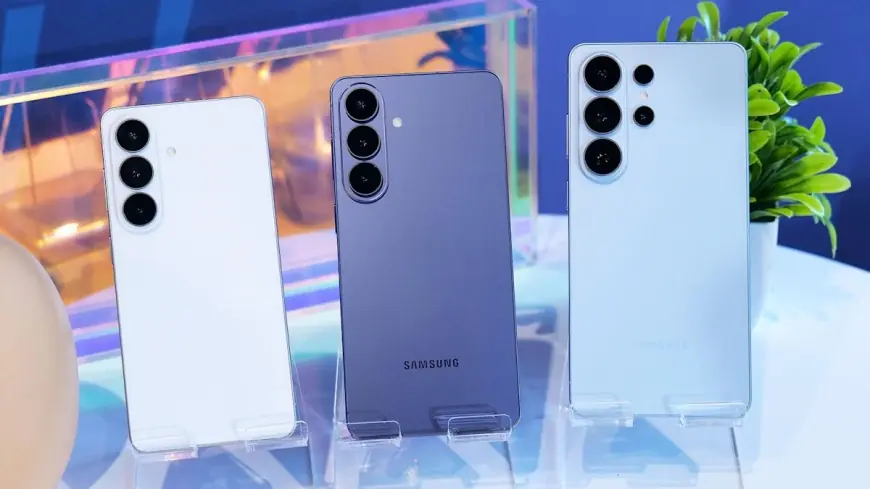
The company ran Galaxy Unpacked on Wednesday at San Francisco’s Palace of Fine Arts and revealed three handsets: the Galaxy S26, the S26+ and the Galaxy S26 Ultra. Hands-on time was collected with all three models. Pre-orders opened the same day; official sales begin on March 11.
- Pre-orders: open now.
- Official on-sale date: March 11.
- Event: Galaxy Unpacked took place at the Palace of Fine Arts in San Francisco.
Design, core specs and platform choices
The three phones share a more cohesive look, with corners rounded to align the smaller models with the Ultra. The base Galaxy S26 has a 6. 3-inch display (slightly larger than the S25), the S26+ retains a 6. 7-inch screen with a higher resolution than the S26, and the S26 Ultra uses a 6. 9-inch AMOLED panel with a QHD+ resolution of 3120 x 1440 and a 120Hz refresh rate.
Battery and chipset notes: the S26’s battery capacity is listed at 4, 300mAh. In North America, China and Japan, Samsung is sticking with Qualcomm chips rather than the Exynos 2600; S26 and S26+ units sold in those markets will run on the Snapdragon 8 Elite Gen 5 chipset.
The camera modules are carried over from last year, but image-processing changes are prominent: a ProScaler image upscaling engine and an MDNIe chip intended to improve color precision. Video stabilization that keeps the horizon level while following a moving person or pet is part of the update, and an Object Aware Engine is designed to better render skin tones and hair textures for selfies. Now Brief and Auto Eraser have been reworked to be compatible with more apps.
Pricing, colorways and the market signal
Price changes are notable: the Galaxy S26 and S26+ each carry a $100 increase over their predecessors and start at $900 and $1, 100 for 256GB variants. The S26 Ultra starts at $1, 300, the same as the prior Ultra model. Commentary in coverage links the price uptick to RAM pressures—one item mentions a RAM shortage and another references a likely RAM bump as a contributing factor.
Color options for all phones include purple, blue, black, white, silver and rose gold; silver and rose gold will be sold exclusively online. The S26 Ultra is offered in the same colorways and on the same date as the smaller phones.
Privacy Display: a hardware-driven take on stopping side glances
The S26 Ultra’s headline hardware change is a Privacy Display that is described as the first of its kind on a smartphone. The panel uses two pixel types: one that emits light directly to the viewer and another, wider pixel that normally allows light to reach off-axis viewers. When the Privacy Display is enabled, the wider pixels are turned off, severely limiting what people around you can see—not just on the left and right but also on the top and bottom of the screen. There is a small reduction in overall brightness when the feature is active, and multiple customization options are available.
Here’s the part that matters: the feature can be toggled from Quick Settings, enabled for incoming notifications or on a per-app basis, and set to activate for apps that require a PIN or passcode (banking apps are given as an example). It will also integrate with routines so the display can switch on automatically geolocation. An illustrative example in the provided context starts but is unclear in the provided context.
It’s easy to overlook, but the Ultra also moved from titanium to aluminum, which is said to make the phone 4 grams lighter and allow color to carry more consistently from the back to the edge.
Audio additions and small extras
Alongside the phones, new earbuds were announced: Galaxy Buds4 and Buds4 Pro. Price points given are $179 for the Buds4 and $249 for the Buds4 Pro, with both arriving on March 11.
Q: Should I preorder? If you prioritize the Ultra’s privacy tooling or the specific AI/processing tweaks, the preorders are open now.
Q: Are these big visual redesigns? No—the three models share a similar visual language this year, with the Ultra less visually distinct than before.
Q: Will public commuters notice the privacy feature? Likely yes, especially in tight seating or on planes—coverage notes the benefits for sensitive documents and private messages.
The bigger signal here is that the release prioritizes practical, software-driven gains and a display-led privacy play rather than radical new camera or industrial-design departures; that will shape who upgrades this cycle and how these features land in everyday use.