























Gold Price Today — February 26, 2026: Gold Futures Hit $5,163 as JP Morgan Targets $6,300 All-Time High

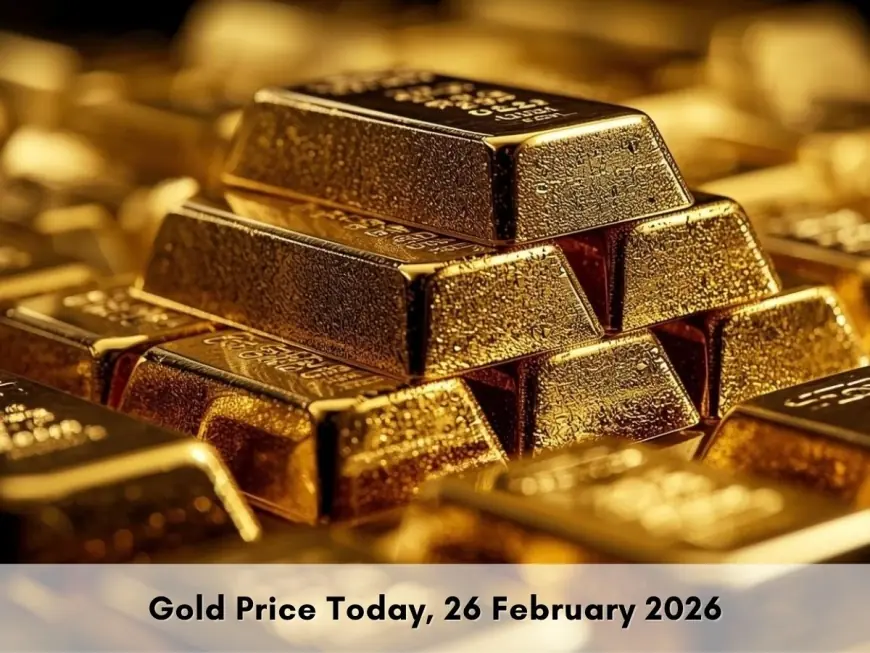
Gold is on fire in 2026 — and it is not cooling down. Gold futures opened today at $5,163.60 per troy ounce, with technical indicators and moving averages issuing a Strong Buy signal across daily charts. The gold price today continues a breathtaking run that has seen the precious metal surge more than $2,200 per ounce year-over-year — and the most powerful bank on Wall Street just told the world it has not peaked yet. JP Morgan sees demand from central banks and investors this year ultimately pushing gold prices to $6,300 an ounce — a target that would make 2026 the most extraordinary year for gold in recorded history.
Gold Price Today: Live Snapshot — February 26, 2026
Gold futures opened today at $5,163.60 per troy ounce. The next settlement date for gold futures is April 28, 2026. The tick size for gold futures is 0.1, with a tick value of $10 USD. Each futures contract point is worth $100 USD.
| Metric | Price / Data |
|---|---|
| Gold futures open today | $5,163.60 per troy ounce |
| Gold spot price (Feb 23) | $5,150.00 per troy ounce |
| Gold spot price (Feb 24) | $5,121.00 per troy ounce |
| Gold spot price (Feb 20) | $5,040.00 per troy ounce |
| Gold price one year ago | ~$2,953 per troy ounce |
| Year-over-year gain | +$2,197 per ounce (+74%) |
| JP Morgan 2026 price target | $6,300 per troy ounce |
| JP Morgan long-term forecast | $4,500 per ounce (revised up 15%) |
| Technical daily signal | Strong Buy |
| Next futures settlement date | April 28, 2026 |
JP Morgan Raises Gold Target to $6,300: The Bull Case Explained
The most market-moving gold news of the week came Wednesday, February 25. JP Morgan raised its long-term forecast for gold prices to $4,500 an ounce — a 15% upward revision — while keeping its 2026 year-end target at $6,300 per ounce, citing demand from central banks and investors as the primary driver. A $6,300 per ounce gold price by December 2026 would represent an additional 22% gain from today's futures level — staggering for an asset already up 74% year-over-year.
Gold is trading at $5,150.56 as of February 25, 2026. On February 26, 2026, gold is expected to continue to rise. Key support levels are $5,153.72, $5,107.72, and $5,052.87. Key resistance levels are $5,320.89 and beyond. Technical indicators including MACD, RSI at 62, and VWAP all point to continued bullish strength.
What Is Driving Gold Futures to Record Highs in 2026
Multiple major forces are converging to drive the gold price today and the gold futures outlook simultaneously:
Gold is supported by expectations of a more accommodative Federal Reserve. Markets have priced in a higher probability of three Fed rate cuts this year, up from two just a week ago. Soft US data — including December retail sales falling short of forecasts, the GDP control group slipping 0.1%, job openings falling to their lowest level since 2020, and private payroll growth undershooting forecasts — are collectively signaling cooling demand and easing inflation pressure.
Central bank demand remains a key structural support, with China's People's Bank extending gold purchases for a fifteenth consecutive month in January. Geopolitical risks continue to underpin safe-haven demand, as tensions between the US and Iran persist despite tentative diplomatic progress, keeping downside risks contained.
The key gold price drivers right now in one view:
| Driver | Impact on Gold |
|---|---|
| Federal Reserve rate cut expectations | Bullish — 3 cuts now priced in for 2026 |
| China central bank buying (15th straight month) | Bullish — structural floor under prices |
| Trump Section 122 tariff uncertainty | Bullish — safe-haven demand surging |
| Supreme Court IEEPA tariff ruling | Bullish — dollar weakness, trade chaos |
| US-Iran geopolitical tensions | Bullish — risk-off sentiment |
| Mexico cartel crisis | Bullish — investor flight to safety |
| Weak US economic data | Bullish — reinforces Fed easing case |
| Strong dollar on select sessions | Bearish — limits upside on risk-on days |
Gold Price History: The 2024–2026 Run Has Been Extraordinary
Gold has historically underperformed the stock market. However, over the past two years, the tables have turned. In both 2024 and 2025, the precious metal gained 28% and 65% respectively. Over the same period, the S&P 500 gained 25% and 18% respectively. Gold has not just beaten equities over two consecutive years — it has lapped them. The gold price today above $5,150 per ounce represents an asset that has more than tripled in value since early 2023.
In 2025, global gold demand rose to 5,002 tonnes — a record. Key drivers included geopolitical instability and strong investor interest. Supported by record prices, the total value of gold demand surged by 45% to $555 billion, while investment volumes reached 2,175 tonnes. Demand for gold bars and coins climbed to 1,374 tonnes, while inflows into gold ETFs increased to 801 tonnes. Gold purchases by central banks totaled 863 tonnes in 2025 and are expected to ease slightly to 850 tonnes in 2026.
Gold Futures vs. Spot Gold: What Investors Need to Know
For anyone new to tracking the gold price today, the distinction between gold spot price and gold futures matters enormously. The gold spot price is the immediate over-the-counter rate for buying or selling gold right now. When the future price is higher than the spot price, it is called contango — common when investing in commodities with high storage costs. When the futures price is lower than the spot price, it is called backwardation. Gold futures today are trading in contango — meaning the market expects prices to be even higher at the April 28 settlement date than they are right now.
The standard gold futures contract on COMEX is 100 troy ounces. Gold is mostly traded on the OTC London market, the US COMEX futures market, and the Shanghai Gold Exchange. Half of the gold consumption in the world is in jewelry, 40% in investments, and 10% in industry. The biggest producers of gold are China, Australia, United States, South Africa, Russia, Peru, and Indonesia.
What Comes Next for Gold Price and Futures
Moderate volatility is expected this week amid the release of US initial jobless claims data, other macroeconomic indicators, and speeches by Federal Reserve officials. Experts expect gold to trade in the $4,914.81 to $5,719.00 range through the end of February 2026. Gold prices rose Wednesday, rebounding after the previous session's weakness, as investors assessed the impact of ongoing trade policy uncertainty following the Supreme Court IEEPA tariff ruling and the rollout of Trump's new Section 122 tariffs. With JP Morgan's $6,300 year-end target now on the table and three Federal Reserve rate cuts increasingly priced in, the gold price today sits at a level that would have seemed extraordinary just twelve months ago — and the world's most powerful financial institutions are betting the run is far from over.