






















Sean Duffy Rolls Out Measures to Rein in Fraud and Raise Trucking Standards

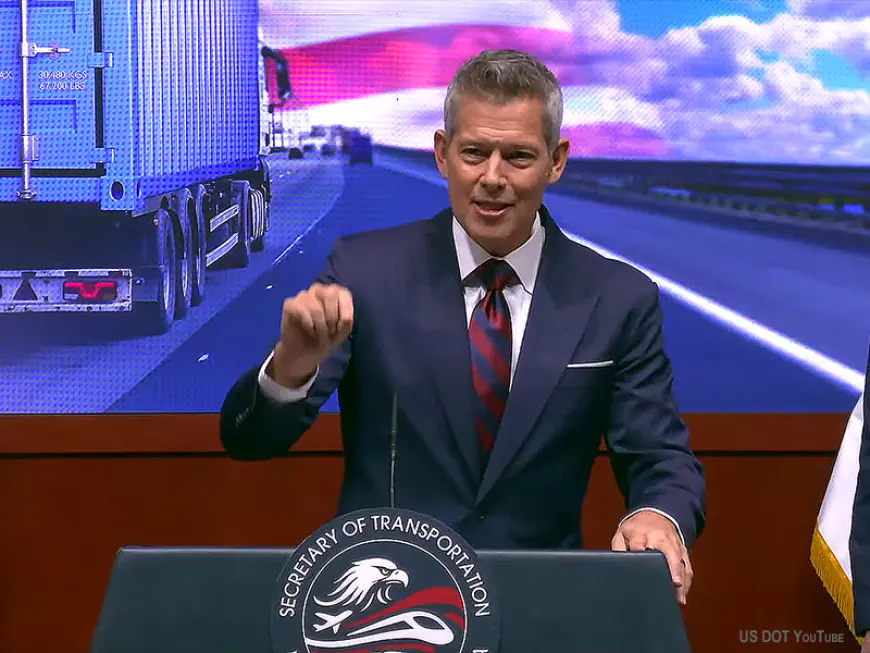
sean duffy joined Federal Motor Carrier Safety Administration Administrator Derek Barrs at a Feb. 20 news conference to unveil a set of measures aimed at removing unsafe drivers and fraudulent carriers from U. S. roads. The package pairs stricter testing and registration requirements with stepped-up enforcement actions meant to restore what officials described as the integrity of American trucking.
Development details — Sean Duffy and FMCSA actions
Federal officials presented a range of concrete steps. FMCSA plans to require all commercial driver’s license (CDL) tests to be administered in English and to move from placing drivers out of service for lack of English proficiency to seeking revocation of those drivers’ CDLs. The agency is upgrading a 40-year-old registration system to one that relies on biometrics to streamline processing and strengthen fraud prevention. Motor carriers will be required to maintain a physical location where records can be inspected within 48 hours, and Operation SafeDRIVE will be expanded into additional states to remove unsafe truckers from the road.
Officials also outlined enforcement tools: expanded sting operations to shut down CDL mills that certify unqualified drivers, an end to self-certification by CDL training schools, and intensified efforts to identify and close down “chameleon carriers” that operate under multiple Department of Transportation numbers. FMCSA said it will also increase vetting of electronic logging device (ELD) manufacturers after many manufacturers have been allowed to self-certify, a practice the agency linked to faulty devices reaching the market.
Context and escalation
Over the past year the administration concentrated on cleaning up the non-domiciled CDL system and issuing out-of-service orders to drivers who cannot speak and read English. Officials framed the new measures as responses to weakened standards that, in their view, opened the door to fraudulent carriers and unqualified schools. "When we get on the road, we should expect that we should be safe, " one official said at the event, adding that those who operate "80, 000-pound big rigs" must be well-trained and qualified.
The agency characterized the situation as a broad breakdown of guardrails that allowed fraud to spread through multiple parts of the industry. What makes this notable is the combination of administrative upgrades — a biometric registration overhaul of a system that has stood for four decades — with explicit enforcement tactics such as sting operations and the expansion of a multi-state removal program.
Immediate impact
The measures are aimed first at drivers, training schools and carriers identified as unsafe or fraudulent. FMCSA has already been placing drivers out of service for English-language deficiencies; the new approach elevates that action to potential CDL revocations. Training schools will lose the ability to self-certify, and ELD manufacturers will face more rigorous vetting. These steps are designed to curtail the certification paths that have allowed unqualified individuals and faulty devices into the system.
sean duffy and FMCSA leadership signaled that carriers operating without a verifiable physical address will face tighter scrutiny because records must be available for inspection within 48 hours. That 48-hour requirement is likely to pressure motor carriers to maintain local, inspectable operations rather than relying on transient or paper-only presences.
Forward outlook
Officials made clear that many of the actions outlined will proceed through formal rulemaking before becoming binding. In the short term FMCSA is moving forward with the registration system upgrade and plans to expand Operation SafeDRIVE to more states. The agency will begin using sting operations to target CDL mills and will change certification rules for training schools and ELD manufacturers.
Derek Barrs and agency leadership framed the package as part of a broader effort under the current administration to "restore law and order to our nation’s roads, " with a stated objective of removing every link that enables fraud and unqualified operators. The immediate milestones are the registration-system modernization, expanded enforcement rollouts, and initiation of rulemaking processes on language and certification standards, all of which were presented as the next steps in enforcing the new standards.
FMCSA has positioned these actions as a coordinated program of administrative, technological and enforcement changes designed to produce measurable reductions in fraud and unsafe operation on America’s highways.