
























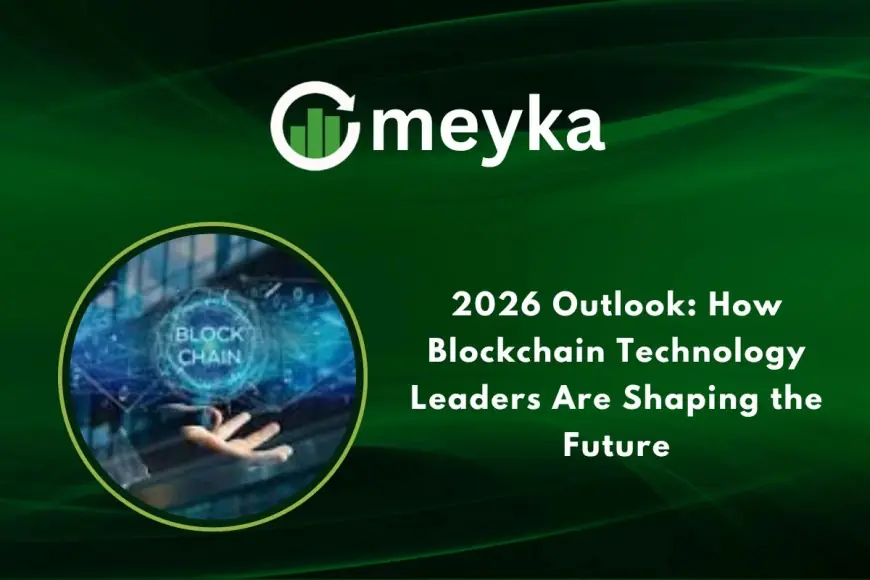
2026 Outlook: How Blockchain Technology Leaders Are Shaping the Future

In 2026, blockchain technology has moved beyond its early days as the backbone of cryptocurrency and is emerging as a foundational tool across business, finance and government operations. That shift matters because industry leaders and innovators are turning experiments into scaled systems that touch payments, identity and global supply chains.
From cryptocurrency backbone to a foundational tool for business and government
Blockchain began as the backbone of cryptocurrency, but in 2026 it is rapidly becoming a foundational tool for business, finance and government operations. The evolution is reaching a new peak this year, driven by innovation, real use cases and forward-thinking leaders pushing blockchain into the mainstream.
Leaders building systems for money, identity, digital assets and secure networks
Industry leaders are shaping systems intended to define the future of money, identity, digital assets and secure global networks. Observers describe the technology not merely as a trend but as a cornerstone of the next digital era, with projects being designed to benefit businesses and individuals worldwide rather than serving purely speculative purposes.
Blockchain Technology powering payments, asset tokenization and supply chains
In 2026, blockchain is powering digital payments, asset tokenization, supply chain tracking and identity systems. Businesses and governments are using these capabilities at scale. Companies use blockchain for faster payments, secure data sharing, smart contracts and tracking goods in global supply chains, translating earlier promises into operational tools.
Decentralized ledgers, immutability and smart contracts explained
At its core, blockchain technology is a decentralized digital ledger that records transactions securely and transparently. Once data is added, it cannot be changed easily, a property that underpins smart contracts and secure data-sharing schemes. That immutability is central to how organizations plan to rely on distributed records for identity and asset systems.
Challenges, innovations, and the research tools backing market participants
Key challenges remain: regulation, scalability, cybersecurity risks and environmental concerns. The context notes that new innovations are solving many of these issues, even as those problems persist. Complementing technical and policy work, research platforms offer 24/7 AI-powered stock research, analysis and market insights to traders and institutions.
The research platform described provides instant AI-powered stock research, machine learning stock forecasts and market insights around the clock. Its chatbot analyzes social chatter, news and alternative data to reveal trading opportunities, and it delivers machine learning forecasts designed to help anticipate price movements across multiple timeframes. A proprietary grading algorithm ranks stocks from A+ to F, and the service can produce instant AI-powered earnings summaries for any stock or by specific dates through an intelligent chatbot with real-time data processing. The platform invites users to subscribe to a newsletter for market insights, AI predictions and updates on its latest tools, and it notes that thousands of traders use its advanced AI tools.
At the same time, the platform states the content it shares is solely for research and informational purposes and is not financial, investment or trading advice. It emphasizes that it is a research platform rather than a financial advisory service, that investing in financial markets involves risks and that past performance does not guarantee future results. Users are advised to conduct their own due diligence, consult professional financial advisors and assess their risk tolerance before making investment decisions. The platform and its operators are not liable for any financial losses incurred from use of the information. The data driving the platform is described as derived from publicly available sources and believed to be reliable but may not always be accurate or up to date; users should independently verify information. The final sentence of the original material is truncated and unclear in the provided context.