

























New York Weather: City Under Blizzard Warning as East Coast Braces for Bomb Cyclone

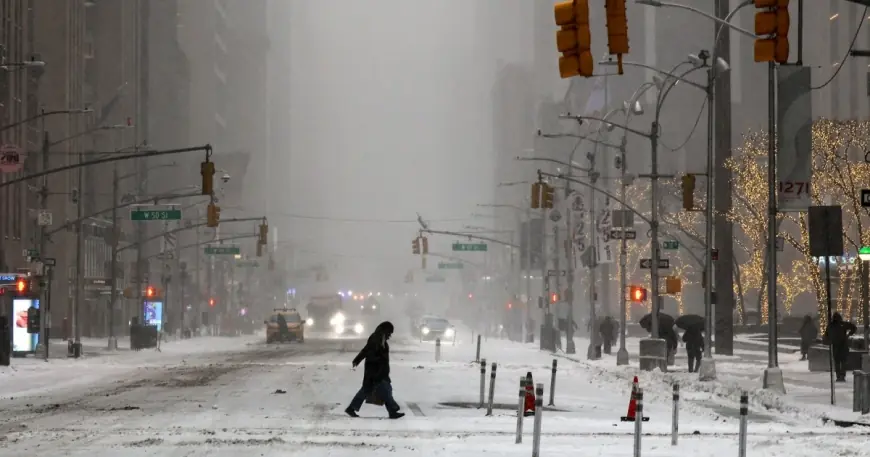
Blizzard warnings were issued across New York City, New Jersey and coastal communities as a late-winter storm is forecast to strengthen rapidly and bring heavy snow and damaging winds. The new york weather emergency matters now because federal, state and city officials have mobilized personnel and equipment while tens of millions of people face travel-threatening conditions and coastal flooding risks.
New York Weather: Blizzard warning for New York City and surrounding coast
The blizzard warning for New York City takes effect at 6 a. m. Sunday and runs through 6 p. m. Monday, and roughly 26 million people are under blizzard warnings from Sunday afternoon to Monday afternoon across New York City, New Jersey and Connecticut. City leaders say snowfall totals remain uncertain: Mayor Zohran Mamdani gave a range, saying the city was "now expecting between 13 to 17 inches of snow" with a slight chance of up to 20 inches or more, and earlier briefings noted the city could see up to 20 inches. Officials from different accounts placed the last city blizzard in 2016 or 2017; that detail is unclear in the provided context.
Timeline and storm track from North Carolina to Boston
Forecasters say the system will take shape Sunday as a low-pressure area forms off the North Carolina coast and moves north-northeast, producing a rapid drop in air pressure consistent with a so-called "bomb cyclone. " The National Weather Service described the storm's shape as a swirling "comma" that will start with light snow and some rain before strengthening into heavy bands. Forecasts show the storm arriving Sunday morning around Washington, DC, stretching toward Philadelphia and New York City, and reaching Boston late Monday evening.
National Weather Service warnings, wind and snowfall projections
The National Weather Service raised its assessment for the region, anticipating 1 foot to 2 feet of snow for New York City, Long Island, southern Connecticut and coastal communities in New Jersey and Delaware, and noting a reasonable worse-case of 2 feet or more on Long Island. Forecast discussions warned of bands of moderate to heavy snow rotating from the southeast to the northwest during evening into the overnight as the cyclone rapidly deepens, producing intense wind gusts—forecasts cite gusts over 50 mph and other statements reference gusts of more than 55 mph. The service also warned of whiteout conditions, coastal flooding, scattered downed tree limbs and possible power outages due to heavy snow load and strong winds.
State, federal and city preparations including National Guard and Code Blue
Federal and state officials activated resources ahead of the storm. Secretary of Homeland Security Kristi Noem said federal resources were ready and urged residents to stay home, stay safe, stay warm, and stay off the roads. New York Governor Kathy Hochul declared a state of emergency Saturday for multiple counties including Albany and New York, and activated the state's National Guard to assist in storm response operations. Mayor Mamdani activated the city's Code Blue operations and said efforts to move unhoused New Yorkers into shelters would begin Saturday afternoon.
Local emergency actions in Philadelphia, Atlantic City and city operations
Across the region, officials staged people and equipment: Philadelphia declared a snow emergency starting at 4 p. m. Sunday, closed public school buildings on Monday, and has staged 1, 000 city personnel, more than 800 pieces of equipment and about 25, 000 tons of salt. Atlantic City officials warned residents and casino visitors to stay off streets, particularly in low-lying neighborhoods prone to flooding; Scott Evans, the city's fire chief and emergency management coordinator, said there are roughly two dozen streets where water is expected and snow will hide hazards. Original forecasts that called for a couple of inches worsened as models and warnings escalated on Friday and Saturday.
Human toll, rates of snowfall and immediate risks
The city is already coping with fragile conditions: parts of New York City remain dotted with hillocks of ice leftover from a major storm nearly a month earlier, and municipal reports note that at least 19 people were found dead outdoors after temperatures plunged on 19 January and stayed below freezing for 10 consecutive days, with at least 15 of those victims believed to have died of hypothermia. Snowfall rates in the upcoming event are expected to intensify Sunday afternoon and overnight in New York City, with up to 2 inches per hour possible during the overnight hours—conditions that will make travel dangerous, if not impossible.
What makes this notable is the confluence of a rapidly deepening coastal cyclone, high gusts and heavy snow over a densely populated corridor: the storm threatens coastal flooding and whiteout conditions from the mid-Atlantic into southern New England while roughly 63 million people are under winter alerts from Tennessee to Maine.
Residents are being asked to stay indoors and off the roads; officials have mobilized personnel and equipment and warned that Monday's commute could be extremely dangerous if the storm tracks and intensifies as forecast.