



















How a 63 Quadrillion Gift Card Receipt Made a Nottingham Customer the ‘Richest Woman in the World’ on Paper

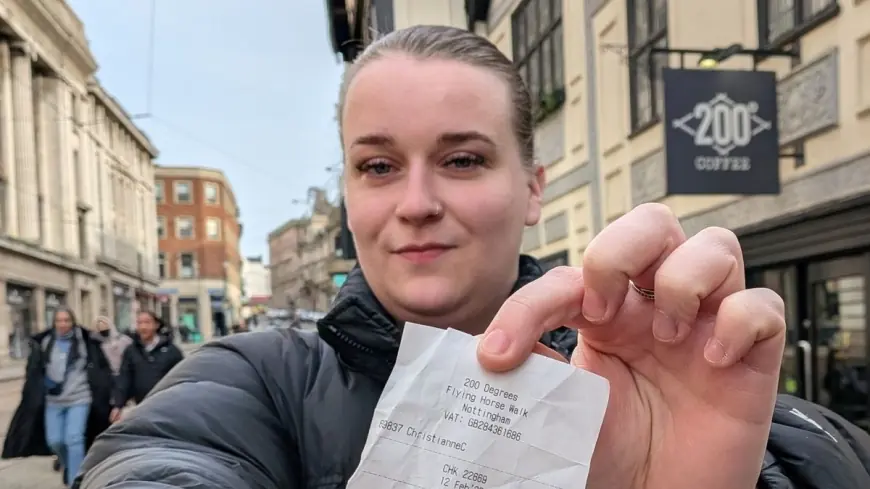
Who felt the immediate impact: a 29-year-old Nottingham business owner found herself briefly elevated to an absurd financial headline when a routine coffee purchase produced a 63 quadrillion gift card figure on a receipt. The mistake matters because it exposed a till-entry problem at a local branch and turned a small, personal purchase into a viral curiosity that highlighted limits on digital balances and what a store system error can — and cannot — actually deliver.
Immediate effect on the customer and the cafe
Sophie Downing, a 29-year-old business owner who runs the Secret Sugar Club hair removal service, went into a 200 Degrees coffee shop in Nottingham intending to use a £10 gift card to buy a matcha latte. The receipt she was handed showed a remaining balance of more than £63 quadrillion. Staff at the branch appeared confused; one staff member said they had never seen such a figure at the till. Downing sent the receipt to her partner, who also found it amusing, and treated herself to one more drink from the card before leaving.
63 Quadrillion Gift Card: how the till error played out
The cafe’s till generated the anomalous balance because the gift card number was entered into the wrong field instead of the gift card value, an administrative technical error at the point of sale. The customer was charged exactly what she should have been for her purchases, and after completion the gift card retained the correct, normal balance — the absurd total appeared only on an erroneous receipt. That mistaken receipt was given to the customer as a keepsake; a correct receipt showing the true value was later issued.
The surreal scale, and why it couldn’t be spent beyond the shop
Here’s the part that matters for perspective: the inflated figure was compared in some coverage with huge global sums. One comparison noted that a commonly-cited private wealth number of $843. 4 billion (listed as £624b) is more than 100, 000 times smaller than the quadrillion figure on the receipt. Other comparisons in the same context placed the number at roughly 22, 500 times the size of the UK economy (given as around £2. 8 trillion), about 2, 700 times the size of the US GDP (noted as $31 trillion/£23 trillion), and more than 670 times the total of the world economy as presented in that coverage. An additional, dramatic comparison referenced the asteroid Psyche’s estimated value at £8, 000, 000, 000, 000, 000, 000. Despite those comparisons, the gift card could only be spent on items at the cafe — coffee and croissants — and could not be turned into cash to buy a car, a home, or solve large-scale problems.
Customer response, moral choices and remaining questions
Downing said she had no intention of taking advantage of the error and declined to clear shelves, noting it would be wrong to exploit a mistake. After using the card a second time and seeing the number persist on a receipt, she chose not to continue using it. She suggested a scan or barcode mismatch might have been involved, saying it looked as though the barcode had been interpreted as a balance. A spokesperson for 200 Degrees explained the administrative error that placed the card number into the wrong till field and confirmed the customer was charged correctly and later issued a correct receipt.
- Customer: Sophie Downing, 29, business owner of Secret Sugar Club.
- Purchase: matcha latte bought with a £10 gift card at 200 Degrees in Nottingham.
- Error: gift card number entered where gift card value should be; produced a receipt showing more than £63 quadrillion.
- Aftermath: mistaken receipt kept as a souvenir; correct receipt later provided; customer charged correctly.
Mini timeline and unresolved point
- Customer uses a £10 gift card to buy a matcha latte.
- Till displays an anomalous remaining balance of more than £63 quadrillion; staff appear confused.
- Mistaken receipt is given as a souvenir and a correct receipt is later issued; customer uses the card again then stops using it.
It is unclear in the provided context whether all branches or the broader company publicly acknowledged the mistake beyond the explanation tied to the administrative error.
What’s easy to miss is how a small point-of-sale entry mistake cascaded into widespread attention because of the magnitude of the number shown. The real test will be whether the incident prompts any till-process checks at individual outlets; readers who work with point-of-sale systems may spot procedural weak points from this example.
A separate local note in the context mentioned a business celebrating 10 years with headline sponsorship and local coverage invited readers to suggest stories to community channels.