

























Weather Philadelphia: Models Split on Weekend Storm, From Light Wet Snow to Potential Nor'easter

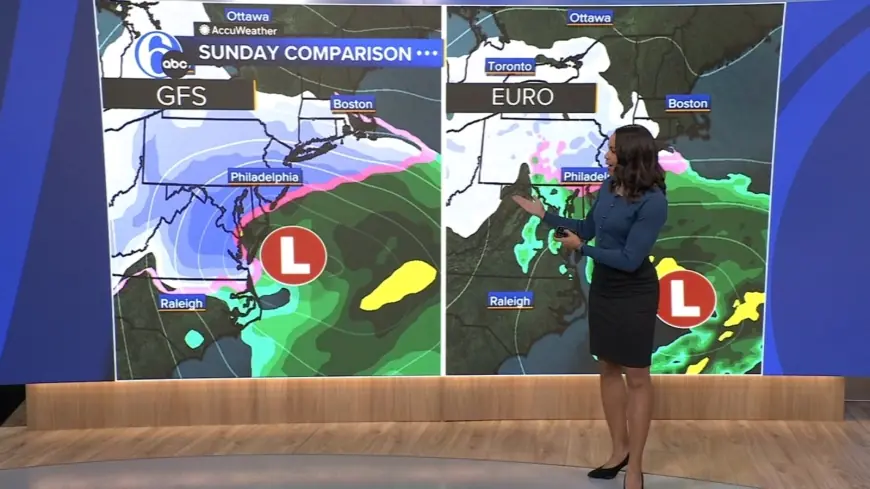
Forecast uncertainty has increased for weather philadelphia as computer models diverge on a coastal low that could arrive Sunday into Monday. The essential issue is simple: a weaker, offshore system would bring mainly light, wet snow while a closer-tracking coastal cyclone could deliver heavy snow, strong winds and coastal flooding.
Weather Philadelphia: What happened and what’s new
A low pressure system has been developing off the West Coast and is expected to progress toward the East Coast late in the weekend, with precipitation most likely from late Sunday into Monday. Forecasters are presenting two main scenarios. The first, currently judged more likely, calls for a weaker, flatter storm tracking farther offshore that would still produce a period of light, wet snow across parts of the Delaware Valley and the Philadelphia region. That scenario includes the potential for a localized band of heavier snowfall tied to an inverted trough extending from the storm.
The alternative scenario is for a stronger coastal storm that tracks closer to shore. In that case, parts of the region could receive heavier, wet snow and very strong winds, with conditions that could approach blizzard criteria in exposed locations. Model guidance and official forecasts for the immediate Philadelphia area list elevated chances of precipitation and measurable snow: an agency forecast notes a high probability of precipitation this period, with a meaningful likelihood that at least a couple inches of snow could accumulate and a smaller but non-negligible chance of higher totals.
Timing cues in the guidance place the arrival of precipitation late Sunday morning into the afternoon and continuing into Monday, with temperatures falling into the 30s during the precipitation window. Forecasts currently do not expect a significant icing threat in this event. A stretch of milder weather and rain ahead of the system is expected to reduce existing snowpacks before the weekend.
Behind the headline
Context: Multiple computer models are producing divergent outcomes because the storm is still organizing far from the East Coast. The central technical uncertainty is the storm’s eventual strength and track; small shifts over the ocean can substantially change how much snow falls onshore.
Incentives and constraints: The meteorological pressure is on model consensus and short-range guidance to converge in the next 24–72 hours. Coastal development stage and interaction with cold air inland will constrain whether precipitation falls as rain, a mix, or snow.
Stakeholders: commuters and regional transportation systems face the risk of a potentially dangerous commute if the heavier, windier scenario materializes; coastal communities could contend with coastal flooding and strong onshore winds in the event of a stronger coastal low; municipal services and utilities would be sensitive to heavy, wet snow and high winds. Forecasters and emergency managers are monitoring model shifts closely.
What we still don’t know
- Exact track of the low once it matures off the Southeast or Mid-Atlantic coast.
- Final storm intensity and how closely it will hug the coastline versus staying offshore.
- Precise snowfall amounts for specific localities across the Philadelphia region.
- Where and how strong any localized heavy-snow band from an inverted trough might set up.
- Extent and timing of coastal flooding and peak wind gusts if the stronger scenario occurs.
What happens next
- Weaker offshore outcome (higher probability): The system tracks farther offshore, producing mainly light, wet snow for the region with isolated heavier bands; impacts remain limited to slick roads and minor accumulations. Trigger: model consensus shifts eastward and storm remains broad and shallow.
- Stronger coastal outcome (lower probability): The low develops closer to the coast, yielding heavier wet snow, widespread accumulations, gale-force winds, and possible blizzard-like conditions in exposed areas, plus coastal flooding. Trigger: guidance shows a compact, deepening coastal low within striking distance of the shore.
- Intermediate outcome: A midtrack system brings measurable snow for many locations—several inches in the immediate urban corridor—with gusty winds but not widespread blizzard conditions. Trigger: models converge on a track close enough to deliver substantial precipitation but without extreme deepening offshore.
- Timing refinement: Expect timing and intensity to be fine-tuned as the storm organizes; forecasts should become clearer in the 24–48 hours before impact.
Why it matters
Near-term impacts hinge on which scenario unfolds. Under the lighter outcome, disruptions would be limited and pre-warming and recent rain should have reduced historic snow piles. Under the stronger outcome, travel could be hazardous, coastal flooding and power outages become more likely, and municipal response resources would be tested. In all cases, the key near-term implication is elevated forecast uncertainty that will influence travel planning and operational decisions for the weekend into Monday.