






















Trump Vows $10 Billion for Board Of Peace at Inaugural Washington Meeting

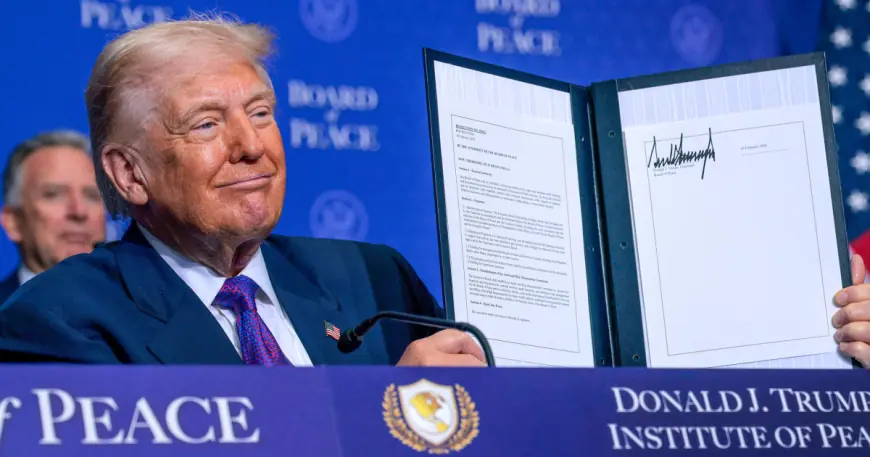
President Donald Trump convened the first Board Of Peace in Washington on Thursday and announced a $10 billion U. S. commitment to the initiative, casting the gathering as a central piece of his global agenda and a driver for Gaza relief and broader conflict resolution. The move matters now because the board’s early pledges and public posture intersect with an unfinished Gaza reconstruction effort and mounting regional tensions that the president said could erupt again within days.
Board Of Peace's Inaugural Session in Washington Brings Major Financial and Security Pledges
The event assembled high-level representatives from multiple countries and featured several headline fiscal commitments tied to Gaza. Participants at the meeting were said to include representatives from at least 40 countries, and materials from the gathering describe combined pledges for Gaza reconstruction and relief in the billions: one description cites a combined $7 billion committed by members, while another account notes $5 billion in earlier pledges. Separately, nine members were described as pledging a combined $7 billion, and five countries agreed to deploy troops for an international stabilization force in Gaza.
President Trump announced that the United States would commit $10 billion to the Board Of Peace initiative but did not specify the funding source for that sum. Event organizers used the meeting to emphasize peacemaking as a legacy priority, and attendees received event-branded hats as part of the gathering’s public presentation.
Diplomatic Ambitions Meet Oversight Claims and Security Warnings
At the meeting the board was framed as an instrument to intervene in Gaza and in other international "hot spots, " with public remarks describing an intent both to support the United Nations and to provide an additional oversight role. The effort drew leaders and political figures from several countries and included listed U. S. representatives among the delegation.
Concurrently, the president linked the initiative to a wider security posture by warning that if negotiations with Iran falter, the United States may take further military steps and that the world would learn of U. S. plans within a likely 10-day window. Those comments were presented alongside the board’s formation and its stated aim to mobilize reconstruction funding and stabilization forces for Gaza.
Unanswered Questions, Funding Gaps and Scenarios for What Comes Next
Key practical and strategic unknowns remain after the inaugural session. Notable gaps include:
- Funding source: the origin of the announced $10 billion U. S. commitment was not identified publicly.
- Inconsistent tallies: descriptions vary between $5 billion and $7 billion pledged by members, and broader estimates for Gaza rebuilding needs were cited at roughly $70 billion, indicating a significant shortfall if those totals stand.
- Membership and mandate: the precise membership roster and the operational relationship between the board and the United Nations are not fully specified.
Plausible next-step scenarios emerge from the available material, with clear triggers:
- Accelerated fundraising push — trigger: outreach to additional governments and private donors to close the gap versus estimated rebuilding needs.
- Deployment of stabilization forces — trigger: formalized troop commitments by countries that agreed in principle to participate in a Gaza stabilization force.
- U. S. security action in the region — trigger: failure to reach a "meaningful" diplomatic agreement related to Iran within the coming roughly 10 days.
- Political follow-through at home — trigger: continued domestic travel and campaigning by the president after the meeting to fuse foreign-policy messaging with electoral goals.
Why this matters: the Board Of Peace’s early pledges and public positioning could shift how reconstruction and stabilization in Gaza are financed and who holds influence over those efforts. The combination of headline-level funding announcements, promises of troop deployments, and an assertive stance toward established international bodies raises immediate questions about implementation, donor sufficiency and the risk of further regional escalation if diplomatic tracks fail.