























Ramadan Mubarak: What to expect for fasting hours, suhoor and iftar in 2026

Following the sighting of the crescent by the moon-sighting committee on Tuesday, Saudi Arabia announced the first day of fasting will be Wednesday, February 18, 2026 (ET). The annual month of fasting will last 29 or 30 days and will see dawn-to-dusk fasts that vary widely by location — generally from about 11. 5 to 15. 5 hours on any given day.
When Ramadan begins this year
With the crescent sighting confirmed, communities that follow local moon-sighting traditions will start fasting on Wednesday, February 18, 2026 (ET). The month follows the lunar Hijri calendar, which is shorter than the solar year by about 10 to 12 days. That shift explains why the start of Ramadan moves earlier in the Gregorian calendar each year and will even occur twice in 2030.
Because the lunar cycle gives months of 29 or 30 days, the exact end date of the month will depend on the sighting near the end of Ramadan. The period is observed by Muslims as a time of worship, reflection and community, marking the month when the first verses of the Quran were revealed more than 1, 400 years ago.
Fasting hours around the world: what to expect
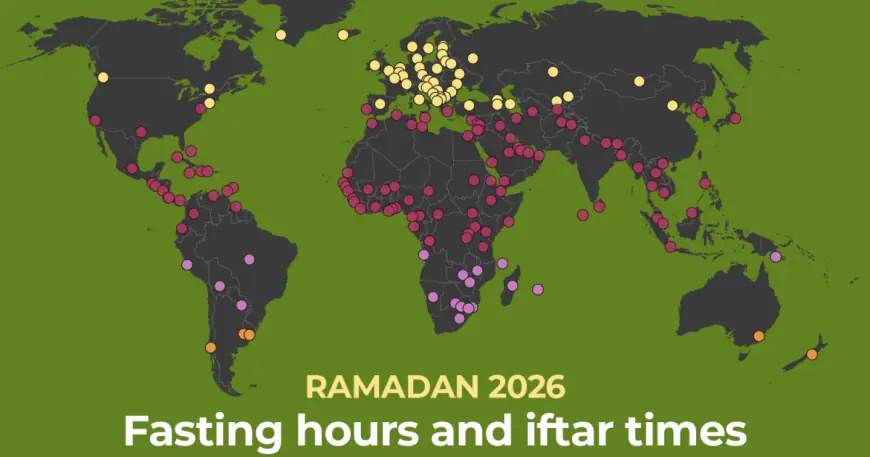
Fasting length this year ranges roughly between 11. 5 and 15. 5 hours depending on latitude. For nearly 90 percent of the world’s population living in the Northern Hemisphere, this Ramadan will offer somewhat shorter day lengths compared with summer months. On the first day, many locations in the Northern Hemisphere will observe dawn-to-dusk fasts of about 12 to 13 hours, with daylight hours lengthening gradually through the month.
By contrast, communities south of the equator will generally experience longer fasts than last year. Countries such as Chile, New Zealand and South Africa can expect fasts close to 14 to 15 hours on the first day, though fasting durations there will tend to shorten as the month progresses. Overall, the number of fasting hours across the globe varies with geography and the progression of the solar seasons.
Notable calendar trivia: because the lunar year is about 11 days shorter than the solar year, Ramadan will occur twice in 2030 — first beginning around January 5 and then again around December 26 of that year. Additionally, fasting hours for Northern Hemisphere residents will continue to fall until Ramadan aligns with the winter solstice in 2031, which will create the shortest daylight span of any year.
What fasting entails and common greetings
During daylight hours throughout Ramadan, observant Muslims abstain from eating and drinking, as well as smoking and sexual relations. The fast is intended to foster greater taqwa — a heightened consciousness of God — and to encourage acts of charity, self-discipline and spiritual reflection.
Daily observances are bookended by suhoor, the pre-dawn meal, and iftar, the meal at dusk that breaks the fast. Local prayer timetables and community calendars provide precise suhoor and iftar times for each city; those times shift slightly each day as daylight hours change.
People exchange warm wishes throughout the month. The greetings "Ramadan Mubarak" and "Ramadan Kareem" are commonly used to wish someone a blessed or generous Ramadan, respectively. Communities also mark the close of the month with communal prayers and celebrations that culminate in the festival of Eid al-Fitr.
This year’s observance will reflect both traditional moon-sighting practices and modern calendar calculations, producing a familiar rhythm of fasting, prayer and community across diverse regions of the globe. Ramadan Mubarak to those observing; may the month be safe, reflective and generous.