U.S. Unveils New Details on Alleged Chinese Nuclear Test

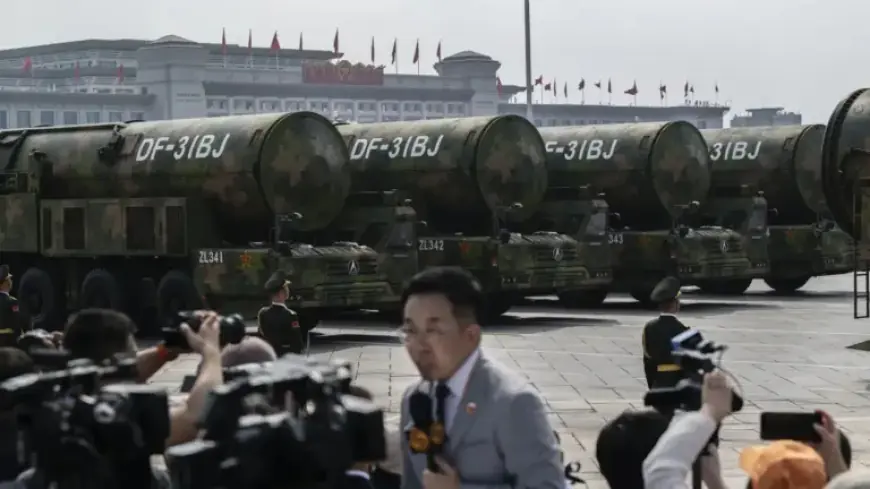
The U.S. has disclosed new intelligence regarding an alleged Chinese nuclear test that reportedly occurred in 2020. This information comes from a seismic event detected on June 22, 2020, by a remote station in Kazakhstan. The tremor, measuring 2.75 on the Richter scale, was traced back to the Lop Nur nuclear test site in China, situated about 450 miles away, as stated by Christopher Yeaw, the assistant secretary for arms control and nonproliferation.
U.S. Claims of a Chinese Nuclear Test
Yeaw emphasized that the event is highly indicative of an explosion, likely a nuclear test. He made these remarks during an event at the Hudson Institute in Washington, D.C. According to Yeaw, the seismic data aligns with what is typically expected from a nuclear explosion.
However, independent experts caution against jumping to conclusions. Ben Dando, head of seismology and verification at NORSAR, acknowledged the characteristics of the seismic waves suggest an explosion. Yet, he flagged the weak nature of the signal and the fact that it was detected at only one station. Therefore, he contends that the possibility of a natural event cannot be dismissed.
Limitations in Evidence
The Comprehensive Nuclear-Test-Ban Treaty Organization confirmed the detection of two small seismic events that were 12 seconds apart. However, they noted that their data is insufficient to determine the cause of these events with certainty. In response to the U.S. allegations, the Chinese government firmly denied any wrongdoing. Chinese Foreign Ministry spokesperson Lin Jian labeled the U.S. accusations as unfounded, criticizing them as attempts to justify American nuclear testing.
The Context of Nuclear Testing Worldwide
Historically, the major nuclear powers have refrained from testing their arsenals. The U.S. last conducted a nuclear test in 1992, while China’s last official detonation occurred in 1996. Both countries are signatories of the Comprehensive Nuclear-Test-Ban Treaty, which remains unratified and inoperative. Despite a voluntary moratorium on nuclear testing, both nations continue development activities involving nuclear weapons.
- The U.S. utilizes supercomputer simulations and real-world experiments to maintain its arsenal of approximately 1,500 deployed nuclear weapons.
- China is reportedly expanding its facilities at the Lop Nur test site, indicating ongoing investment in its nuclear capabilities.
China’s Growing Nuclear Arsenal
The Pentagon estimates that China’s nuclear arsenal has significantly increased from about 200 warheads in 2019 to approximately 600 today. The nation aims to reach 1,000 warheads by 2030. In contrast, U.S. officials express concern that China may be violating the test moratorium and planning tests with significant yields.
Thomas DiNanno, the U.S. undersecretary for arms control, indicated awareness of Chinese preparations for nuclear tests yielding hundreds of tons. Yeaw substantiated claims that the 2020 event was a “yield-producing” nuclear test, although he did not disclose specifics on its size.
Possible Implications of China’s Nuclear Development
If verified as a nuclear test, the magnitude 2.75 event could correspond to an explosion equivalent to tens of tons of TNT. However, strategic placement of the device could conceal a much larger explosion. Experts suggest China may be exploring the development of lower-yield nuclear weapons for potential limited conflicts or testing new hypersonic weapon designs.
Zhao, a senior fellow at the Carnegie Endowment for International Peace, argues that these U.S. claims may be supported by confidential intelligence. He highlighted the increasing activity at China’s Lop Nur test site over the years.
Future of U.S.-China Nuclear Relations
These developments come amid discussions in the U.S. about potentially resuming nuclear testing. Some experts warn that a return to nuclear tests could provide China with critical knowledge due to its fewer previous tests compared to the U.S. Negotiations for new arms control agreements could potentially take place, with Yeaw expressing hope for dialogues with both China and Russia.