

























Lifetouch faces school photo cancellations after online claims and privacy fears

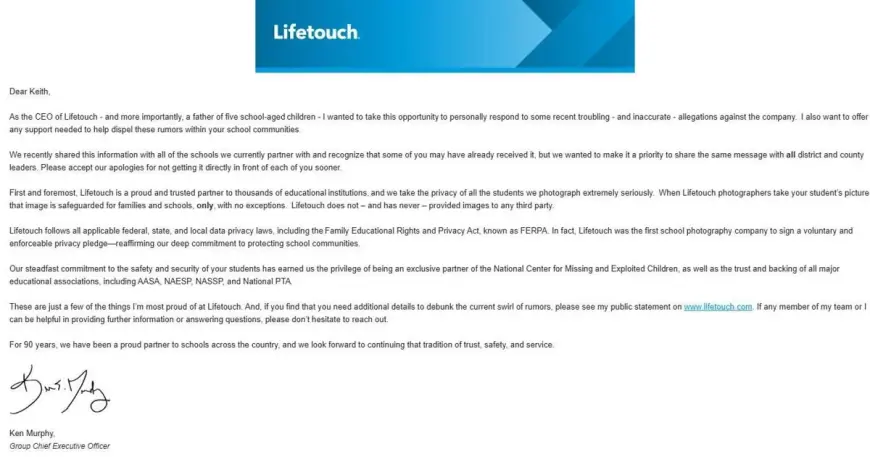
Lifetouch, one of the largest school photography companies in the United States, is dealing with a sudden wave of school picture-day cancellations after viral online posts linked the company to figures mentioned in newly released federal records tied to Jeffrey Epstein. The claims have not been supported by evidence of improper access to student images, but the blowback is already affecting school schedules and reigniting debate over how much student information is collected during picture day.
The disruption has spread unevenly, with some districts moving quickly to pause Lifetouch sessions and others reviewing contracts and privacy terms before deciding what to do next.
What triggered the cancellations this week
The immediate catalyst was a burst of online speculation that connected Lifetouch’s corporate ownership chain to Apollo Global Management and to Leon Black, a billionaire investor who had personal financial dealings with Epstein in the past. The connection being shared online centers on Apollo-managed funds’ 2019 purchase of Lifetouch’s parent company, Shutterfly.
In statements issued this week, Lifetouch emphasized that it has never shared student images with any third party and that neither Black nor Apollo’s investors had access to student photos. The company also pointed to the timing: the deal closed in September 2019, about a month after Epstein’s death in custody.
That clarification has not stopped the cancellations, driven largely by parent concerns and by the speed at which rumors travel once schools are named in local community posts.
How schools and parents are responding
The most visible immediate change has been districts pulling the plug on scheduled photo days, particularly in parts of Texas and at least one school network in Arizona. In several cases, districts said they would either move to an in-house solution for the remainder of the current school year or seek a different vendor for 2026–2027.
The parent concerns extend beyond the viral claim itself. Many families have focused on the amount of identifying information connected to picture orders—student name, grade, teacher, school, and other details that may appear on forms or ordering portals. Even when those details are routine for fulfilling photo packages and yearbooks, critics argue that the data footprint feels bigger than it used to, and that consent feels limited when picture day is treated as a default school activity.
District leaders in several metro areas have signaled they are consulting legal counsel or reviewing vendor privacy commitments and data retention language before making changes.
What’s known—and what remains unproven
No public evidence has emerged showing Epstein, or anyone acting on his behalf, obtained Lifetouch student photos. The federal document dump that intensified attention this month is vast, and the mere appearance of names or business entities in records does not establish wrongdoing.
What is clear is that Lifetouch’s brand sits at a sensitive intersection: children’s images, school operations, and private-sector contracting. That combination makes the company uniquely vulnerable to reputational shocks, even when the underlying allegations are unsubstantiated.
A key practical question schools are now asking is less about sensational claims and more about governance: who can access images, how long images and associated order data are stored, whether any subcontractors touch the files, and what auditing exists for data security.
A separate shift: Lifetouch narrows its focus in 2026
The current controversy is unfolding alongside a major business transition already in motion. In August 2025, Lifetouch announced that a portion of its high school and college photography accounts in select U.S. regions would be acquired by competitor CADY. Lifetouch said it would continue to service those transitioning accounts through the 2025–2026 school year, with a handoff planned for summer 2026.
The move effectively concentrates Lifetouch’s priorities more heavily on K–8 and select high school programs, while giving CADY a bigger footprint in senior portraits and related services in the affected markets. For schools, this matters because vendor switches often come with changes in ordering systems, photo styles, retake procedures, and yearbook workflows.
The timing now creates a compound challenge: districts already slated for a vendor change later this year may face new pressure to accelerate decisions, while districts not involved in the transition may still reconsider vendor relationships amid the current scrutiny.
What to watch next
The next few weeks will likely determine whether this remains a short-lived rumor-driven disruption or becomes a broader reshaping of school photography contracts.
Key developments to watch:
-
District decisions on whether to reschedule picture day, replace vendors mid-year, or wait until summer procurement cycles
-
Updated vendor contract language on image access, data retention, and third-party involvement
-
Any formal guidance from state or local education offices on student image privacy practices
-
Whether the cancellation trend spreads beyond isolated districts into larger multi-school systems
For Lifetouch, the near-term priority is restoring trust with clear, plain-language explanations of who can access student images and what safeguards are in place. For schools, the moment is forcing a hard look at a long-standing tradition—picture day—through a modern lens of privacy, data stewardship, and reputational risk.