






















Why the friday the 13th movies are buzzing again: Jason’s mask and its real hockey roots

As of February 13, 2026 (ET), renewed attention is turning to the friday the 13th movies, with fresh retrospectives zeroing in on the unlikeliest detail in slasher history: Jason Voorhees’ signature hockey mask. New context highlights how a real Detroit hockey connection helped define one of horror’s most enduring images—and how it didn’t arrive until the third film.
The killer in 1980 wasn’t Jason
The franchise launched in 1980 without Jason as the central stalker—or the mask. The original film’s killer was Pamela Voorhees, driven by grief over her son’s past death at Camp Crystal Lake. The series’ eventual icon emerges more gradually: Jason’s presence grows across the early sequels, but the now-classic look wasn’t there from the start.
That slow-burn evolution reflects the franchise’s freewheeling launch. Before a script even existed, the project was teased with the audacious promise of being “the most terrifying film ever made!” The title and a bold hook came first, the details later—one reason the mythology found its shape over several entries rather than in a single, pre-planned origin story.
A prank, a harpoon, and a mask: Part III cements the look
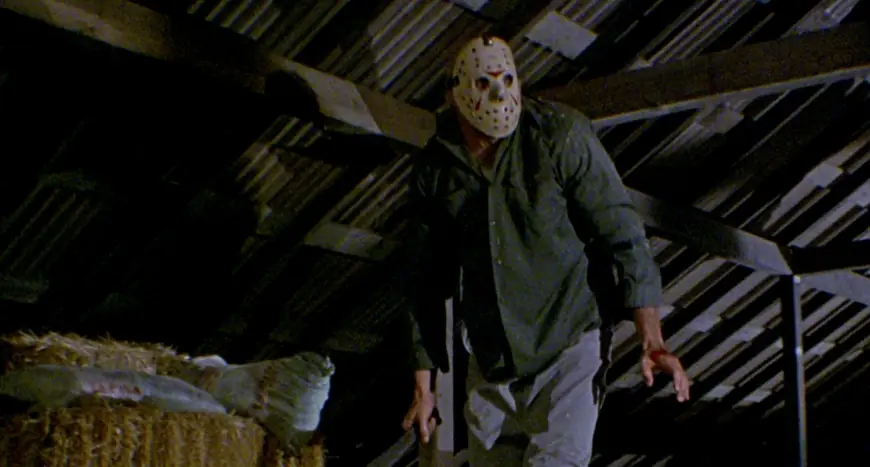
The watershed moment arrives midway through 1983’s Friday the 13th Part III. The hockey mask enters the story not as a grand design choice for Jason, but as a prop in a prank by Shelly, the group’s resident jokester. Outfitted with a diving suit, a harpoon gun, and that now-fabled mask, he startles Vera—only for Jason to soon claim both the harpoon and the face covering for himself.
From that scene onward, the silhouette is unmistakable. The harpoon gun fades after Part III, but the mask endures, instantly transforming Jason into a pop-culture figure whose blank, expressionless face could project any number of nightmares.
A then-struggling Detroit team left its mark
The mask’s leap from prop to legend has an unexpected hockey assist. Someone working on Part III was a fan of the then-struggling Detroit Red Wings, a fandom that helped put a real-world hockey link onto Jason’s face. Before it became a horror icon, the mask had ties to the Red Wings organization, underscoring how practical, even happenstance decisions on set can harden into franchise-defining lore.
Rewatching Part III with that background reframes the choice: a lakeside killer adopting a goalie’s gear is an odd, almost whimsical touch that ended up carrying the weight of the entire brand. What began as a utilitarian costume solve became the franchise’s visual language.
The mask that stayed; the weapon that didn’t
Part of the mask’s power is utility. It hides the actor’s face, simplifies continuity, and—crucially—creates instant recognition in a single glance. The harpoon gun, by contrast, is dramatic but limited; it doesn’t invite the same repeatable, ritualized imagery. The mask does. It reads from across a room, on a poster, or down a dark hallway, helping the friday the 13th movies build a consistent, marketable identity across sequels and generations of fans.
In horror, a strong silhouette often outlives plot specifics, and Jason’s mask became the series’ shorthand for dread. The result: a franchise that may have started with shifting rules and identities found its anchor in a piece of borrowed sports equipment.
Why fans are rewatching the friday the 13th movies today
This renewed focus on origins has set off a wave of nostalgia, with casual viewers and die-hards alike revisiting the early entries to trace how the look—and the legend—came together. Even pop-culture quizzes are spotlighting the franchise’s basics, a reminder that the central antagonist remains a touchstone for mainstream audiences.
For fans diving back in, the recommended path is simple: start at 1980 to see the misdirection that birthed a franchise, then hit Part III to watch the mask cross the threshold from prop to icon. The detour through Crystal Lake’s evolving lore reveals how the friday the 13th movies weren’t born fully formed but discovered themselves along the way—one prank, one harpoon, and one Detroit-linked mask at a time.