
























Nancy Guthrie disappearance timeline: Last confirmed movements, when the doorbell camera went offline, and the latest FBI-photo release

Nancy Guthrie, 84, remains missing as investigators treat the case as an abduction and continue working a narrow overnight window in Tucson, Arizona. Authorities have mapped a minute-by-minute timeline from her last confirmed family contact on Saturday, Jan. 31, 2026, through a series of digital disruptions early Sunday, Feb. 1—most notably a doorbell camera that went offline and later yielded newly recovered images released by the FBI on Feb. 10.
What follows is the clearest publicly outlined timeline so far, with all times converted to Eastern Time (ET).
Last confirmed movements on Jan. 31
Investigators say Guthrie’s last confirmed movements began in the early evening of Saturday, Jan. 31, when she traveled to a relative’s home for dinner and games.
She used a rideshare to get to the gathering, then was driven home later that night by a family member. The final verified sighting places her back at her residence close to midnight ET.
Key timestamps (ET):
-
7:32 p.m. — Guthrie arrives at a family home for dinner and visiting.
-
11:48 p.m. — Guthrie is dropped off at her home.
Authorities have repeatedly described this drop-off as the last confirmed time she was seen by family.
When the doorbell camera went offline
The most critical “break” in the public timeline is the abrupt change in the home’s doorbell camera status in the early hours of Sunday, Feb. 1. Investigators have said the device disconnected at 3:47 a.m. ET.
Shortly afterward, software logs showed motion activity at the home, but usable footage was not immediately available to investigators. That gap has been central to both the search strategy and public frustration: the system reflected activity, but the images tied to that activity were initially missing, inaccessible, or corrupted.
Key timestamp (ET):
-
3:47 a.m. — Doorbell camera disconnects.
The other digital “breadcrumbs”: motion logs and the pacemaker app
Beyond the camera, investigators have highlighted a second data point: Guthrie’s pacemaker connection to its companion app. The pacemaker’s link to the app disconnected at 4:28 a.m. ET on Feb. 1.
Officials have treated these digital disruptions as markers, not definitive proof of what happened. A device disconnect can occur for benign reasons—battery, distance from a paired phone, interference, or device handling—but the clustering of events in a tight window has kept attention focused on the early-morning hours.
Key timestamp (ET):
-
4:28 a.m. — Pacemaker disconnects from its app.
Investigators have also said Guthrie’s personal items were left behind at home, reinforcing the view that she did not leave voluntarily.
The missing-person call and how the case escalated
Guthrie was reported missing on Sunday, Feb. 1, after she failed to appear for a planned morning commitment. As relatives and contacts realized something was wrong, law enforcement response escalated quickly from a welfare check to a criminal investigation.
Authorities have described evidence at or near the home that pushed them toward an abduction theory. They have also said there has been no publicly confirmed proof-of-life since the disappearance.
Over the days that followed, the investigation expanded beyond immediate searches to include digital forensics, neighborhood canvassing for private surveillance, and coordination between local investigators and federal agents.
The latest FBI photo release: what it shows and why it matters
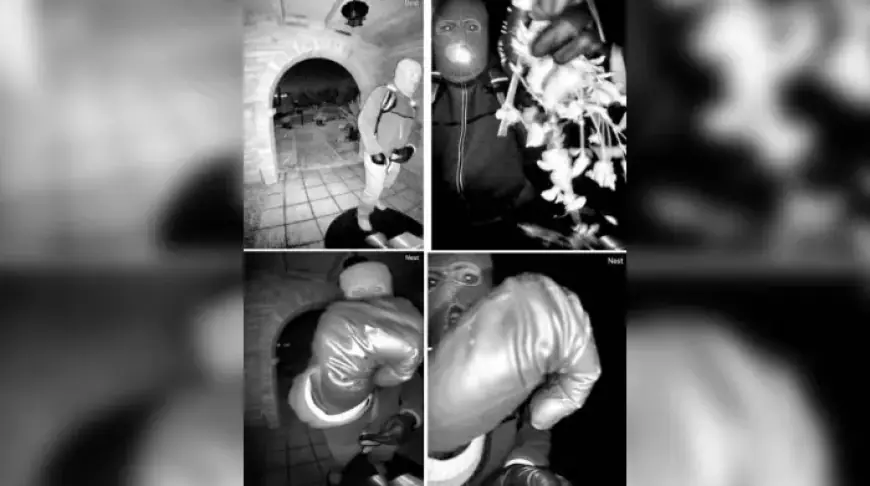
On Tuesday, Feb. 10, 2026, the FBI released newly recovered images—and a short video clip—showing a person near Guthrie’s front door in the early morning hours of Feb. 1. Authorities have described the individual as masked, gloved, and appearing to be armed, and have said the person seems to tamper with the doorbell camera.
Investigators have said the material was recovered after additional work to retrieve previously inaccessible images. The public release signals two things at once: a push to identify the person quickly, and a belief that public tips could materially move the case forward.
Authorities have not publicly confirmed the person’s identity, whether the individual acted alone, or whether any vehicle is directly tied to the images. They have asked anyone with information—especially neighbors with video from the overnight window—to come forward.
What to watch next
The next meaningful update is likely to come from one of three areas: identification of the person in the newly released images, confirmation of a vehicle or route tied to the overnight window, or recovery of additional video that links the camera disruption to specific movement at the home.
For now, the timeline remains anchored by a few fixed points: Guthrie’s drop-off late Jan. 31, the doorbell camera disconnect at 3:47 a.m. ET on Feb. 1, the pacemaker app disconnect at 4:28 a.m. ET, and the Feb. 10 release of images that investigators believe could help identify a key person of interest.
Sources consulted: FBI, Pima County Sheriff’s Department, Reuters, PBS NewsHour