






















Bad Bunny Explores American Identity in Super Bowl Halftime Show

Bad Bunny’s Super Bowl halftime performance on Sunday night marked a significant moment in the discussion of American identity. His act was a blend of cultural expression and a political statement emphasizing unity among the diverse nations of the Americas.
Significance of Bad Bunny’s Performance
As the show concluded, Bad Bunny uttered the words “God Bless America,” signaling his message to a global audience. Throughout the performance, he listed countries from the Americas, including the United States and Canada. A backdrop read, “The only thing more powerful than hate is love,” reflecting themes he has previously addressed at major award shows.
His performance faced backlash, with some labeling it un-American. Nonetheless, it stands as a powerful reminder that Puerto Ricans are U.S. citizens as well. Notably, critics such as former President Donald Trump labeled the performance an affront to American culture.
The American Experience in Diversity
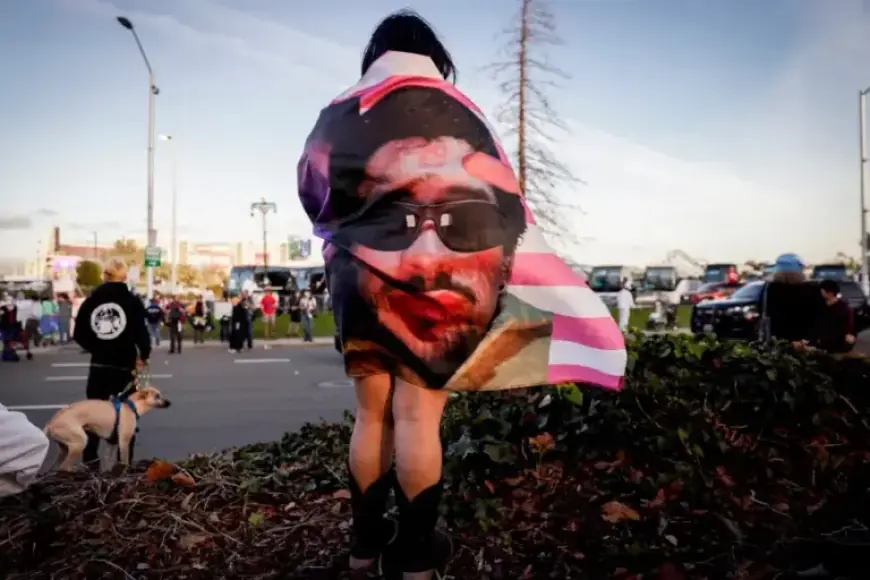
At the height of his performance, Bad Bunny was surrounded by a diverse crowd, waving flags from various countries, including territories like Bonaire and the U.S. Virgin Islands. This moment was underscored by the presence of plena musicians, a genre linked to community and protest.
Petra Rivera-Rideau, an expert in American studies, highlighted that Bad Bunny’s performance was a celebration of Latino belonging in the United States. She stated, “He was inviting people into his world, advocating that immigrants and Latinos are integral to the American fabric.”
Reanna Cruz, a music critic, paraphrased the performance as a radical rethinking of what it means to be American, emphasizing community and joy in challenging times.
Cultural and Historical Context
Historically, the idea of a united Americas has been echoed by artists like Rubén Blades and Los Tigres del Norte. Rivera-Rideau emphasized that Bad Bunny’s show brought forth the notion that Latinos, Caribbean people, and immigrants belong in America just as much as any other group.
Christopher Campo-Bowen, a musicology professor, noted that Bad Bunny’s performance articulated a broader definition of American identity. He presented Puerto Rican culture as a unique contributor to this identity while promoting a sense of unity.
Puerto Ricans and the Complexity of American Identity
- Since 1917, Puerto Ricans have held U.S. citizenship regardless of their birthplace.
- Despite this, residents of Puerto Rico face limitations, including a lack of voting rights for the President.
- The island’s status as a U.S. territory complicates the understanding of citizenship for its people.
The performance’s use of the original Puerto Rican flag’s light blue triangle stirred conversations about colonial relationships and a demand for full recognition in the U.S. Rivera-Rideau explained how this aligns with historical struggles faced by the island.
A Political Commentary through Music
Bad Bunny’s choice to end with “God Bless America” diverged from traditional conservative depictions of American identity. His message united various nations, promoting the idea that all are part of America. This stands in contrast to alternative performances promoting a more exclusionary view of American culture.
Vanessa Díaz, an academic specializing in Chicano and Latino studies, described the performance as profoundly political and an artistic expression of joy and togetherness. It reflected on the realities of immigration and identity during a politically charged climate.
Overall, Bad Bunny’s halftime show serves as a monumental statement, showcasing how music can transcend barriers and foster community amidst diversity. Joy and dancing became acts of resistance against the backdrop of a complex political landscape.