

























AI Rivals Uncover Rules of Mysterious Roman-Era Board Game

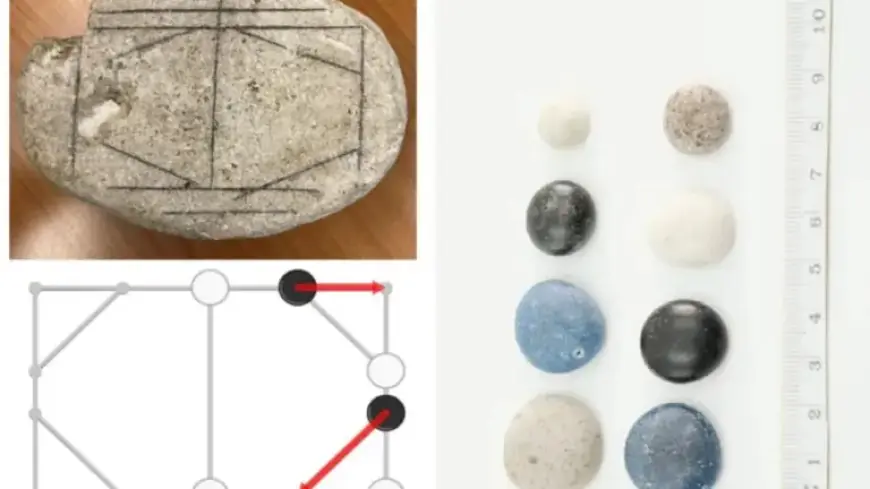
Recent research has employed artificial intelligence (AI) to unravel the mysteries surrounding an ancient Roman-era board game. This intriguing artifact, found in Coriovallum, now part of the modern Netherlands, has geometric patterns suggesting it was designed for gameplay. The object is currently housed in the Het Romeins Museum, where its significance is being closely examined.
Discovery of the Ancient Game Board
- Location: Coriovallum, Roman town in the Netherlands
- Artifact Type: Stone game board
- Current Location: Het Romeins Museum
The study, published in the journal Antiquity, explores the possibility that this stone object served as a board for ancient games. Walter Crist, an archaeologist at Leiden University and lead author of the study, noted the importance of geometric patterns found on the board, which indicate deliberate shaping.
Identifying Game Rules with AI
Researchers faced a challenge: the geometric patterns did not correspond to any known board game. To tackle this, they turned to AI. This technology simulated gameplay to hypothesize potential rules that would explain the wear patterns observed on the surface of the artifact.
According to Crist, damage on the board’s surface suggests it was used for gameplay, particularly through the uneven distribution of visible abrasions. The researchers utilized AI to play various ancient European board games, eventually identifying a match with “blocking games.” These games involve strategies to hinder the opponent’s movements, similar to modern games like Ticket to Ride.
The Implications of the Research
This innovative application of AI is groundbreaking. It marks the first instance of AI-driven gameplay being integrated with archaeological studies to identify a board game. The findings suggest that blocking games were played in Europe earlier than previously thought, possibly dating back to the Roman era.
- Significance: Potentially identifies new aspects of ancient cultures
- Research Method: Combination of AI and archaeological analysis
This approach provides archaeologists with enhanced tools to explore ancient games that might not align with current references or artistic representations. As a result, it opens a new avenue for understanding leisure activities in historical contexts, revealing patterns of social interaction and competition among early civilizations.
Ultimately, this research not only sheds light on the gameplay of the past but also highlights how AI can bridge gaps in archaeological inquiry, allowing for a deeper understanding of human history.