
























Turning Point USA “All-American Halftime Show” Draws Spotlight as a Political Alternative to the Super Bowl Halftime Show

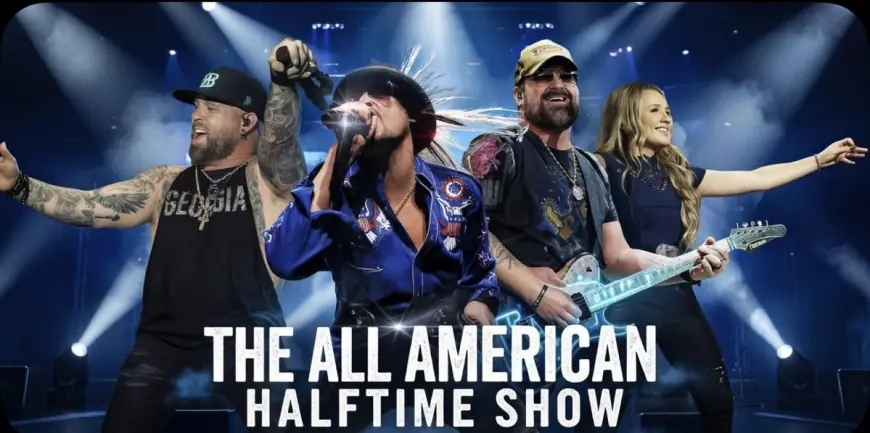
A conservative “alternative halftime show” branded as the Turning Point USA halftime show is set to run alongside the Super Bowl halftime window on Sunday, February 8, 2026, turning a pop-culture staple into a parallel-stage political statement. The event, often promoted as the All-American halftime show or tpusa halftime show, is billed as a patriotic, family-friendly concert anchored by a lineup that includes Kid Rock, Gabby Barrett, Lee Brice, and Brantley Gilbert.
The timing is the point. With the main halftime performance already a major cultural flashpoint this year, Turning Point USA is positioning its turning point halftime show as a deliberate counter-program — not just another concert, but a competing narrative about identity, entertainment, and who gets to represent “America” on its biggest sports night.
What happened and why the tpusa halftime show is trending now
In recent days, Turning Point USA and its partners have promoted the Turning Point USA halftime show as an “All-American Halftime Show” and an “alternative halftime show” for viewers who want a different option during halftime. Coverage is expected to begin around 7:30 p.m. ET, with the core performance window marketed around roughly 8:00 p.m. ET, aligning with the Super Bowl’s halftime period.
At the same time, attention has surged around “cool daddy cool lyrics,” after an older Kid Rock track resurfaced in online debate ahead of his appearance. The renewed scrutiny is less about set lists and more about reputational risk: whether past material, viewed through today’s lens, becomes a liability for brands and organizers trying to sell “family-friendly” programming.
Turning Point USA, incentives, and the business of an alternative halftime show
This is not only a cultural protest; it’s a turnout and fundraising machine with entertainment as the delivery system.
Turning Point USA has long operated at the intersection of politics, youth activism, and media strategy. A Super Bowl-adjacent event offers three built-in advantages:
-
Attention is concentrated and predictable. Halftime is one of the few moments when millions of people are simultaneously open to switching channels or opening a second screen.
-
The audience is already in “event mode.” Viewers are primed for spectacle, not policy papers.
-
The call-to-action can be downstream. Even if the All American halftime show is the hook, the long-term goal can be list-building, mobilization, and influence.
For the artists, the incentive varies. For some, it’s exposure to a highly engaged fan base; for others, it can be brand alignment with a particular cultural identity. For organizers, it’s a chance to frame a political dispute as a consumer choice: “If you don’t like the main show, here’s your replacement.”
Gabby Barrett, Lee Brice, Brantley Gilbert, and Kid Rock: the lineup and the stakes
The lineup is designed to signal genre familiarity and cultural continuity — names associated with country and heartland rock, not novelty acts. That matters because the pitch is implicitly comparative: the turning point usa halftime show is being presented as a “real America” alternative, with performers meant to feel recognizable to a target audience.
But the same recognition cuts both ways. Once a show is framed as political, every performer becomes a proxy in a broader argument. That raises the reputational temperature, especially for artists who rely on mainstream venues, broad radio reach, and sponsorship-adjacent partnerships.
What we still don’t know: missing pieces to watch before airtime
Several practical details remain worth watching as the tpusa halftime show approaches:
-
Production scale and format. Will it be a tightly produced concert segment, a multi-location package, or a live stage with minimal staging?
-
Final runtime and pacing. Halftime is short and unforgiving; a show that drags risks losing its audience quickly.
-
Brand and advertiser posture. Even if sponsorship isn’t public-facing, partners can quietly shape what is shown and what is avoided.
-
How the “family-friendly” promise is handled on-air, given the renewed scrutiny around older lyrics tied to Kid Rock.
How to watch tpusa halftime show without getting lost in the noise
If you’re searching “how to watch tpusa halftime show” or “tpusa halftime show how to watch,” the simplest approach is to start with Turning Point USA’s official event pages and official livestream destinations on Sunday, February 8, 2026.
What to expect, in ET:
-
Coverage buildup: expected around 7:30 p.m. ET
-
Main “All-American Halftime Show” window: marketed around 8:00 p.m. ET, roughly matching the halftime break
Because halftime timing can shift slightly based on the game’s pace, viewers should treat the start time as approximate and be ready a few minutes early.
Second-order effects: why the turning point usa halftime show matters beyond one night
The bigger impact may be normalization. If a partisan-aligned “alternative halftime show” pulls strong engagement, it becomes a template for future parallel programming: alternate award-show coverage, alternate debate shows, alternate holiday specials. That can accelerate the fragmentation of mass culture into ideologically sorted entertainment lanes.
It also pressures the main event ecosystem. When halftime becomes a political litmus test, brands, leagues, and artists face higher stakes in talent selection — and higher blowback risk regardless of choice.
What happens next: realistic scenarios and triggers
-
Scenario 1: Strong viewership, rapid repeat. Trigger: high live engagement and clean execution with minimal controversy.
-
Scenario 2: Moderate reach, bigger influence than numbers suggest. Trigger: clips travel widely and drive follow-on organizing.
-
Scenario 3: Controversy eclipses performance. Trigger: renewed debate over past lyrics and “family-friendly” branding dominates the postgame cycle.
-
Scenario 4: Artist distancing after backlash. Trigger: sustained sponsor or venue pressure in the days following the show.
-
Scenario 5: Copycat alternatives next season. Trigger: organizers and aligned groups see a scalable model that’s cheaper than traditional ad buys.
Whether you view it as a culture-war stunt or savvy counter-programming, the Turning Point USA halftime show is engineered for one thing: turning halftime into an identity choice — and proving that modern politics can be packaged as entertainment with a countdown clock.