





















Turning Point USA’s “All-American Halftime Show” with Kid Rock, Gabby Barrett, Lee Brice, and Brantley Gilbert is set to counterprogram Super Bowl halftime

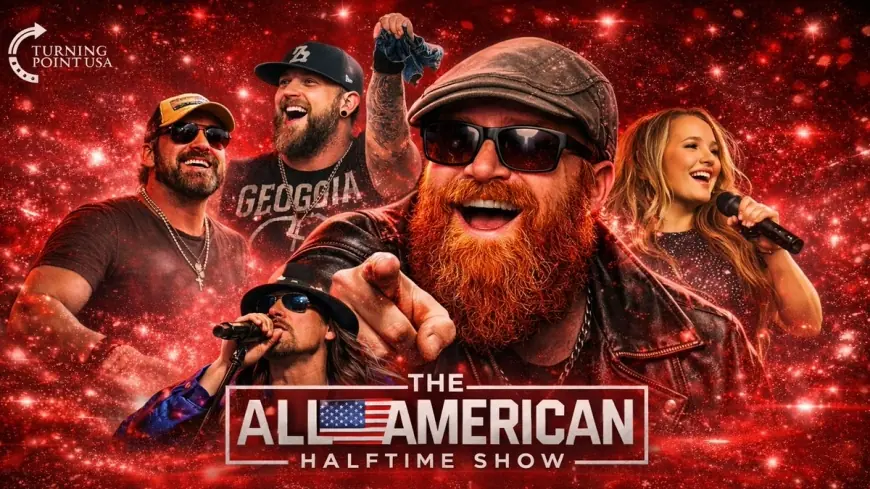
Turning Point USA is moving from political organizing into full-scale culture counterprogramming with a made-for-streaming concert billed as the “All-American Halftime Show,” scheduled to run during the Super Bowl halftime window on Sunday, February 8, 2026, around 8:00 PM ET. The lineup pairs Kid Rock with country acts Gabby Barrett, Lee Brice, and Brantley Gilbert, positioning the event as a patriotic, values-forward alternative to the official halftime performance.
The strategy is simple: hijack the most concentrated live entertainment window in American television and offer a parallel show for viewers who feel alienated by the direction of mainstream pop culture. The message is not subtle. Turning Point USA is framing this as a “faith, family, and freedom” showcase, with artists whose public personas map neatly onto those themes.
What happened: a rival halftime show goes from rumor to real lineup
Turning Point USA first teased the concept months ago, but the story turned concrete this week when the organization confirmed the four headliners. Kid Rock is being pitched as the main draw, a familiar figure for conservative audiences who blends rock theatrics with overt political signaling. The supporting slate, Barrett, Brice, and Gilbert, reinforces the intended mood: radio-friendly, heartland-coded country music with a broad “America first” aesthetic.
The timing is deliberate. The announcement arrives just days before the Super Bowl, when interest spikes, plans lock in, and fan communities are most likely to share watch-party options.
Behind the headline: why Turning Point USA is doing this now
This is not only a music story. It is a media strategy story.
Context: In recent years, the halftime show has become a symbol far bigger than its runtime. It is read as a statement about who mainstream America is for, which communities are centered, and what values are being normalized. That makes it a high-value target for political branding.
Incentives: Turning Point USA wins even if viewership is modest, because the real product is the narrative. If the alternative show trends online, it becomes proof of cultural reach and fundraising potency. For the artists, it offers a massive attention spike, access to a highly motivated audience, and the chance to be framed as cultural standard-bearers rather than just entertainers.
Stakeholders: The organization gains a ready-made annual playbook for future counterprogramming. The artists gain visibility and a refreshed storyline. Viewers who are politically aligned get a communal event. And the broader entertainment ecosystem gets another proof point that big cultural moments are now fragmented into rival camps.
Second-order effects: This kind of parallel programming accelerates the split between “shared national spectacle” and “choose-your-tribe spectacle.” The more successful it is, the more likely it becomes that future major events attract competing broadcasts designed to siphon attention, donations, and identity-driven loyalty.
The lineup: why these four names fit the project
Kid Rock functions as the headline because he is polarizing on purpose, which makes him efficient in the attention economy. He is also legible in a single sentence: loud, patriotic-coded, confrontational, and familiar.
Gabby Barrett provides crossover accessibility and a modern country-pop sheen. Lee Brice offers a proven catalog of stadium-friendly hooks and sentimental anthems. Brantley Gilbert brings the country-rock edge that bridges the gap between party energy and “harder” branding. Together, the lineup covers multiple lanes of conservative-leaning music taste without drifting into niche territory.
It is not a festival bill. It is a coalition.
What we still don’t know: key missing details that will shape the impact
Several pieces remain unclear heading into Sunday night:
How the show is produced and where it is staged. If it looks like a major broadcast, it reads as a serious competitor. If it looks like a simple set captured for social video, it reads more like a statement than an event.
Whether the performances are truly live in real time or pre-recorded. Live creates urgency. Pre-recorded reduces risk and raises quality, but can soften the feeling of “we’re all watching together.”
How long the programming runs. A compact set can feel punchy. A sprawling show risks losing viewers who only tune in for the halftime window.
Whether any surprise guests appear. That is one of the few levers that can meaningfully change the next-day narrative.
How to watch, and why the watch plan is part of the message
Turning Point USA is distributing the show through online streaming and select television partners rather than a single mainstream broadcast home. That distribution choice aligns with the project’s identity: decentralize, mobilize, and let supporters share clips and links inside their own networks. In other words, the viewing experience is built to be social, portable, and politically legible.
Just as important, the show is being marketed as “family-friendly,” which is doing double duty. It signals content expectations, and it also frames the official halftime show as the opposite without needing to argue specifics.
What happens next: realistic scenarios and triggers
Here are the most likely outcomes after Sunday, and what would drive each one:
A viral win: If clips travel widely and the performance quality looks polished, the event becomes an annual franchise and a permanent fundraising asset.
A niche success: If viewership is concentrated but highly engaged, Turning Point USA still claims victory by demonstrating a loyal base that will show up on command.
A backlash cycle: If the show is widely mocked or feels thrown together, the story may shift from “alternative” to “stunt,” limiting its future leverage.
A platform expansion: If distribution performs well, expect more culture-forward programming beyond politics, including concerts, festivals, and event broadcasts.
A broader copycat effect: If this grabs attention, other groups across the spectrum may attempt their own rival programming during major national moments.
The “All-American Halftime Show” is less about replacing the Super Bowl halftime spectacle than reframing it. Turning Point USA is betting that in 2026, identity-driven entertainment can compete not by being bigger, but by being clearer about who it is for.