
























Union Station Revitalization Transforms Toronto’s Key Transit Hub

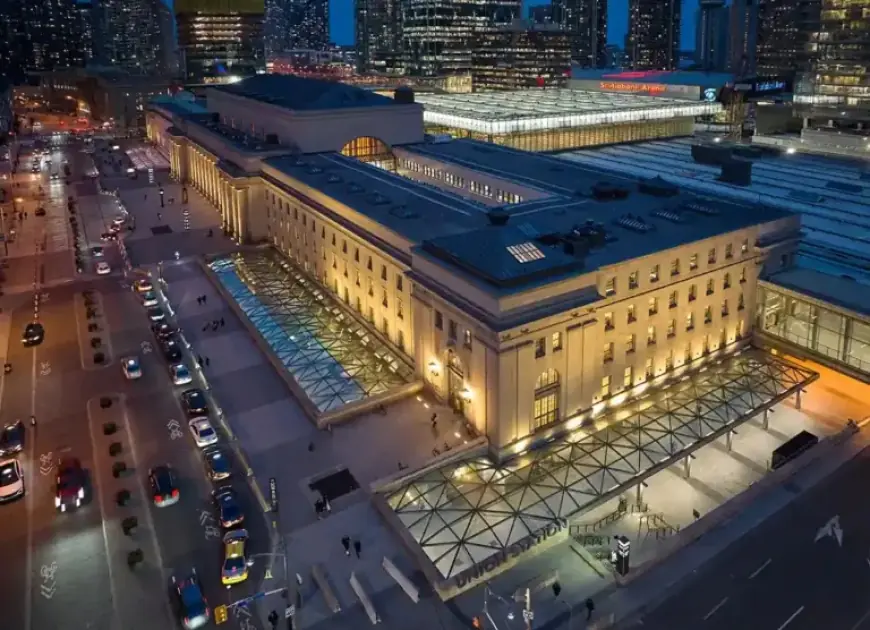
Toronto’s Union Station has recently undergone a significant revitalization, enhancing its role as a multi-modal transportation hub. Designed to accommodate up to 130 million passengers annually, this transformation has been remarked upon positively by experts, including Canadian Architect.
Overview of the Revitalization Project
Initiated in 2007, the ongoing renovations combine the preservation of Beaux-Arts architectural features with a major expansion beneath the existing structure. Uniquely, the station remained operational throughout this comprehensive update.
Historical Significance
Completed in 1927 by architects John M. Lyle, Ross & Macdonald, and Hugh G. Jones, Union Station initially served as a civic monument. However, as time passed, its layout became convoluted, leading to inefficiencies and the encroachment of retail spaces into significant areas.
Project Goals and Scope
- Enhance operational efficiency to support 65 million annual passengers with capacity for 130 million.
- Restore historical features while integrating modern amenities.
- Construct a below-grade expansion to expand usability without disrupting the existing structure.
Construction Highlights
The project required extensive planning and coordination among various stakeholders including federal, provincial, and municipal governments. A pivotal moment came in 2006 when a feasibility study by NORR and heritage consultants EVOQ established a vision for the project’s direction.
The significant below-grade expansion adds 270,000 square feet of usable space, nearly doubling the original concourse area. In total, it will introduce 160,000 square feet for retail and dining options, fostering a more vibrant environment.
Engineering Innovations
The renovation’s intricate engineering is highlighted by the jacking up of 185 columns, allowing for precise adjustments to minimize track movement and maintain operational service on eleven of the twelve railway tracks during construction.
Accessibility and Passenger Flow Improvements
Key to the revitalization was improving accessibility throughout the station. Changes include:
- Replacing stairs with a gentle ramp in the east moat, aiding subway transfer efficiency.
- Installing a glass canopy over the moat for weather protection while preserving aesthetics.
Restoration and Heritage Conservation
The restoration involved extensive cleaning and refurbishment of the Great Hall and the overall building. The once-neglected spaces have been rejuvenated, allowing modern amenities to blend seamlessly with historic features.
Future Projections
Originally projected to handle 130 million passengers by 2030, recent adjustments estimate future usage at approximately 95 million by 2036. Scott Barrett, director of property management at the City of Toronto, emphasized the project’s transformative impact on capacity and passenger experience.
Conclusion
The Union Station revitalization not only enhances the functionality of this critical transit hub but also honors its historical significance. This ambitious project positions the station as a crucial asset for Toronto’s future transit landscape.