























Bad Bunny makes Grammy history, turns acceptance speech into an “ICE out” moment

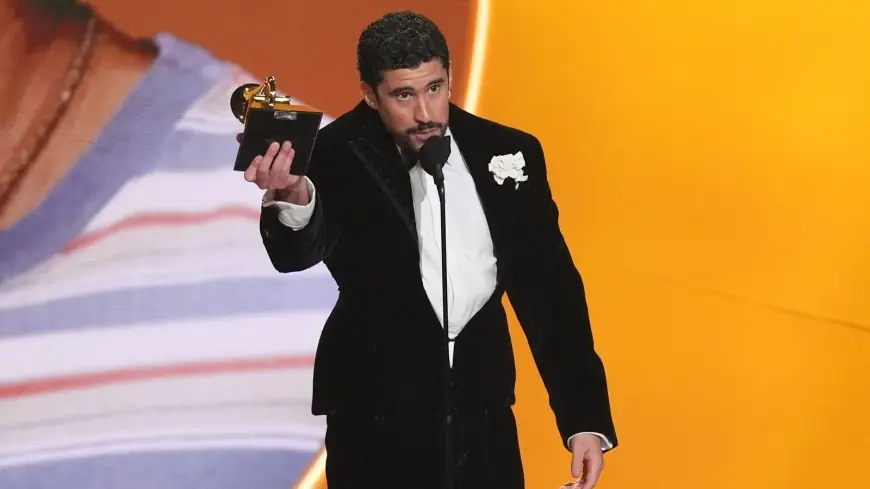
Bad Bunny closed out a defining weekend on Sunday, February 1, 2026, winning the top prize at the Grammy Awards and then using an earlier acceptance speech to deliver a pointed message on immigration enforcement. The combination — a landmark Album of the Year win for an all-Spanish-language record and a political flashpoint on a mainstream stage — has set up an unusually high-profile week ahead for the Puerto Rican superstar.
The headline result: his album Debí Tirar Más Fotos won Album of the Year, the first time a Spanish-language album has taken the ceremony’s biggest honor. Earlier in the night, he also won Best Música Urbana Album for the same project.
Bad Bunny’s historic night at the Grammys
The Album of the Year win is being framed as a breakthrough moment for Spanish-language music in the industry’s most visible awards category, not just a genre-specific acknowledgment. It also lands at a moment when Latin music’s global footprint is already widely evident in touring, streaming, and festival lineups.
Bad Bunny’s acceptance remarks for Album of the Year centered on Puerto Rico, gratitude to his team and family, and a dedication to people who had to leave home to pursue their future. The tone was emotional and celebratory — and a sharp contrast to the political edge of his earlier speech.
“ICE out” speech ignites political backlash
When he accepted Best Música Urbana Album, Bad Bunny opened with two words: “ICE out.” He then addressed the treatment of immigrants and rejected rhetoric that dehumanizes people. In one of the night’s most replayed lines, he said: “We’re not animals… we are humans, and we are Americans.”
The message drew applause inside the venue and immediate reaction outside it. A senior U.S. homeland security official publicly criticized the remarks, and the moment quickly became part of a broader conversation about immigration enforcement, protest pins and statements at entertainment events, and the way major live broadcasts are increasingly used for political messaging.
What’s next: Super Bowl LX halftime spotlight
Bad Bunny’s next major appearance is already one of the most watched bookings on the U.S. entertainment calendar: the Super Bowl LX halftime show on Sunday, February 8, 2026, in Santa Clara, California.
Super Bowl kickoff is scheduled for 6:30 p.m. ET, and the halftime show typically begins around 8:00–8:30 p.m. ET, depending on game flow. With the Grammys speech fresh in the public debate, the halftime performance is now arriving with an extra layer of scrutiny — and heightened expectations about whether his set will stay strictly musical or carry a message.
Tour momentum and a packed February calendar
Away from awards-season headlines, Bad Bunny is still in the middle of a large-scale world tour supporting Debí Tirar Más Fotos. Several February dates are clustered around major stadium stops in South America and Australia, creating a tight run of performances that would be demanding even without the added pressure of a Super Bowl week.
Here are key dates on his near-term schedule:
| Date (2026) | Event | Location |
|---|---|---|
| Feb 1 | Grammy Awards: Album of the Year and Best Música Urbana Album | Los Angeles |
| Feb 8 | Super Bowl LX halftime show | Santa Clara, California |
| Feb 13–15 | World tour stadium dates | Buenos Aires |
| Feb 20–21 | World tour stadium dates | São Paulo |
| Feb 28–Mar 1 | World tour stadium dates | Sydney |
Why this moment matters for his career
Bad Bunny has spent years balancing pop-star scale with culturally specific storytelling, and this week compresses that tension into a single news cycle: industry validation at the highest level, political controversy that reaches far beyond music, and an upcoming performance slot that can redefine an artist’s mainstream profile overnight.
The next few days are likely to be less about whether he can deliver a big live show — that track record is established — and more about what kind of statement, if any, he chooses to make when the audience expands from an awards-night crowd to the single largest television stage in American entertainment.
Sources consulted: Reuters; Associated Press; The Recording Academy; National Football League