
























Doomsday Clock 2026 Moves to 85 Seconds to Midnight, as Atomic Scientists Warn the “Seconds” Era Is No Longer Symbolic

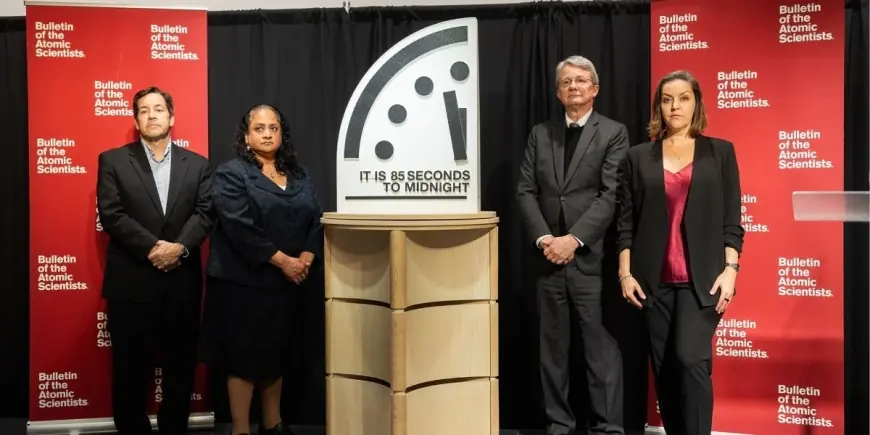
The Doomsday Clock has been reset for 2026 to 85 seconds to midnight, the closest the clock has ever been to its symbolic endpoint. Midnight represents a human-driven global catastrophe. The shift is small in absolute terms, but the message is blunt: the group of scientists and security experts who steward the clock believes the world’s risk trajectory is worsening, not stabilizing.
The announcement was made on Tuesday, January 27, 2026 (ET), continuing a pattern of late-January resets meant to capture the past year’s trendlines in nuclear risk, climate disruption, biological threats, and fast-moving technology hazards.
Doomsday Clock 2026: Why “85 Seconds to Midnight” Matters
The clock is not a prediction tool and it is not a countdown. It is a warning system that compresses complex risk into a single image people can remember. The number itself, though, is designed to shock: 85 seconds is a statement that the current moment is not “dangerous in theory,” but dangerous in practice.
The clock’s stewards framed the 2026 move as a response to two reinforcing failures:
-
Great-power competition that is increasingly zero-sum, making cooperation harder exactly when it is most needed
-
Leadership choices that normalize escalation, blur red lines, and reduce room for de-escalation when crises hit
That’s the core of the midnight Doomsday Clock logic: a world can survive high risk if it has reliable brakes. The 2026 reset argues the brakes are wearing out.
The Clock With Seconds: How the Doomsday Clock Became a Stopwatch
For decades, the Doomsday Clock was set in minutes. In recent years it has been expressed in seconds, a shift that reflects both how close the setting has come to midnight and how the risk picture now moves on shorter timelines.
A quick snapshot shows why the seconds format stuck:
-
1947: debuted at 7 minutes to midnight
-
1991: moved as far back as 17 minutes to midnight after major geopolitical thawing
-
2020: moved to 100 seconds to midnight
-
2025: moved to 89 seconds to midnight
-
2026: moved to 85 seconds to midnight
The point is not the arithmetic. It’s that the clock’s stewards now believe marginal changes matter because the baseline is already extreme: when you’re that close, a “few seconds” is meant to represent meaningful deterioration in the conditions that keep worst-case outcomes from happening.
What the Atomic Scientists Panel Is Signaling in 2026
The 2026 rationale centers on overlapping risk systems that can cascade:
Nuclear risk and arms control stress. The panel highlighted a world where diplomatic guardrails are fraying, modernization races continue, and multiple conflicts sit under a nuclear shadow. The danger is not only deliberate nuclear use, but miscalculation during fast-moving crises.
Climate risk compounding instability. Climate impacts are treated as accelerants: they strain food systems, disaster response, migration politics, and state capacity. That pressure can reduce leaders’ willingness to cooperate and increase the temptation to externalize blame.
Biological threats in a new tech environment. The panel emphasized biological risk in a world where advanced tools can lower barriers to designing harmful agents, while public health systems and trust can be fragile.
Disruptive technologies, especially AI and information integrity. The concern is twofold: the integration of advanced systems into military decision loops, and the broader erosion of shared reality through disinformation and synthetic media. In a crisis, confusion can be as dangerous as aggression.
Behind the Headline: Incentives, Stakeholders, and What’s Missing
Incentives. Leaders facing domestic polarization often get rewarded for toughness and punished for compromise. Defense establishments have incentives to plan for worst-case scenarios, which can drive procurement and posture choices that look threatening to rivals. Technology competition rewards speed, even when safety standards lag.
Stakeholders. Nuclear-armed states and their allies sit at the center, but so do non-nuclear countries that bear the fallout of instability. Tech firms, researchers, and regulators are stakeholders in whether safeguards become norms or afterthoughts. Citizens and civil society matter because public pressure can either harden nationalist instincts or force accountability.
Missing pieces. The clock setting is an alert, not a roadmap. It does not quantify which risk dominates or exactly what threshold would trigger catastrophe. It also cannot capture “near-miss” dynamics: how many incidents were quietly defused, how often command-and-control systems were stressed, or how close crises came to spiraling.
What Happens Next: Realistic Scenarios and Triggers
-
Risk stabilizes without improvement if major powers avoid headline escalations but keep modernizing and posturing. Trigger: continued stalemate in arms control and conflict resolution.
-
A cooperative pivot if rivals reopen sustained dialogue on nuclear guardrails, crisis communications, and emerging tech limits. Trigger: a near-miss event that shocks leaders into action.
-
A technology-driven scare involving AI-enabled misinformation or military automation that amplifies a real-world crisis. Trigger: a rapidly unfolding incident with unclear attribution.
-
Climate-linked security strain where extreme events fuel political instability and deepen international distrust. Trigger: compounded disasters that overwhelm response capacity.
-
A step-change escalation from a regional conflict expanding in scope. Trigger: miscalculation, domestic political pressures, or a failed deterrence signal.
The Doomsday Clock 2026 move to 85 seconds is designed to be uncomfortable. Its practical implication is simple: the panel believes the world is operating with shrinking margins for error, while moving faster and cooperating less. In a “clock with seconds” era, the warning is that hesitation and denial are no longer neutral choices.