ServiceNow stock swings after earnings as investors weigh AI momentum against valuation and execution risk

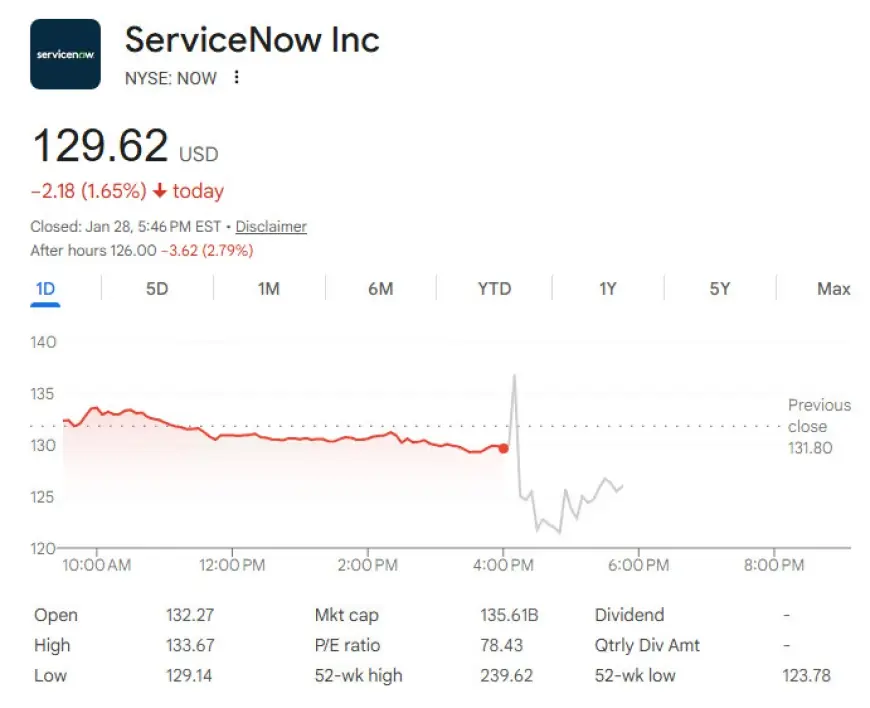
ServiceNow stock, trading under ticker NOW, has been volatile around its latest earnings update as the company highlights strong demand for workflow automation and enterprise AI. The shares have been trading near the low-$130s in late January 2026, a level that can look surprising to casual observers because it reflects a recent stock split rather than a sudden collapse in the underlying business.
Further specifics were not immediately available about how quickly the company expects its newest AI offerings to convert into long-term contracted revenue across every customer segment.
What moved NOW stock this week
The most immediate driver has been the company’s quarterly report and forward outlook. ServiceNow emphasized continued growth in subscription revenue and pointed to rising adoption of its AI capabilities inside core workflows, which investors generally treat as a leading indicator of renewal strength and expansion deals.
At the same time, the stock reaction shows that “beat and raise” is not always enough to push shares higher when expectations are already elevated. Traders often focus on the smallest changes in forward growth rates, operating margin direction, and near-term billings signals, because those can hint at whether demand is accelerating, stabilizing, or simply pulling forward.
Some specifics have not been publicly clarified, including the exact pace of customer ramp for the newest AI product bundles and how much of near-term growth is coming from large enterprise expansions versus mid-market adoption.
The business model behind the stock: why subscription signals matter most
ServiceNow’s financial engine is subscription software sold into large organizations that standardize workflows across IT, HR, customer service, security operations, and other functions. Customers typically sign multi-year agreements, and revenue is recognized over time as the service is delivered rather than all at once up front.
That’s why investors track contracted backlog-style measures and renewal health so closely. When new deals are signed, the value often shows up first as committed future revenue, then gradually turns into recognized revenue each quarter. Services and professional work can help adoption, but the long-term stock story tends to hinge on subscription growth, margin discipline, and free cash flow generation.
This mechanism is also why AI features are a focal point. If AI drives more use cases onto the platform, it can raise average contract values and reduce churn, but it can also increase costs if pricing does not keep up with compute and development investment.
AI as the growth catalyst, and the risks that come with it
ServiceNow is positioning AI as a practical layer inside everyday work rather than a separate experimental product. In plain terms, the pitch is that AI should help employees resolve tickets faster, automate repetitive handoffs, and surface answers from enterprise knowledge and data inside workflows.
The opportunity is clear: enterprise buyers want measurable productivity gains and governance, not just demos. If ServiceNow can prove consistent return on investment, it can deepen its role as a system of action across departments.
The risks are also real. Competition is intense, and large software vendors are embedding AI across their suites. Customers can become more demanding on pricing and proof of outcomes, and the cost of delivering AI at scale can pressure margins if not managed carefully.
Key terms have not been disclosed publicly about how the company will standardize pricing for different AI tiers across its broad product footprint.
Stakeholder impact: who feels NOW stock moves first
Investors feel the impact immediately through valuation swings, especially when guidance updates shift expectations for growth and operating leverage. Enterprise customers feel it more subtly: a financially strong vendor can invest faster in product, security, and global support, which matters for mission-critical workflow tools.
Employees are another key stakeholder group. Market expectations can influence hiring, internal investment priorities, and performance pressure, particularly in product and go-to-market teams tied to AI adoption targets. Partners and implementation firms also feel the ripple effects, since a stronger platform cycle can increase demand for deployments, integrations, and managed services.
What to watch next for ServiceNow stock
In the days ahead, the most meaningful signals will be execution signals rather than headlines: the pace of subscription growth, the durability of margins, and whether AI-led deals translate into expanding contract sizes without a drag on profitability.
The next verifiable milestone is the company’s next quarterly earnings report and guidance update, when investors will look for clearer evidence that AI adoption is strengthening renewal rates and expansion activity, not just generating interest.